Fast Facts
OPC UA and MQTT Sparkplug B are now the accepted answer to industrial IoT protocol fragmentation, and McKinsey estimates interoperability is required to capture around 40% of IoT’s total potential value. But adopting both standards doesn’t end fragmentation — it relocates it to the edge gateway, where a vendor’s proprietary translation software becomes the new lock-in point.
A unified namespace built on someone else’s closed gateway is still a point of control a buyer doesn’t own. The fix isn’t picking a protocol; it’s checking who owns the layer that bridges them.
Industrial IoT protocol fragmentation is usually described as a technical problem: PLCs, robots, CNC machines and sensors from different vendors speak different languages, so sharing data takes custom integration work. That’s accurate, but incomplete. Fragmentation persists even after a plant adopts the recommended fix, because the standard answer — OPC UA for device integration, MQTT with Sparkplug B for cloud transport — still leaves one layer unstandardized: whatever sits in between.
Industrial IoT Protocol Fragmentation on a Real Line
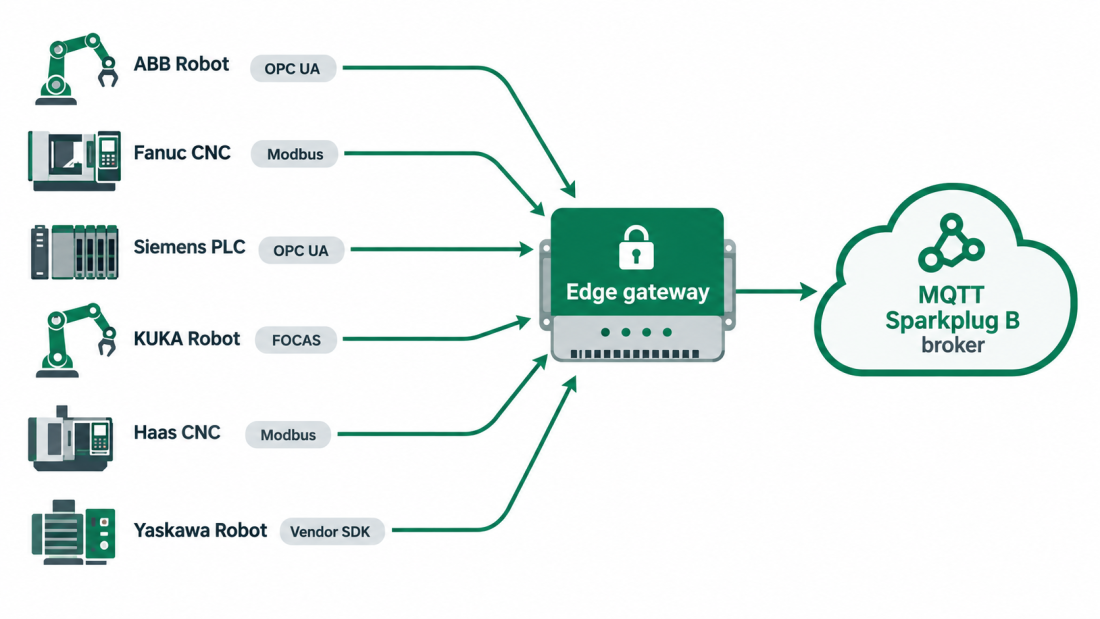
A single automated line can run six-axis robots from Fanuc, ABB, KUKA, Yaskawa or Universal Robots, each exposed only through its own vendor SDK, alongside CNC machines from Fanuc, Siemens, Heidenhain or Mazak speaking MTConnect, FOCAS, OPC UA on newer models, or plain Modbus on older ones. None talk to each other natively. OPC UA, released in 2008 as IEC 62541, exists to replace that mess with a vendor-neutral standard, and every major PLC vendor — Siemens, Beckhoff, Allen-Bradley, ABB, B&R, Mitsubishi — now supports it. See our analysis where we explain why legacy-equipment integration’s real cost isn’t the machines themselves.
Where Industrial IoT Protocol Fragmentation Survives Standardization
OPC UA solving device-level fragmentation doesn’t end this problem for buyers, because OPC UA itself ships with many different vendor-specific data model definitions — two OPC UA servers from two manufacturers can describe the same sensor reading incompatibly. The accepted pairing adds MQTT Sparkplug B on top to carry that data from edge to cloud, and nearly every 2026 industry guide recommends the same architecture: OPC UA organizes the data, MQTT moves it. That pairing is sound. It just doesn’t make the protocol choice disappear — it moves it to whoever builds the edge gateway translating between the two.
Verified numbers
| Stat | Detail |
|---|---|
| ~40% | Share of IoT’s total potential value McKinsey estimates requires interoperability to capture — the value industrial IoT protocol fragmentation blocks |
| 2008 | Year OPC UA (IEC 62541) launched to replace fragmented, Windows-only industrial protocols |
| 6+ | Named robot and CNC vendors (Fanuc, ABB, KUKA, Yaskawa, UR, Siemens, Heidenhain, Mazak) each using different native protocols on one typical line |
Unified Namespace Doesn’t Remove the Choice — It Relocates It
A unified namespace (UNS) is the pattern built to solve this: a central MQTT broker that becomes the single source of truth every system reads from, rather than point-to-point integrations between every pair of systems. The detail buyers miss is that UNS is a pattern, not a product that erases protocol decisions. Machines still speak OPC UA.
An edge gateway still has to translate that into Sparkplug B before it reaches the broker, and that gateway is usually a specific vendor’s software, running a specific vendor’s translation logic, with a specific vendor’s export — or lack of one — for the mapping rules themselves. See our analysis where we explain what a unified namespace actually is for manufacturers and why the dark-data IIoT opportunity is hiding in files you already own.
The Security Gap Industrial IoT Protocol Fragmentation Opens
The bridge point between OPC UA and MQTT is also where security most often breaks down: the most common mistake documented across 2026 industrial-networking guides is an unprotected MQTT exposure point created right where OT and IT networks meet, at exactly the gateway doing the translation. A buyer evaluating any IIoT platform should treat that seam as both the lock-in risk and the security risk, since it’s frequently the same software causing both. See our analysis where we explain how industrial cyberattacks are targeting factory floors directly.
⚠️ Hypothetical scenario (illustrative only, not a reported case)
A Lagos beverage plant standardizes on OPC UA across its filling lines and buys a popular edge gateway to bridge everything into an MQTT Sparkplug B broker, exactly as recommended. Two years later it wants to switch MES vendors. The new MES reads standard Sparkplug B data fine, but the rules deciding which OPC UA tag becomes which Sparkplug metric live entirely inside the old gateway’s proprietary configuration, which isn’t exportable. The “open standard” migration turns into a project nearly as expensive as the original integration.
What to Put in the RFP
Before signing with any IIoT or edge-gateway vendor, buyers should ask for the mapping configuration itself — the rules translating device tags into the unified namespace — in a portable, exportable format, not just confirmation the output conforms to Sparkplug B. This was never about which protocol a device speaks; it’s about who controls the rules that make protocols interoperate. See our analysis where we explain why 93% of plants have an MES but only 23% finished the integration.
💡 CreedTec Analyst’s Note by Daniel Ikechukwu
Strategic Impact
Open protocols don’t guarantee an open architecture. The translation layer between them is where real control sits, and it’s the layer almost no RFP explicitly asks about.
Stop / Start / Watch
- Stop: treating OPC UA and MQTT Sparkplug B compliance alone as proof an IIoT platform is vendor-neutral.
- Start: requiring an exportable, documented mapping configuration from any edge-gateway vendor before signing.
- Watch: whether OPC UA Pub/Sub matures enough to bypass the MQTT bridge entirely, which would remove this specific lock-in point rather than just relocate it again.
ROI Outlook
The 40% of IoT value McKinsey ties to interoperability only materializes if a plant can change vendors without rebuilding its data layer. Paying slightly more upfront for an exportable mapping configuration is cheap insurance against a costlier forced migration later.
— Daniel Ikechukwu
Standardizing your plant’s data architecture?
Get CreedTec’s weekly briefing on IIoT protocols, vendor lock-in and procurement economics, written for plant and IT leaders who sign the contract. Subscribe free.
Sources
- Wirtek: “Protocol fragmentation in industrial IoT: how to integrate Modbus, OPC UA, MQTT, and the rest” — cites McKinsey’s 40% interoperability-value estimate (May 20, 2026)
- FlowFuse: “MQTT vs OPC UA: Why This Question Never Has a Straight Answer” (Jan 2026)
- Industrial Monitor Direct: “Fragmented Factory Automation: OPC UA, PackML Integration” (2026)
- HiveMQ: “OPC UA and MQTT: How to Bridge OT Protocols for Scalable Industrial Data” (2026)
- Merobix: “MQTT vs OPC-UA: Which Industrial Protocol Fits Your Plant in 2026?” (2026)