Fast Facts
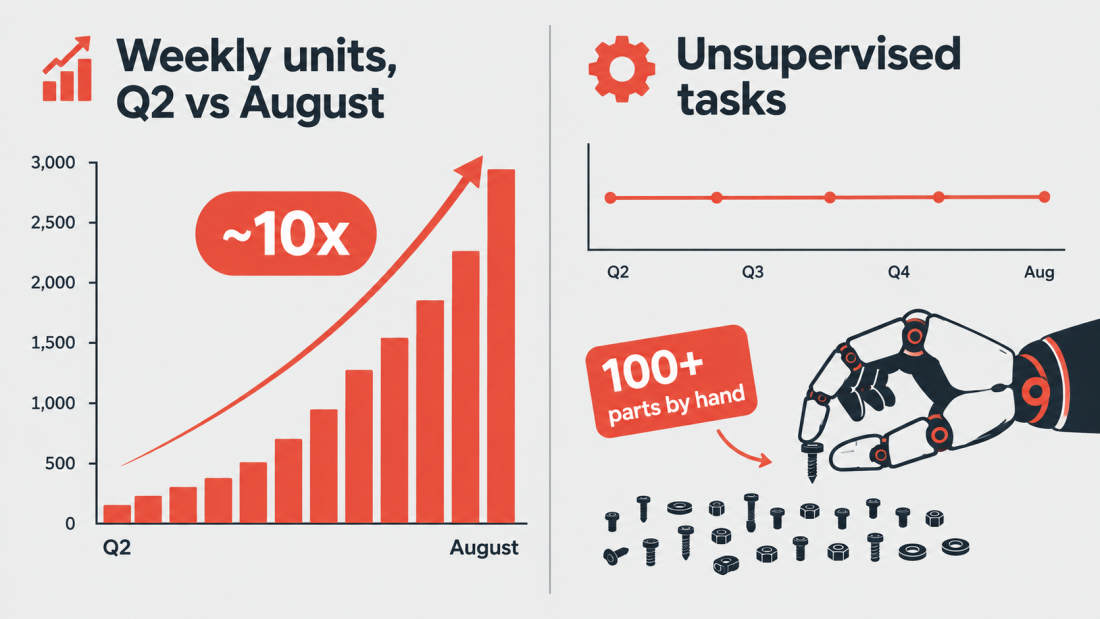
Tesla Optimus production reached several hundred robots a week in August, roughly ten times the second quarter, according to The Information via Electrek. Most units stay inside Tesla for testing, training and data collection, so the volume measures the factory, not the robot.
Buyers should score any humanoid on days to learn a task, unsupervised working hours and hand failure rates. Those three numbers decide whether a humanoid earns more than a task-specific arm.
Tesla Optimus production is the cleanest test case for a mistake the humanoid market keeps making: reading weekly output as proof of capability. On September 25, The Information reported, as summarized by Electrek, that Tesla (NASDAQ:TSLA) went from a few dozen Optimus units a week in Q2 to several hundred in August. Managers reportedly target an automated line above 1,000 a week by year-end and about 20,000 eventually. The unit counts are real progress. They say nothing about what any of those robots can do unsupervised.
What Tesla Optimus Production Volume Doesn’t Measure
According to the report, most units are used internally, and those working in Tesla factories sit in tightly controlled, supervised areas, programmed for specific tasks. The V3 robot now being built is not the commercial version, which still has to pass stricter durability and reliability thresholds. The line occupies the Fremont space where the Model S and Model X were built until early May. A year ago Elon Musk said several thousand Optimus robots would be doing useful work by the end of 2025; in January he acknowledged that none were. See our analysis where we explain why headline humanoid production claims are so hard to verify.
The Hand Is a Manufacturing Problem
The report says the hand and forearm contain over 100 screws and small components that workers still assemble by hand. Fixtures at several stations cannot consistently align parts smaller and tighter-tolerance than anything on a car, so more robots need rework after leaving the line. Some touch sensors have had reliability problems; Tesla’s reported fix is a replaceable sensing glove next year. Motor and precision-gear suppliers, many in China, can hit quality in prototype quantities but struggle to hold it at volume. See our analysis where we explain the $9.7M bet on robot touch and how Chinese robot-hand makers are winning the volume war.
Verified numbers
| Stat | Detail |
|---|---|
| ~10× | Weekly Tesla Optimus production output, Q2 versus August (The Information via Electrek) |
| 100+ | Hand-assembled screws and parts in the Tesla Optimus production hand and forearm |
| 500,000+ | Hours of training data, with a goal to double by year-end |
All figures are as reported by The Information; Tesla has not published them.
Days to Learn a Task Is the Number to Ask For
The bigger problem is the brain. Three people familiar with the system told The Information that Optimus cannot yet reliably handle a wide range of tasks and behaves unpredictably in untrained situations. It reportedly takes several days to learn even basic tasks, so Tesla is building a library of basic movements the robot can recombine. It has hired data collectors in camera helmets and motion-capture suits and set up training hubs in Colorado, Arizona and Florida. See our analysis where we explain what Virtuix’s Optimus teleoperation deal actually sold.
A humanoid needing days of training per task in a fenced area is “an expensive, less efficient specialized robot,” writes Fred Lambert, Editor in Chief at Electrek.
Tesla’s customer plan follows the same logic. It reportedly intends to lease rather than sell to a short list of companies whose factories and warehouses resemble its own, then feed deployment data back into the AI. That is a workaround for missing generalization, not a demonstration of it. Meanwhile XPeng (NYSE:XPEV) started running an automated IRON humanoid line in Guangzhou this month, targeting commercial sales in 2027.
A Buyer Scorecard for Lagos and Bangkok Plants
Lookalike-factory leasing tells emerging-market manufacturers something useful: unstructured floors, mixed pallets and irregular power are not in the first wave. Ask every humanoid vendor for four numbers: days to teach a new task, hours run without a supervisor, rework or failure rate on the hands, and what a leased sensing component costs to replace. See our analysis where we explain the robot maintenance cost model procurement teams get wrong.
⚠️ Hypothetical scenario (illustrative only, not a reported case)
A plant manager at a Nigerian packaging facility receives a lease quote for two humanoids. The sales deck cites weekly factory output. She asks how long a new carton size takes to teach, and how many hours the robots ran without a supervisor at the reference site. The vendor answers the first with “days” and cannot answer the second. She books a task-specific palletizing arm instead and asks for a re-quote in twelve months.
💡 CreedTec Analyst’s Note by Daniel Ikechukwu
Strategic Impact
Tesla Optimus production proves the factory can scale before the robot can generalize. The bottleneck has moved from body count to software and component reliability, which favors whoever solves the hand and the learning loop first.
Stop / Start / Watch
- Stop: using weekly unit output or demo videos as evidence of deployability.
- Start: demanding days-to-learn, unsupervised hours and hand-failure data in every humanoid RFP.
- Watch: the promised V3 reveal, the sensing-glove rollout next year, and whether year-end output nears 1,000 a week.
ROI Outlook
A humanoid pays back only if it works unsupervised across tasks; until then, task-specific arms and wheeled bots carry better margins. Expect leasing terms, not purchase prices, to reveal the true unit economics through 2027.
— Daniel Ikechukwu
Evaluating humanoids for your plant?
Get CreedTec’s weekly briefing on robotics claims, procurement checks and real deployment economics, written for buyers, not fans. Subscribe free.
Sources
- Electrek: “Tesla ramps Optimus to hundreds a week, but the robots can’t generalize” (Sept 25, 2026)
- The Information: report on Optimus hand, supplier and scale-up problems (Sept 25, 2026, paywalled)
- Electrek: Musk admits no Optimus robots are doing useful work at Tesla (Jan 28, 2026)
- Electrek: XPeng starts IRON humanoid production line in Guangzhou (Sept 7, 2026)
- Humanoid.guide: Tesla ramps Optimus production despite hand and AI limits (Sept 2026)