Fast Facts
Manufacturing AI systems are being blamed for stalling out when the real constraint is almost always upstream: the data infrastructure underneath them. MIT Technology Review found 57% of manufacturing executives cite inadequate data quality as the top block on AI use-case development, with weak integration (54%) and weak governance (47%) close behind, and only about one in five manufacturers have production assets with data actually ready for existing models. A separate 2026 industrial survey found 84% of manufacturers can’t use their own data, and just 34% run real-time data streaming in production at all. The pattern holds across both studies: manufacturers keep buying AI capability before fixing the plumbing it depends on.
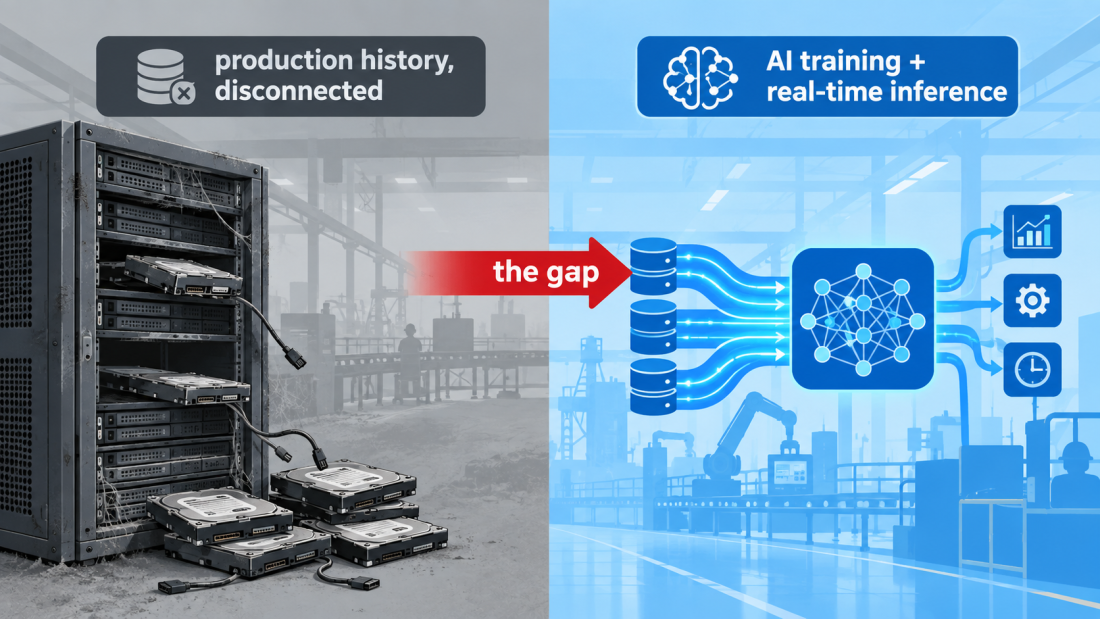
Ask a plant manager why their manufacturing AI systems rollout stalled after the pilot, and the answer is rarely the model. It’s the historian database that stops accepting new tags after eighteen months, the SCADA system built to show an operator a screen rather than feed a machine-learning pipeline, and years of full-resolution production data disconnected and lost because nobody thought a hard drive full of pressure readings would ever be worth keeping.
The Model Was Never the Bottleneck
For a decade, manufacturers collected data they couldn’t use. Machine learning and generative AI flipped that problem: the tools to extract value from operational data now exist, and the constraint moved to whether the infrastructure can supply what manufacturing AI systems demand. An hourly average of a pressure reading tells a predictive model almost nothing, because the model needs the fluctuation pattern inside that hour, not the smoothed-over summary a legacy historian was built to store.
That single fact explains most of the readiness numbers. MIT Technology Review’s manufacturing survey found inadequate data quality (57%), weak integration (54%), and weak governance (47%) are the top barriers cited by executives already working with AI, not skeptics on the sidelines. A separate 2026 industrial AI readiness study puts data quality and availability at 54% and legacy system integration at 48%, with only 34% of respondents running real-time streaming in production.
📊 The Numbers That Matter
- 57% — executives citing inadequate data quality as the top AI barrier (MIT Technology Review)
- 84% — manufacturers who report they cannot use their own data
- 1 in 5 — manufacturers with production assets that have AI-ready data today
- 34% — manufacturers running real-time data streaming in production
- 64% / 55% — predictive maintenance vs. process optimization as leading use cases where data does exist
What Happens When the Database Runs Out of Room
Doug Pagnutti, Industrial Developer Advocate at Tiger Data, lived this cycle as an automation engineer before AI made the data problem visible. A SCADA database would start with dashboards loading instantly, then stop accepting new data within twelve to eighteen months. Adding a tag for new equipment meant sacrificing an existing one — a zero-sum tradeoff engineers made with nobody above them noticing.
“We were throwing away some super valuable resources.”— Doug Pagnutti, Industrial Developer Advocate, Tiger Data
That history is exactly what today’s manufacturing AI systems need for training, and in most plants it’s already gone.
Two Data Diets, One Pipe
AI systems on a factory floor need two things a legacy historian was never built to deliver at once: full-resolution historical data for training, and a five-second-old real-time feed for inference. A model comparing current vibration readings against a decade of failure patterns needs both streams live simultaneously, on infrastructure originally sized to refresh an operator’s screen once a minute. Manufacturers who solved a dosing-optimization problem by correlating humidity, ambient conditions, and process variables engineers had never manually connected found those relationships only because the pipeline could finally carry both loads at once.
Why Procurement Keeps Buying the Wrong Layer
ServiceNow CEO Bill McDermott has made a version of this argument about enterprise software for years: 85% of digital transformation investments fail to deliver positive ROI, and the reason cited is almost always integration, not the software itself. The same logic applies one layer down in manufacturing. Buying a manufacturing AI systems platform without funding the historian or data-integration layer underneath it is the industrial version of the mistake McDermott describes — new capability bolted onto infrastructure that can’t feed it.
The procurement fix isn’t glamorous: budget the data infrastructure line item before the AI platform line item, and treat “can this stream full-resolution historical and real-time data simultaneously” as a harder qualifying question than any vendor’s accuracy claims.
💡 CreedTec Analyst’s Note by Daniel Ikechukwu
Strategic Impact: The gap between AI ambition and AI results in manufacturing isn’t a model problem, and treating it like one wastes the budget on the wrong layer. Manufacturers pulling ahead funded data infrastructure first and let the use case follow.
Stop: Evaluating manufacturing AI systems primarily on model accuracy claims when the deployment lives or dies on data plumbing.
Start: Budgeting historian and data-integration upgrades as a prerequisite line item before any new AI platform purchase.
Watch: Whether the 2027 Industrial Data and AI Readiness survey shows the 84%-can’t-use-their-own-data figure improving, or still stuck.
ROI Outlook: Data infrastructure spend is the less exciting line item, but it carries the real multiplier — manufacturers who’ve solved integration and governance report far higher AI use-case success than those who haven’t, regardless of vendor. Budget it first, and the manufacturing AI systems built on top of it have a real shot at showing up as ROI instead of a stalled pilot.
— Daniel Ikechukwu, CreedTec
Further Reading
- Unified namespace architecture preps manufacturing data for AI.
- The dark data opportunity is hiding in files manufacturers already own.
- 93% have an MES integration and only 23% finished the job.
- Legacy equipment integration’s real cost isn’t the machines.
- Equipment-as-service pricing doubles manufacturing AI ROI.
Still budgeting manufacturing AI systems before the data layer underneath them? The CreedTec newsletter tracks the readiness surveys and the gap between vendor claims and factory floors. Subscribe before your next pitch.
Sources
- MIT Technology Review — Taking AI to the Next Level in Manufacturing
- IIoT World — Factories Threw Away the Data AI Needs Now
- IIoT World — Industrial Data and AI Readiness Survey 2027
- IIoT World — 84% of Manufacturers Cannot Use Their Own Data
- Constellation Research — ServiceNow CEO McDermott on Integration and ROI