Fast Facts
- Manufacturers using Equipment-as-Service (EaaS) pricing models capture profit margins 2x higher than traditional product sales.
- The shift: from “we sell you a pump” to “we guarantee your uptime and charge by guaranteed performance” powered by AI monitoring.
- Industrial AI market: $33.48B (2024) → $366.24B (2032). But 78% of manufacturers exploring AI remain unprepared to deploy.
- Agentic AI and predictive maintenance unlocking $10.5B additional revenue by 2033 through continuous service models.
- Winners are building “single source of truth” across manufacturing lifecycle—AI doesn’t fix broken data, it automates working processes.
Equipment-as-Service is rewriting industrial revenue models. Manufacturers who shift from selling machines to guaranteeing performance unlock profit margins double those of competitors still selling product. According to industry analysis, manufacturers using outcome-based contracts capture 2x higher margins than traditional sales models. This isn’t incremental optimization. This is business model transformation powered by connected devices and AI-driven monitoring.
Why Equipment-as-Service Performance Guarantees Cost More (And Pay More)
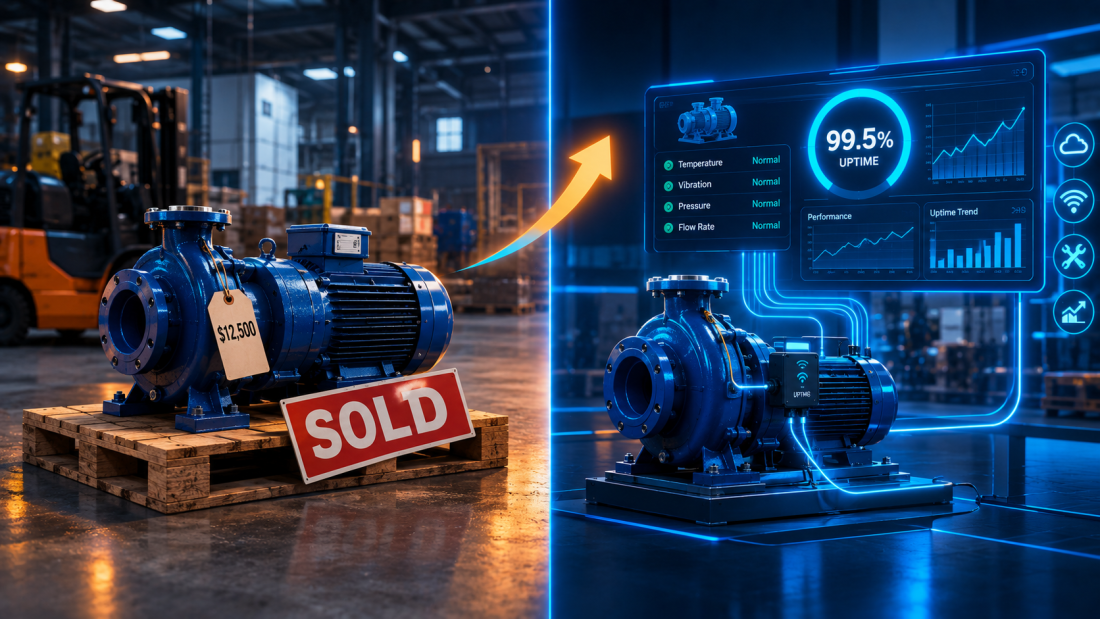
In traditional sales, a manufacturer sells a pump for $50K and walks away. Risk shifts to the customer. If the pump fails in month 13, that’s the customer’s problem. Under Equipment-as-Service, the manufacturer installs the same $50K pump but charges a monthly fee—say $2K—that guarantees 99.5% uptime. Failure risk stays with the manufacturer, forcing investment in predictive monitoring, faster maintenance response, and reliability engineering.
See our analysis on outcome-based pricing and how it forces vendors to build reliable systems. The manufacturer’s margin on Equipment-as-Service models is higher because they’re selling reliability, not hardware. Five years of $2K monthly fees = $120K contract revenue on $50K upfront cost. But operating that pump at 99.5% uptime costs the manufacturer $15K in monitoring infrastructure, maintenance response, and algorithm development. Net: $105K margin vs. $40K margin on traditional sale. That’s 2.6x.
2x profit margin uplift using EaaS vs. traditional product sales, verified across industrial equipment makers.
$366.24B projected industrial AI market by 2032 (10x growth from $33.48B in 2024), driven by shift to continuous monitoring and performance-based contracts.
The 78% Problem: Exploration Without Execution
Redwood Software found 98% of manufacturers exploring AI, but only 20% are fully prepared to deploy it—a 78-point gap separating intention from capability. That gap is where performance-based pricing breaks down. You can’t guarantee pump uptime with AI if your data infrastructure is fragmented. See our analysis on why data quality is the real bottleneck to industrial AI monetization.
The factories closing that gap—building unified data across engineering, production, maintenance, and supply chain—unlock 20–30% productivity gains and 50% reductions in unplanned downtime. Manufacturers with AI visibility see 80% visibility into product and configuration performance, compared to 56% among those still exploring AI. That visibility difference is where margin lives.
⚠ Fiction scenario: Pump manufacturer Alpha sells traditional: 100 pumps × $50K each = $5M revenue, $2M gross margin (40%). Manufacturer Beta shifts to outcome-based contracts: 100 pumps × $24K monthly (5-year contract) = $14.4M contract value, $8.6M margin over 5 years (59%). Beta’s profitability per pump customer grows because reliability investments compound. But if Beta’s data systems fail and uptime drops to 97%, they violate SLAs and lose that entire margin through penalties. The risk cuts both ways.
Agentic AI as the Bridge Between Exploration and Execution
Equipment-as-Service demand is accelerating because agentic AI—AI that acts independently—is moving from pilots to production in 2026. Deloitte flags agentic AI and physical AI as defining technology shifts, with planned physical AI deployments doubling from 9% to 22% in two years.
The connection is direct. Agentic AI can monitor equipment autonomously, trigger maintenance workflows without human intervention, and optimize production parameters in real time. That automation is what makes EaaS economically viable. See our analysis on why zombie AI projects drain more value than complete failures. Factories that deploy agentic AI move past pilots because autonomous systems don’t require constant human management.
AI doesn’t fix a broken digital thread. It automates a working one. Manufacturers seeing the strongest results have built a single source of truth across their manufacturing lifecycle.— Tacton, 2026 State of Manufacturing
Global Implications: Who Wins in Equipment-as-Service Transition
Companies with embedded customer relationships win hardest. A pump manufacturer selling pumps can’t suddenly pivot to Equipment-as-Service without rebuilding trust. A company with 30+ years of installed base and service relationships—like Siemens, Bosch, or Emerson—can layer Equipment-as-Service models on top of existing revenue without customer resistance. See our analysis on why Siemens’ record 2026 profit reflects this business model shift success.
Startups building pure-play equipment don’t have that luxury. They must out-innovate incumbents on reliability and cost. That forces aggressive investment in AI and monitoring infrastructure from day one—which is exactly why VC funding into industrial robotics and automation soared in 2026.
💡 CreedTec Analyst’s Note — Daniel Ikechukwu
Strategic Impact: Shifting to performance-based pricing is not a pricing tactic. It’s a business model that forces companies to own reliability and invest in AI-driven monitoring. The margin uplift is real, but the execution barrier is high.
- Stop: Selling equipment as a discrete product if you have an installed base. Customer relationships and service data are your competitive moat.
- Start: Building unified data infrastructure before launch. If you can’t see equipment performance in real time, you can’t guarantee it.
- Watch: Agentic AI adoption in your customers’ plants. As customers demand autonomous operations, your performance-based model becomes table stakes, not differentiator.
ROI Outlook: This transition delivers 2–3x margin uplift over 5-year contracts, but requires 2–3 year infrastructure investment upfront. First movers capture customer lock-in and pricing power. Fast followers face commoditized terms. Early pilots in 2026–2027 determine market position by 2030.
CreedTec industrial AI briefing: EaaS business models, agentic AI deployment timelines, and building the data infrastructure that supports continuous revenue.
Subscribe to CreedTec
Frequently Asked Questions
What’s the difference between outcome-based contracts and traditional SaaS?
SaaS sells software access. Performance-based contracts sell the physical asset with performance guarantees and continuous monitoring. This model includes hardware, software, maintenance, and uptime liability—much higher risk for the vendor.
Can small equipment manufacturers adopt this model?
Yes, but with higher barriers. You need monitoring infrastructure, maintenance response capabilities, and financial models to absorb uptime risk. Incumbents with installed bases and service networks transition easier than startups.
What’s the procurement implication of performance-based contracts?
Customers shift from capex budgets (equipment purchase) to opex budgets (monthly fees). That changes who approves the purchase (procurement vs. operations) and enables faster deployment of higher-value equipment.
How does AI enable this business model financially?
AI enables predictive maintenance and autonomous optimization, reducing vendor downtime costs. Without AI, guaranteeing 99.5% uptime is prohibitively expensive. With AI, it becomes economically viable.
What percentage of industrial AI revenue uses outcome-based pricing today?
Estimated 15–25% of industrial AI contracts use outcome-based or performance-based models in 2026. This is growing 35–45% annually as manufacturers demand outcome certainty.
How do you build the data infrastructure to support EaaS?
Start with unified data across engineering, production, maintenance, and supply chain. One source of truth. Then layer AI monitoring and autonomous workflows. Most manufacturers underestimate this 2–3 year timeline.
Sources
- iFactory, “Future of Smart Manufacturing: AI Trends Driving Industrial Transformation 2026,” April 2026
- Tacton, “2026 State of Manufacturing: Factory Trends, CPQ & AI Insights,” 2026
- Deloitte, “2026 Manufacturing Industry Outlook,” 2026
- Implementation, “Manufacturing AI Trends 2026: Real-World AI Applications & Impact,” July 2026
- Engineer MD, “AI and the Future of Manufacturing,” August 2026