Fast Facts
On September 3rd, 2026, Netmore Group added Kinéis‘ sovereign European satellite constellation to its LPWAN portfolio, creating a single-platform hybrid terrestrial-satellite IoT connectivity solution. Customers can now deploy hybrid connectivity immediately—with zero custom hardware engineering required. The global hybrid IoT connectivity market is estimated at $8.6 billion in 2025 and is projected to grow to $89.4 billion by 2034, a nearly 30% CAGR. The Kinéis-Netmore hybrid IoT partnership eliminates the integration barrier that has historically kept satellite connectivity out of reach for most industrial operators.
Kinéis-Netmore hybrid IoT partnership was announced on September 3rd, 2026, when Netmore Group, a massive IoT operator serving utilities, water, infrastructure, and smart city sectors, integrated Kinéis’ satellite connectivity into its LPWAN portfolio. Through this agreement, Kinéis’ satellite connectivity is now available directly from Netmore, giving customers a single platform for hybrid terrestrial-satellite IoT connectivity.
The partnership is significant because it removes the integration barrier that has historically kept satellite connectivity out of reach for most industrial operators. Rather than investing in a long and costly development cycle, businesses can deploy operational hybrid connectivity today. Kinéis-Netmore hybrid IoT partnership delivers proven hybrid LoRaWAN/satellite products across several key verticals, enabling rapid deployment without additional hardware development.
The Market Context: $8.6B to $89.4B by 2034
The global hybrid IoT connectivity market, combining terrestrial cellular networks and satellite, is estimated at $8.6 billion in 2025 and is expected to grow nearly tenfold to reach $89.4 billion by 2034, representing a compound annual growth rate of close to 30%. This market momentum reinforces the strategic relevance of the Kinéis-Netmore hybrid IoT partnership.
For industrial buyers, the numbers tell a clear story: hybrid connectivity is no longer a niche capability. It is becoming the standard for any operation that needs to track assets, monitor equipment, or manage risks across areas where terrestrial networks don’t reach.
How Hybrid Connectivity Actually Works
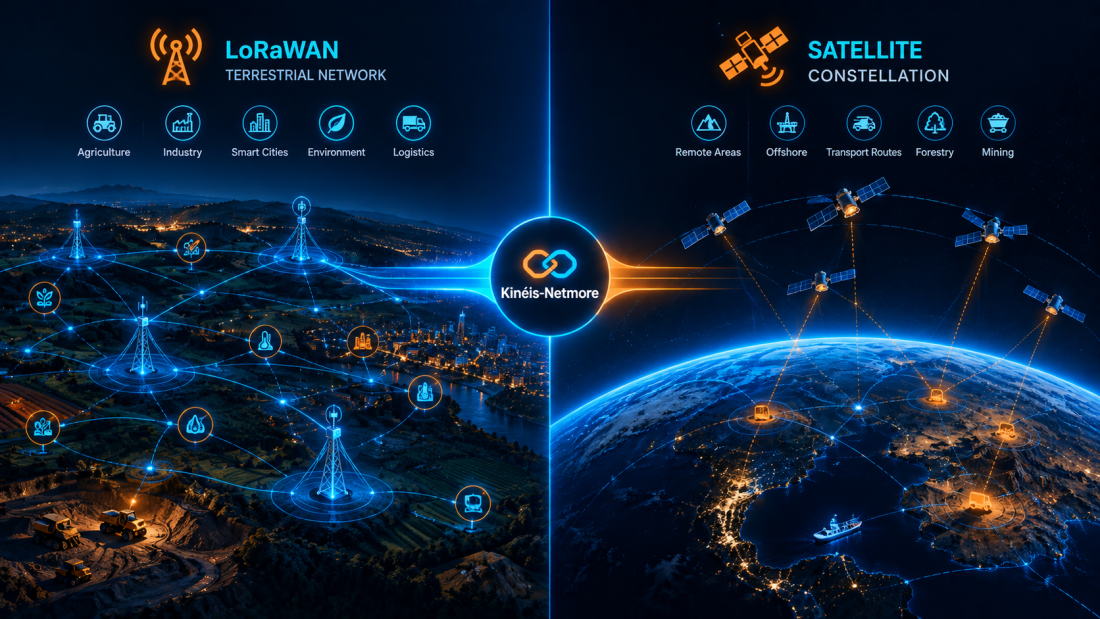
Combining terrestrial and satellite networks enables uninterrupted tracking and monitoring of assets wherever they are located. Terrestrial networks ensure responsiveness in densely covered areas, while satellites take over everywhere else, guaranteeing global coverage even where no ground infrastructure exists or can ever be installed.
This complementarity gives businesses the ability to:
- Remotely monitor sensitive equipment or sites, with no human intervention required
- Shift from reactive to predictive maintenance, by detecting warning signs before failures occur
- Manage risks more effectively, even outside conventional coverage areas
- Optimise routes and itineraries, thanks to continuous asset tracking
Switching between networks is fully automated between LPWAN and satellite, stepping in whenever needed with no manual intervention. Delivered directly through Netmore’s ThingPark platform, this hybrid connectivity is available to Netmore’s customers and partners—keeping devices connected whether they communicate over satellite or terrestrial LoRaWAN.
The Procurement Implication: No Custom Engineering Required
The most important detail for procurement teams is this: the Kinéis-Netmore hybrid IoT partnership delivers proven, off-the-shelf hybrid LoRaWAN/satellite products across several key verticals, enabling rapid deployment using pre-validated commercial devices rather than multi-month hardware R&D cycles
This is a departure from the traditional model where adding satellite capability meant new hardware, new integration work, and months of development. Netmore’s customers can deploy operational hybrid connectivity today.
For industrial buyers, this means:
- Faster time-to-market: No hardware development cycle
- Lower total cost of ownership: No new equipment to purchase, install, or maintain
- Immediate capability: Deploy hybrid connectivity now, not in 12-18 months
The partnership covers several key verticals, including asset tracking (Track Value and Beepro for uninterrupted geolocation), water and infrastructure management (Sentiv for remote monitoring of meters, tanks, and facilities), and environmental monitoring (Sylvanet/Dryad for early wildfire detection).
What This Means for Industrial Buyers
Kinéis-Netmore hybrid IoT partnership is part of a broader trend in industrial IoT: the convergence of terrestrial and satellite connectivity into a single, seamless platform. Kinéis operates a sovereign European constellation of 25 satellites dedicated to IoT and AIS. For manufacturers, logistics operators, and utilities with assets in remote locations, this partnership removes the integration barrier that has historically kept satellite connectivity out of reach.
For buyers in emerging markets, the value is even clearer. A single platform for hybrid connectivity means no separate contracts, no separate hardware, and no separate integration work. The Kinéis-Netmore hybrid IoT partnership is available to Netmore’s customers and partners globally.
⚠ Fiction—composite scenario, not a real event: A water utility operator in Southeast Asia manages thousands of remote monitoring sensors across a region with inconsistent cellular coverage. Previously, satellite connectivity required separate hardware, separate contracts, and months of integration work. With Kinéis-Netmore hybrid IoT partnership, the operator enables satellite fallback through the existing platform—no new hardware, no new development. The sensors that previously went dark during cellular outages now stay connected continuously.
Global Implications
Kinéis operates a sovereign European constellation, and this partnership demonstrates its ability to team up with a large massive IoT operator on an international scale. The Kinéis-Netmore hybrid IoT partnership is a signal that European satellite IoT infrastructure is ready for global commercial deployment.
The hybrid IoT market’s near 30% CAGR through 2034 suggests that this is not a temporary trend. Industrial buyers who adopt hybrid connectivity now will have a competitive advantage over those who wait for the market to mature further.
💡 CreedTec Analyst’s Note — Daniel Ikechukwu
Strategic Impact: The Kinéis-Netmore hybrid IoT partnership removes the integration barrier that has historically kept satellite connectivity out of reach for most industrial operators. Procurement teams should treat hybrid connectivity as a standard capability, not a premium add-on.
Stop: Assuming satellite connectivity requires separate hardware, separate contracts, and months of integration work.
Start: Asking your IoT platform vendor whether hybrid terrestrial-satellite connectivity is available through your existing platform—and if not, why not.
Watch: Whether other massive IoT operators follow Netmore’s lead in integrating satellite connectivity into their LPWAN portfolios.
ROI Outlook: Hybrid connectivity typically pays for itself through avoided downtime, reduced manual monitoring costs, and the ability to track assets in areas previously unreachable. The no-new-hardware deployment model significantly shortens payback periods.
Frequently Asked Questions
What is the Kinéis-Netmore hybrid IoT partnership?
Netmore Group integrates Kinéis’ satellite constellation into its LPWAN portfolio for a hybrid IoT solution deployable immediately with zero custom hardware engineering.
Why does hybrid connectivity matter for industrial buyers?
Hybrid connectivity enables uninterrupted tracking and monitoring of assets wherever they are located. Terrestrial networks cover dense areas; satellites cover the rest. This means no connectivity gaps, even in remote locations.
Do I need new hardware to use this hybrid solution?
No. Kinéis already offers proven hybrid LoRaWAN/satellite products across several key verticals, enabling rapid deployment without additional hardware development.
Sources:
Further Reading:
- Qualcomm Dragonwing IoT Day Proves the Industrial IoT Market Has a New Kingmaker
- Edge Computing Cuts IIoT Latency by 87%: Why Manufacturers Move Data Off Cloud in 2026
- Semtech Sold Its Cellular Module Business for $62M. What Happens to Your Fleet Now?
- The Industrial IoT Trends That Decide Your 2030 ROI
- Why Every Industry Needs a Secure IoT Satellite Constellation by 2030
Subscribe to CreedTec’s weekly briefing—industrial IoT connectivity, hybrid networks, and the procurement signals behind the hardware headlines.