Fast Facts
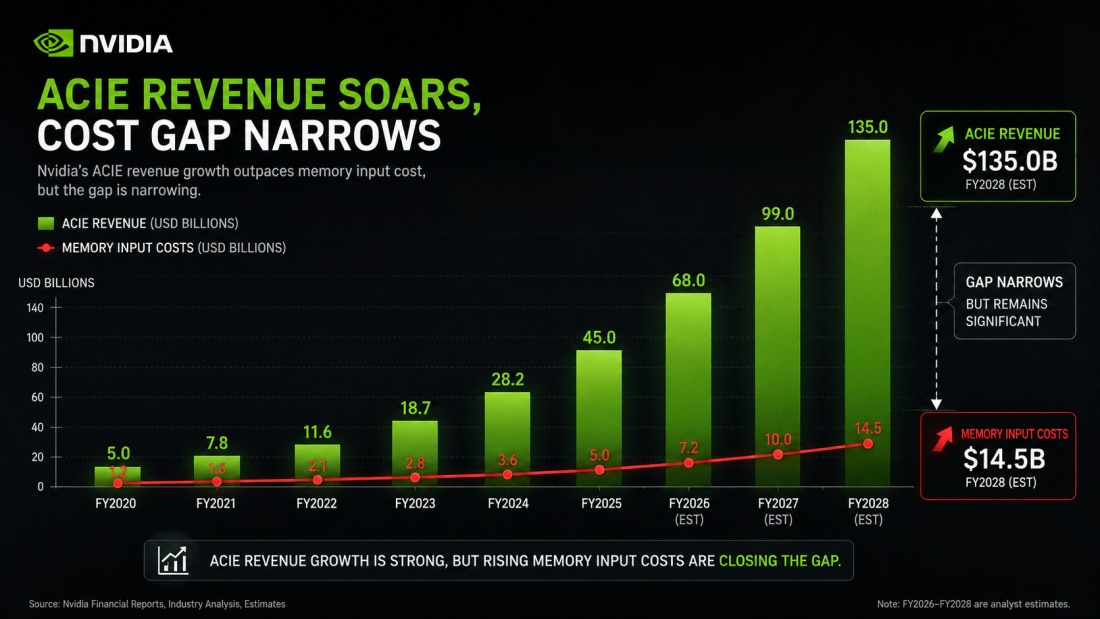
Nvidia’s ACIE segment, AI Clouds, Industrial, and Enterprise, hit $40.3 billion in Q2 FY27, up 138% year over year and now representing nearly half of data center revenue. The same earnings call carried a quieter warning: memory scarcity is pushing Nvidia’s own costs higher and could weigh on gross margins in coming quarters. The growth is real. So is the cost pressure sitting underneath it.
Nvidia ACIE revenue just delivered the clearest proof yet that industrial and enterprise AI spending is real money, not a hyperscaler side story. Nvidia’s AI Clouds, Industrial, and Enterprise category generated $40.3 billion in the quarter ended July 2026, up 138% year over year and 25% sequentially, according to Fortune’s coverage of the earnings report. CFO Colette Kress said non-hyperscaler growth, spanning sovereign regional NeoClouds, enterprise edge, and air-gapped data centers, now represents roughly half of Nvidia’s data center business.
The Segment Nvidia Had to Invent to Prove This
Nvidia created the ACIE category specifically to separate hyperscaler cloud spending from AI-native clouds, sovereign AI, and on-premises enterprise and industrial demand, according to Yahoo Finance’s earnings call highlights. That reporting change matters on its own: Nvidia ACIE revenue needed its own line item because industrial and enterprise AI demand had grown large enough to distort the picture if it stayed folded into the broader hyperscaler number. Data center revenue overall reached $89 billion for the quarter, with hyperscale customers contributing $48.7 billion and ACIE the remaining $40.3 billion.
$40.3 billion — Nvidia’s ACIE revenue for Q2 FY27, up 138% year over year.
~44% — ACIE’s share of Nvidia’s total data center revenue this quarter, the clearest sign yet of how large Nvidia ACIE revenue has grown relative to hyperscaler spending.
Now, compute is revenue.— Jensen Huang, CEO, NVIDIA, Q2 FY27 earnings call
The Line Buried in the Same Call
Management also flagged that memory scarcity is pushing costs higher and could weigh on gross margins in coming quarters, according to Investing.com’s transcript of the call. That detail lands in the same quarter Nvidia ACIE revenue is celebrated as proof of durable, diversified AI demand, and it connects directly to the memory supply crunch already reshaping procurement elsewhere in the industry. See our analysis where we explain why the AI memory shortage already delivered Samsung a 250-fold profit surge and why Micron’s take-or-pay memory contracts lock buyers in with no exit.
⚠ Fiction — illustrative scenario: A manufacturer signs a multi-year deal for an on-premises AI system, budgeting against this quarter’s published hardware pricing. Before the deployment finishes, memory-driven cost increases push the vendor’s next hardware refresh price meaningfully higher. The manufacturer’s AI investment case still holds, but the margin they modeled at signing has already narrowed before the system finished its first year of operation.
Why the Growth Doesn’t Cancel Out the Cost Pressure
Nvidia’s own revenue-per-gigawatt figures show why buyers keep paying up despite the cost pressure: the company estimates roughly $18 billion of revenue opportunity per gigawatt of data center capacity in the Hopper generation, rising to $25 billion with Blackwell and $40 billion with Vera Rubin, according to Yahoo Finance’s reporting. Nvidia ACIE revenue growth reflects real industrial and enterprise buyers committing to that escalating cost curve, not just hyperscalers with effectively unlimited capital. See our related coverage of why nobody can agree on the actual size of the industrial AI market.
Global Implications
For industrial buyers outside the largest markets, Nvidia ACIE revenue growth is a signal that on-premises and sovereign AI infrastructure demand is being taken seriously at the platform level, but the same memory scarcity pressuring Nvidia’s margins will likely reach smaller buyers’ hardware budgets with less warning and less negotiating leverage than a company of Nvidia’s scale has. See our analysis of the memory price metric that could break your 2026 AI hardware budget.
💡 CreedTec Analyst’s Note — Daniel Ikechukwu
Strategic Impact: Nvidia ACIE revenue confirms industrial and enterprise AI spending is real and growing, but the memory cost pressure disclosed in the same call means the input economics behind that spending are shifting in real time.
- Stop: Treating this quarter’s AI hardware pricing as a stable baseline for multi-year infrastructure budgets.
- Start: Building memory-cost sensitivity into any AI infrastructure business case, not just GPU pricing.
- Watch: Whether Nvidia’s gross margin guidance for the next two quarters reflects the memory scarcity impact materializing, or whether supplier capacity additions ease it first.
ROI Outlook: Buyers who lock in hardware pricing now, before further memory-driven cost increases, are likely to fare better than those who wait for a clearer margin picture that may not arrive before prices move again.
Does Nvidia’s ACIE growth mean industrial AI spending is now bigger than hyperscaler spending?
Not yet, but it’s close. Nvidia ACIE revenue reached $40.3 billion against $48.7 billion in hyperscale revenue this quarter, meaning industrial, enterprise, and sovereign AI customers now account for nearly half of Nvidia’s data center business.
Nvidia ACIE revenue is the clearest evidence available that industrial AI spending has become a real, independently trackable line of business. The same earnings call that proved it also flagged the cost pressure that will decide how much of that growth reaches the bottom line.
Get CreedTec’s next industrial AI procurement briefing before your next infrastructure budget cycle.
Subscribe free
Sources