Fast Facts
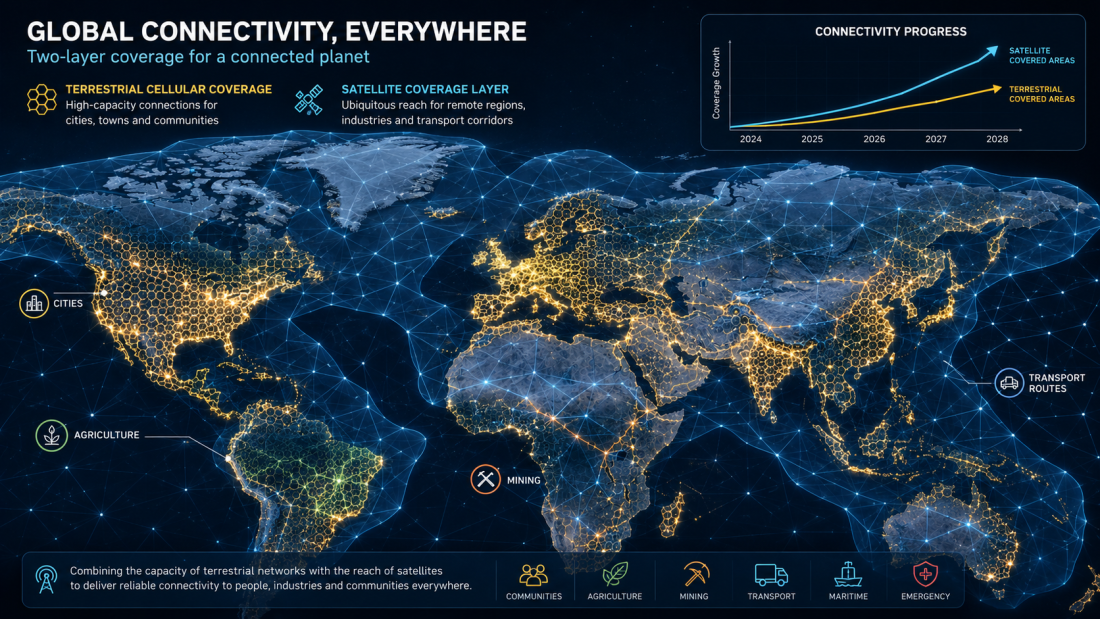
A global survey of 600 IoT decision-makers found that 91% plan to adopt direct-to-device (D2D) satellite connectivity within 18 months. But organizations already blending satellite and cellular report increased progress at a rate 16 points higher than terrestrial-only users, 86% versus 70%. The gap already exists. Most buyers are still treating adoption as a future decision rather than a current one.
D2D satellite connectivity is heading toward near-universal adoption on paper, but the buyers who already made the move are quietly pulling ahead of everyone still planning to. Viasat and Vanson Bourne surveyed 600 IoT decision-makers across agriculture, energy, transport and logistics, mining, and utilities, and found that organizations blending satellite and cellular connectivity report increased progress at 86%, compared with 70% for organizations relying on terrestrial-only networks, according to IoT Tech News’ coverage of the report.
The Adoption Number Everyone Is Quoting
The headline figure from the Viasat-commissioned study, conducted by Vanson Bourne, is that 91% of decision-makers plan to adopt D2D IoT devices within 18 months, with 69% planning adoption within 12 months and 32% within just six, according to Viasat’s own release. That number is genuinely significant. D2D satellite connectivity, enabled by 3GPP’s Release 17 standard for narrowband non-terrestrial networks, lets a device with a standard cellular chipset connect to satellite without a separate terminal, gateway, or bespoke hardware, removing what used to be the single biggest cost barrier to satellite IoT.
91% of surveyed decision-makers plan D2D satellite connectivity adoption within 18 months.
86% vs. 70% — reported progress rate for hybrid satellite-cellular users versus terrestrial-only users, already, before that broader wave of adoption completes.
Why the Gap Exists Before the Adoption Wave Arrives
The survey also found that 78% of organizations report increased progress on their IoT strategy over the past 12 months, up from 68% the year before, and that 55% now use satellite in their IoT estates compared with 41% a year earlier. D2D satellite connectivity isn’t a future technology being planned for; a majority of the market is already using some form of it, and the ones doing so are outperforming the ones who aren’t.
That’s the detail the 91%-adoption headline obscures: buyers waiting for a cleaner future rollout are choosing to sit inside the 70% progress group while a real performance gap widens next to them. See our analysis where we explain why component lead times are quietly reshaping IIoT procurement timelines.
Direct to device satellite connectivity is moving from concept to procurement planning.— IoT Tech News, analysis of the Viasat/Vanson Bourne study, February 2026
⚠ Fiction — illustrative scenario: A mining operations director reviews next year’s connectivity budget and defers a D2D satellite pilot, reasoning the technology will mature and get cheaper within eighteen months anyway. A competitor two sites over runs the pilot this quarter instead, catches an equipment fault in a dead zone that would have gone unreported for days, and uses the incident in its next board presentation. The wait wasn’t free. It just wasn’t billed yet.
What’s Actually Driving the Urgency
Fear of being the last mover is doing real work here, and for good reason: current terrestrial IoT users are the most eager to adopt, with almost a third planning to move within six months, according to Computer Weekly’s coverage. That urgency tracks the direct-to-device satellite connectivity market itself, projected to grow from $558.1 million in 2026 to $3.26 billion by 2034, a 24.7% compound annual growth rate, per Fortune Business Insights.
Vendors including SpaceX, AST SpaceMobile, Lynk Global, and Skylo are all racing to lock in early industrial customers before pricing stabilizes, which means buyers who wait may face a smaller field of negotiating partners, not a cheaper one. See our related coverage of why the industrial IoT hardware layer keeps carrying risk nobody budgets for and what a hybrid satellite-cellular IoT network actually requires.
Global Implications
For operators in Africa, Southeast Asia, and other regions with large coverage gaps between cities, D2D satellite connectivity solves a problem terrestrial infrastructure investment never fully addressed: monitoring assets in agriculture, mining, and logistics corridors that sit outside any cellular tower’s reach. The performance gap in this survey should matter more to these buyers, not less, since the terrestrial-only baseline they’re being compared against is already the weaker option in low-infrastructure regions. See our analysis of why every industry needs a secure IoT satellite constellation by 2030 and industrial IoT ROI heading into 2026.
💡 CreedTec Analyst’s Note — Daniel Ikechukwu
Strategic Impact: D2D satellite connectivity has already produced a measurable performance gap between adopters and non-adopters, ahead of the broader 91% adoption wave the industry is still forecasting.
- Stop: Treating D2D satellite connectivity as a future-roadmap item to revisit once the technology fully matures.
- Start: Running a limited hybrid satellite-cellular pilot on your highest-value, hardest-to-monitor assets this quarter.
- Watch: Whether early D2D vendors begin favoring existing customers with better terms as the 2026-2027 adoption wave compresses available capacity.
ROI Outlook: The 16-point progress gap between hybrid and terrestrial-only users suggests early movers are already capturing operational value that a wait-and-see approach forfeits, not just avoids.
Is D2D satellite connectivity cost-competitive with traditional satellite IoT terminals yet?
3GPP Release 17’s narrowband non-terrestrial network standard removes the need for separate satellite terminals or gateways, which is the main cost reduction driving current D2D satellite connectivity adoption, though pricing still varies significantly by vendor and region.
D2D satellite connectivity’s 91% adoption forecast makes for a clean headline, but the more useful number in this survey is the 16-point gap that already exists between organizations that moved and organizations still planning to. That gap is the actual cost of waiting, and it’s accruing now.
Get CreedTec’s next industrial IoT connectivity briefing before your next network planning cycle.
Subscribe
Sources
- Viasat, “D2D planned for mass adoption within industrial IoT within 18-months,” February 2026
- IoT Tech News, “Direct-to-satellite report indicates decision-maker interest,” February 2026
- Computer Weekly, “Direct-to-device connectivity set to underpin next generation of industrial IoT,” 2026
- Fortune Business Insights, “Direct To Device Satellite Connectivity Market,” July 2026
- Viasat, “The Great Connectivity Convergence: NTN in Industrial IoT,” February 2026