Fast Facts
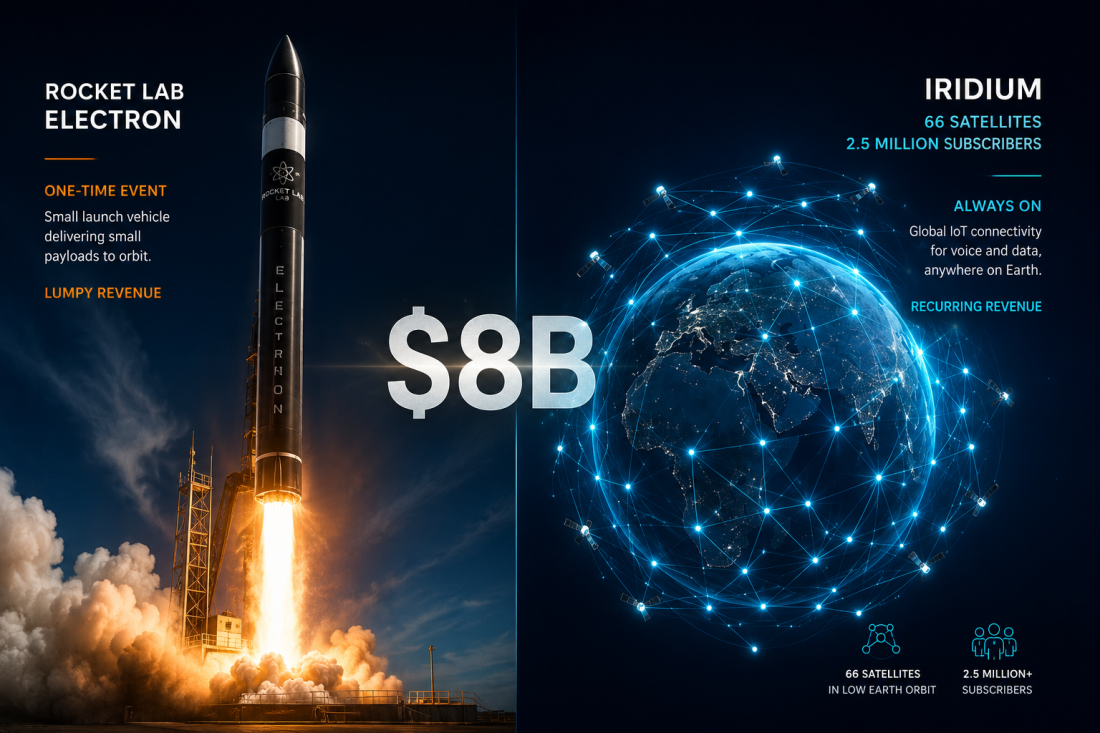
The Rocket Lab Iridium acquisition is a bet on IoT subscribers, not rockets. Rocket Lab is acquiring satellite operator Iridium for roughly $8 billion, a deal announced June 29, 2026. Most coverage frames this as a space-industry consolidation story. The more useful read for industrial operators: Rocket Lab, a capital-intensive launch business, is buying Iridium’s 2.5 million paying subscribers and 57% EBITDA margin — a recurring-revenue IoT connectivity business that launch contracts alone can’t match.
- ~$8.0B — enterprise value of the Rocket Lab-Iridium deal
- $54/share — $27 cash plus Rocket Lab stock, collar banded $67.50–$112.50
- 2.5 million — Iridium’s paid subscriber base
- $871.7M / 57% — Iridium’s 2025 revenue and operational EBITDA margin
- 66 — active satellites in Iridium’s low-Earth-orbit constellation
- Mid-2027 — expected deal close, pending regulatory and shareholder approval
What Rocket Lab Is Actually Buying
Rocket Lab will acquire all outstanding Iridium shares for $54 each, combining its launch and satellite-manufacturing business with Iridium’s global network, spectrum, and industrial partner ecosystem. The headline framing is “vertical integration.” The financial substance is simpler: launch contracts are lumpy and capital-intensive, while Iridium’s subscription base generates steady, high-margin recurring revenue every month, regardless of whether a rocket flies that quarter.
“We are going to absorb it, optimize it and scale it into something that is really truly fantastic.” — Peter Beck, CEO, Rocket Lab
Why the Margin Number Matters More Than the Satellite Count
Iridium generated $871.7 million in 2025 revenue at a 57% operational EBITDA margin, built on 2.5 million paying subscribers using its network for voice, data, and industrial IoT applications — asset tracking, maritime communications, aviation safety systems. That margin profile is rare in space infrastructure, where most revenue comes from one-off launch or hardware contracts rather than recurring subscriptions.
The Competitive Fear Driving the Timing
This deal isn’t happening in isolation. Amazon agreed to acquire satellite operator Globalstar for roughly $11.6 billion in April 2026, and SpaceX went public this month in the largest IPO on record, raising $86 billion at a valuation exceeding $2 trillion. Rocket Lab’s move reads as a direct response to consolidation pressure: smaller satellite IoT and communications players are being absorbed by companies large enough to fund direct-to-device ambitions, and standing alone is increasingly not an option.
⚠ Illustrative scenario (fictional): An oil and gas operator in the Niger Delta relies on Iridium-based satellite modems for remote wellhead monitoring, chosen years ago for network reliability. With ownership consolidating under Rocket Lab, the operator now has to ask whether pricing, hardware roadmaps, or support priorities shift once integration begins — a question worth raising with their connectivity vendor now, not after the deal closes.
Global Implications: Consolidation Changes Vendor Risk, Not Just Ownership
For industrial operators anywhere relying on Iridium-based satellite IoT — remote asset tracking, maritime fleets, agriculture in areas without cellular coverage — this acquisition is a vendor-continuity question, not just space-sector news. Iridium CEO Matthew Desch has emphasized the network’s “secure, safety-critical” role for maritime, aviation, and industrial customers operating in remote locations — exactly the customer base that needs continuity assurances during a multi-year integration process closing in mid-2027.
💡 CreedTec Analyst’s Note — Daniel Ikechukwu
Strategic Impact: Satellite IoT consolidation is being driven by recurring-revenue economics, not launch capability — subscription margins now outweigh rocket cadence as the valuable asset.
Stop: Treating satellite operator M&A as purely a space-industry story disconnected from IoT procurement.
Start: Asking your satellite IoT vendor directly about post-acquisition roadmap and pricing continuity if they rely on Iridium infrastructure.
Watch: Regulatory approval timelines through mid-2027 and whether Amazon’s Globalstar deal triggers further consolidation among smaller satellite IoT providers.
ROI Outlook: Neutral-to-cautious for current Iridium-dependent IoT deployments during integration; potentially favorable long-term if combined scale improves pricing and coverage.
A vendor acquisition shouldn’t be the first time you learn your connectivity roadmap changed. Subscribe to CreedTec’s newsletter for the infrastructure consolidation signals IoT buyers miss.
Further reading on CreedTec:
Myriota’s Hybrid Satellite-Cellular IoT Network · The Iridium 9604 Hybrid IoT Module · AT&T’s Industrial IoT Logistics Play Is About Margin, Not Bandwidth · Why Every Industry Needs a Secure IoT Satellite Constellation by 2030 · Nigeria’s Satellite IoT Licenses and the 2026 NCC Rules