Fast Facts
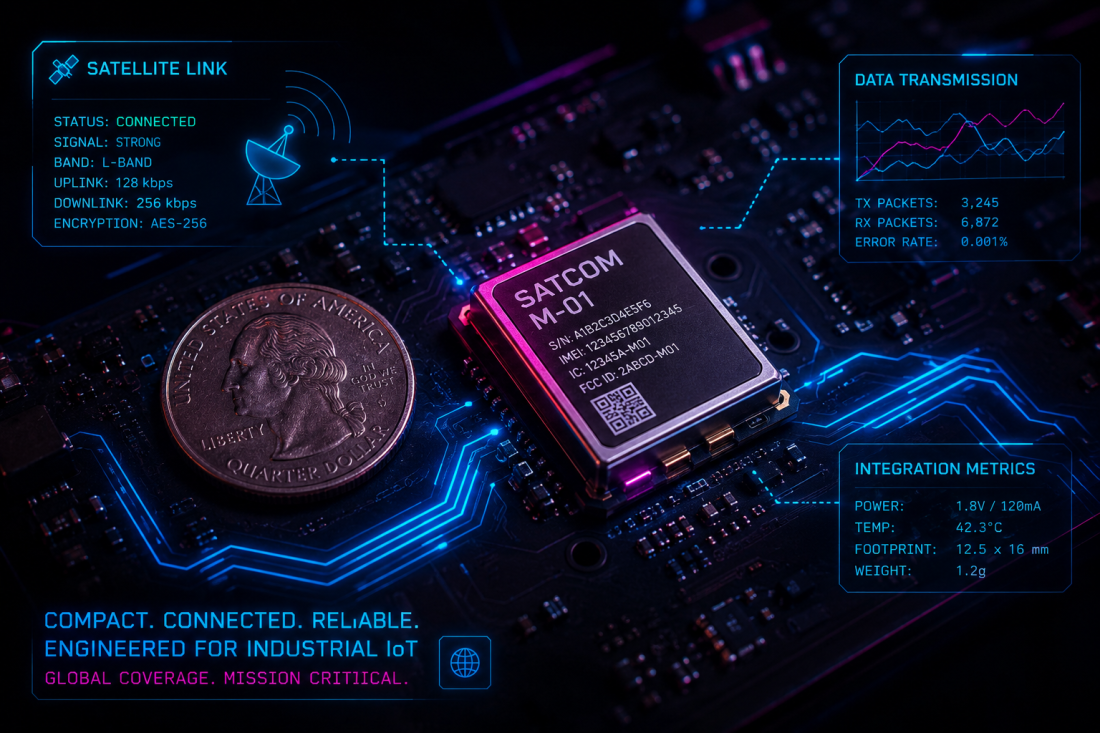
The Iridium 9604 hybrid IoT module reached commercial availability on June 23, 2026 — a three-in-one device combining Iridium SBD satellite, LTE-M cellular, and GNSS in a 16 x 26 mm footprint that cuts board space by 60% or more. Its commercial significance is not the miniaturization. It is that industrial operators in coverage-gap environments no longer have to choose between cellular affordability and satellite reliability. The tradeoff is gone. The failover logic is theirs to control.
📊 By the Numbers
| Stat | Value |
|---|---|
| 60%+ | Board space reduction vs separate satellite, cellular, and GNSS components — Iridium, June 2026 |
| 16×26mm | Module dimensions — Iridium’s smallest-ever form factor, 2.4mm thin |
| 100% | Global coverage via Iridium L-band network — including polar regions, oceans, remote land areas |
The Iridium 9604 hybrid IoT module has been commercially available since June 23, 2026 — and most coverage has treated it as a hardware release. The commercial argument it makes is more consequential than its form factor.
Industrial operators deploying connected monitoring in remote infrastructure — pipelines, offshore platforms, agricultural systems, power grids — have faced a structural connectivity dilemma for years. Cellular is affordable and low-latency but fails in coverage gaps. Satellite is globally reliable but historically required larger hardware, separate integration, and higher unit costs. The consequence has been a forced choice: either accept connectivity blackouts where cellular drops, or absorb the complexity and cost of building separate satellite and cellular hardware into constrained device form factors.
The 9604 removes that choice from the equation.
What the Beta Program Told Iridium Before Commercial Launch
The 9604’s beta program was oversubscribed, according to StockTitan’s analysis. Beta customers specifically cited three outcomes: board-space savings, lower bill-of-materials (BOM) complexity, and location-aware network selection. Each of those three outcomes maps to a different layer of the industrial deployment problem.
Board space savings matter because the deployments where global connectivity is most needed — compact telematics units, pipeline sensors, maritime buoys, emergency response equipment — are also the deployments with the tightest physical constraints. Previous satellite-cellular combo solutions required space that the device didn’t have. At 16 x 26 x 2.4 mm built on the u-blox SARA-R5 platform, the 9604 fits where its predecessors could not.
Lower BOM complexity matters because integration cost in industrial hardware design is not just component price — it is engineering time, RF validation, power management design, and firmware coordination across multiple radio subsystems. A unified AT command set and single SDK removes the majority of that overhead.
Location-aware network selection — the ability to route connectivity decisions based on where the device is and what networks are available — is the operational intelligence layer that converts a hardware module into a deployable connectivity strategy.
“By integrating cellular, GNSS, and Iridium satellite into a single, power-efficient module, we’re giving customers the flexibility to design and deploy lower cost, smaller, power-efficient, and location-aware solutions without the burden of integrating multiple components.”— Tim Last, Executive Vice President, Iridium (February 24, 2026)
The Failover Logic That Changes Industrial Risk Calculus
The 9604 gives developers independent control over satellite, LTE-M, and GNSS subsystems, enabling flexible implementation of failover logic. In industrial terms: when the cellular network drops, the device automatically routes through Iridium’s L-band satellite network without requiring a manual switch, a separate device, or operator intervention.
For operators in sectors where connectivity loss has direct operational or safety consequences — offshore oil and gas, remote pipeline monitoring, emergency response, utility grid infrastructure — this failover capability is not a feature enhancement. It is a risk reduction mechanism that changes the financial calculus of deploying connected monitoring in coverage-gap environments.
Hybrid satellite-cellular IoT modules have been technically possible for several years. What the 9604 changes is the integration overhead and form factor constraint that previously made them impractical for price-sensitive, high-volume industrial deployments. The module specifically targets cost-sensitive applications — which is where the gap between connectivity need and deployment reality has been widest.
⚠ Fiction — Illustrative Scenario
A utilities company deploys 3,200 remote monitoring sensors across a gas distribution network spanning rural and semi-urban terrain. Cellular coverage covers 78% of the network. The remaining 22% — spanning mountainous and coastal segments — has historically been monitored manually, at a quarterly inspection cycle. A pressure anomaly develops in a coastal segment during a storm. The nearest scheduled inspection is six weeks away. The anomaly is undetected for 11 days. With failover-capable hybrid modules, the alert routes through satellite in under two minutes.
The Global Deployment Case — Emerging Markets Specifically
The Iridium 9604’s commercial significance is amplified in markets where cellular coverage is structurally incomplete. The case for satellite IoT constellation coverage by 2030 is strongest in West Africa, South Asia, and Southeast Asia — regions with large industrial infrastructure footprints and cellular coverage gaps in rural and coastal areas. For Nigerian oil and gas operations, East African agricultural monitoring, and Southeast Asian maritime logistics, the 9604 represents the first commercially viable single-module path to always-connected industrial monitoring without the satellite-only cost premium.
Industrial IoT connectivity hardware in these markets has historically forced operators into a tiered approach: cellular where available, manual reporting where not. The 9604’s automatic failover collapses that tiering into a single, globally consistent connectivity layer — which is the prerequisite for deploying industrial AI monitoring systems that require uninterrupted data streams to function.
💡 CreedTec Analyst’s Note
By Daniel Ikechukwu — Strategic Impact Assessment
Strategic Impact: The Iridium 9604 marks a practical inflection point for industrial IIoT deployments in coverage-gap environments. The integration of satellite, cellular, and GNSS into a single controllable module at this form factor and cost tier removes the hardware constraint that has blocked hybrid connectivity adoption in price-sensitive industrial applications for years. The oversubscribed beta is the market confirming the demand was real — the question now is deployment velocity.
- ⛔ Stop: Designing industrial monitoring hardware with separate satellite and cellular components where a single hybrid module can serve both functions. The BOM complexity reduction and board space savings are immediate engineering budget arguments.
- ✅ Start: Evaluating 9604 integration for any industrial monitoring deployment that operates in or near cellular coverage boundaries. The development kit is available now — validation cost is low relative to deployment risk.
- 👁 Watch: Iridium’s NTN Direct testing track — if standards-based NB-IoT over satellite reaches commercial availability, the 9604’s architecture positions Iridium to integrate it without a hardware platform change. That upgrade path is worth tracking before locking in long-lifecycle deployment contracts with competing modules.
ROI Outlook: IIoT ROI in remote monitoring applications is directly correlated with data continuity. A sensor that goes dark during cellular outages produces incomplete datasets, missed anomaly detection, and manual inspection costs that the IIoT system was supposed to eliminate. The 9604’s failover capability converts connectivity reliability from a technical specification into a financial variable — and for long-lifecycle industrial deployments, that variable compounds. The platform continuity lesson from KDDI’s Aeris renewal applies here: hardware decisions with decade-long operational implications need to be evaluated on reliability across coverage conditions, not just per-unit cost.
📬 CreedTec Weekly
If your industrial monitoring deployments include coverage-gap locations and your connectivity strategy doesn’t account for satellite failover, your data pipeline has a gap your IIoT ROI model hasn’t priced. Subscribe to CreedTec’s weekly briefing — Industrial IoT, connectivity, and the financial logic behind the machines. → creedtec.online