Fast Facts
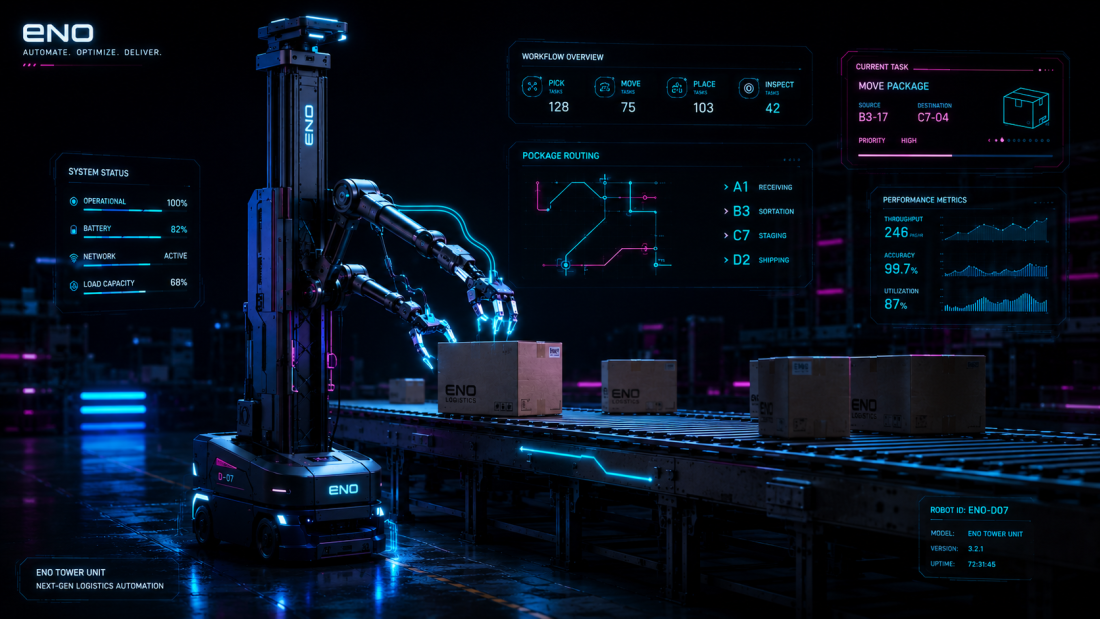
The Genesis AI Eno wheeled robot, unveiled June 16, 2026, rejects traditional bipedal layouts. This design shift is a calculated simulation training economics directive. By eliminating complex leg locomotion math, Genesis concentrates its GENE foundation model’s data compute budget purely on dexterous warehouse manipulation and multi-step workflow reasoning.
| Number | What It Means |
|---|
| $105M | Genesis AI’s seed funding round led by Eclipse and Khosla Ventures. |
| $39B | Figure AI’s valuation, underscoring investor confidence in humanoid robotics. |
| 1B | Projected number of general-purpose robots worldwide within 10 years, according to Zhou Xian. |
Genesis AI Eno wheeled robot landed on June 16, 2026, and most coverage treated it as a contrarian hardware story — wheels instead of legs, minimalism over mimicry. That framing is accurate but incomplete. The more consequential decision Genesis made is not about what Eno looks like. It is about where the company’s simulation training compute goes.
While the robotics industry has spent billions of dollars building simulation infrastructure to solve one problem — teaching bipedal robots not to fall over — Genesis used wheels to sidestep that problem entirely and redirect its entire training stack toward the problem that actually pays: making hands work.
How Simulation Training Economics Dictates Hardware Design
Locomotion simulation for bipedal humanoids is among the most computationally expensive challenges in physical AI. Contact physics, balance recovery, terrain variation, gait cycle optimization — these require massive simulation environments and enormous training runs before a robot can walk reliably across a flat factory floor, let alone an uneven one. The physics simulation bottleneck in bipedal training is well documented and still unsolved at scale.
Eno uses a wheeled base. Wheeled locomotion simulation is orders of magnitude simpler. Genesis does not need to spend training compute teaching Eno how to stand. That budget goes instead to GENE — the company’s in-house robotics foundation model — which focuses on dexterous manipulation and multi-step workflow reasoning across manufacturing, logistics, and laboratory environments.
Genesis built the full stack in-house: hardware, training gloves for data capture, simulator, and the GENE model itself. That vertical integration means the simulation environment is tuned directly to the manipulation tasks Eno needs to perform — not generalized for locomotion scenarios that Eno will never encounter on a flat factory floor.
“The only path to creating a robot that can truly deliver value to society and excel in the real world is through intentional design and a single, comprehensive system.”— Zhou Xian, Co-founder and CEO, Genesis AI (June 16, 2026)
What the LG CNS Partnership Confirms
Genesis simultaneously announced a strategic partnership with LG CNS to pilot Eno in manufacturing and logistics operations, starting with LG’s own facilities and expanding to industrial customers in the United States. LG CNS CTO Sangyeob Park stated the collaboration would “unlock new levels of automation in labor-intensive environments that traditional robotics have historically failed to address.”
That language is precise. Traditional robotics have failed in labor-intensive, unstructured environments not because of hardware form factor — but because the training infrastructure to handle dexterous, variable manipulation tasks did not exist at deployable cost. Sim-to-real transfer for manipulation remains the hardest unsolved problem in industrial robotics. Genesis is betting that concentrating its simulation investment here — rather than splitting it between locomotion and manipulation — produces a deployable advantage faster.
⚠ Fiction — Illustrative Scenario
A procurement manager at a logistics facility evaluates two robots for a picking station. The bipedal option requires six months of site simulation data before deployment. The wheeled option — trained entirely on manipulation tasks — begins deployment in week three. The bipedal robot’s simulation requirements were never mentioned in the vendor proposal. The procurement team finds out during integration.
Enterprise Humanoid Simulation Metrics vs Wheeled Systems
Figure AI carries a $39 billion private valuation and has deployed its Figure 03 humanoid in a Catalyst Brands warehouse. Tesla’s Optimus program continues its bipedal roadmap. These are not small bets. But they are bets that require solving locomotion simulation at scale before manipulation ROI can be demonstrated — and that sequence costs time and capital that industrial customers are increasingly unwilling to absorb.
Genesis’s counter-argument is embodied in Eno’s design: simulation training cost reduction is the commercial variable that determines which robots actually reach customers first. A robot that can be trained faster, deployed sooner, and validated in real industrial environments with less simulation overhead has a deployment velocity advantage that a higher valuation does not automatically overcome.
Global Implications
For manufacturers in emerging markets — where flat factory floors and structured logistics environments are standard, but simulation compute budgets are constrained — the limitations of data-heavy simulation approaches are already a deployment barrier. A wheeled platform with a manipulation-focused training stack lowers that barrier. Eric Schmidt’s framing — that Eno will “amplify” human expertise to unlock “one of the largest economic opportunities of the AI era” — is most directly true in the markets where deployment friction, not robot capability, has been the limiting factor.
💡 CreedTec Analyst’s Note
By Daniel Ikechukwu — Strategic Impact Assessment
Strategic Impact: Genesis AI’s Eno is a simulation economics argument as much as a hardware product. The decision to use wheels eliminates the most expensive training problem in physical AI and concentrates resources on the capability — dexterous manipulation — that industrial customers are actually willing to pay for. That sequencing may matter more than form factor in the 2026–2028 deployment window.
- ⛔ Stop: Evaluating robot platforms purely on form factor. The simulation training infrastructure behind the robot determines deployment timeline and adaptation cost — factors that rarely appear in vendor specifications.
- ✅ Start: Asking vendors directly: what percentage of training compute goes to locomotion vs. manipulation? For flat industrial environments, the answer should heavily favor manipulation.
- 👁 Watch: The LG CNS pilot deployments in H2 2026. If Genesis demonstrates measurable manipulation performance in logistics within the first three months, the simulation cost argument becomes a procurement differentiator, not just an engineering claim.
ROI Outlook: Genesis’s $105M seed positions it to reach customer deployment before most Series A-stage humanoid competitors. If Eno’s manipulation performance validates in controlled industrial settings, early customer data compounds into training advantage that late entrants — regardless of valuation — cannot replicate quickly. The window for industrial buyers to pilot early is open now.
FAQ: Robotic Simulation Training Economics & Bipedal AI
Why do bipedal robots have high simulation training costs?
Teaching bipedal humanoids complex contact physics, footing balance, and terrain recovery consumes massive cloud compute resources. These expensive simulation run budgets delay the time it takes a platform to achieve real-world commercial viability.
What is the commercial benefit of Genesis AI Eno’s wheeled design?
By utilizing a wheeled base platform, Genesis eliminates complex walking simulation costs. 100% of the simulation data engineering budget is instead poured straight into perfecting human-like dexterous hand manipulation and workflow processing.
📬 CreedTec Weekly
If your team is evaluating robot platforms for industrial deployment and hasn’t mapped simulation training cost against your floor environment, you are comparing specs that don’t predict performance. Subscribe to CreedTec’s weekly briefing — robotics, simulation, and the financial logic behind the machines. → creedtec.online