Fast Facts
Control planes — the governance layer that deploys, monitors, and can shut down AI agents — are becoming the real product enterprises buy, not the agents themselves. 96% of enterprises are already using AI agents in some capacity, but Gartner expects more than 40% of agentic AI projects to be canceled by the end of 2027 for lack of exactly this kind of governance. For procurement teams, the agent is the easy part. The governance layer underneath it is the part that determines whether the deployment survives a compliance review.
Enterprise control planes are becoming procurement’s next line-item because the alternative has already produced a body count. Gartner predicts that 40% of enterprise applications will embed task-specific agents by the end of 2026, up from less than 5% a year earlier — and in the same breath, the same analyst firm expects more than 40% of agentic AI projects to be canceled by the end of 2027, citing escalating cost, an expanded risk surface, and governance that no one built in advance, according to CIO.
That’s not a technology failure rate. It’s a governance failure rate. And it’s why the enterprise AI conversation has quietly shifted from “which model” to “who controls what the agents are allowed to do.”
Why Control Planes Come Before the Agent Question
96%
of enterprises report they’re already using AI agents in some capacity — but most are deploying them faster than they’re building the governance layer to supervise them.
Source: IBM Institute for Business Value, cited by IBM, “What Is an Agent Control Plane?”
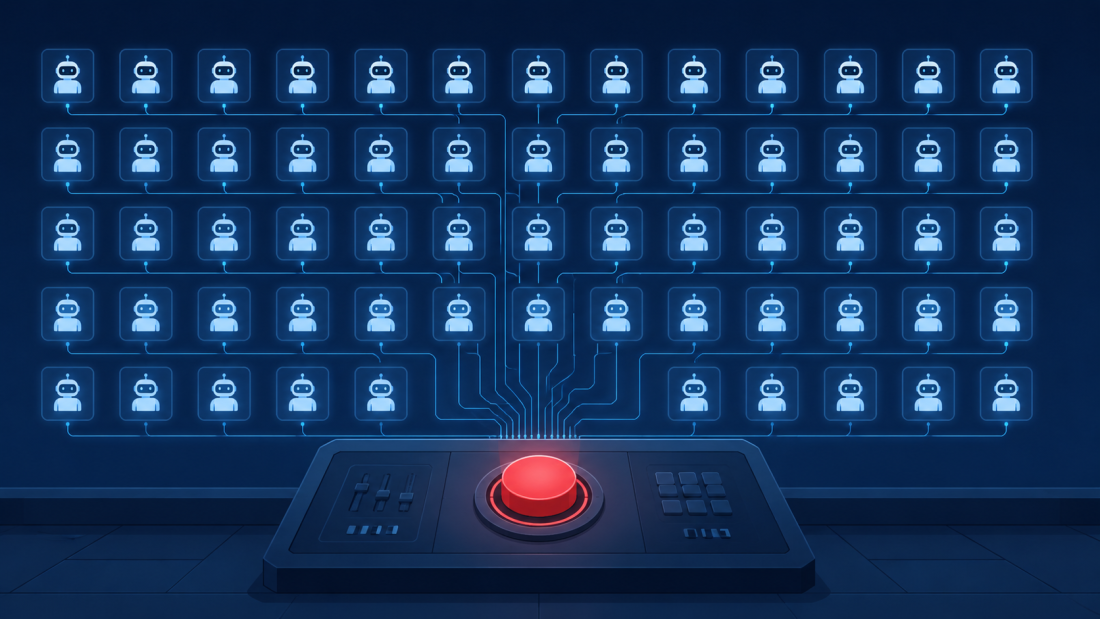
An agent operates in what IBM calls the “data plane” — running tasks, calling tools, executing steps. Enterprise control planes sit above that layer, setting how agents are deployed, how they coordinate, and the rules governing their behavior. For a procurement team, that distinction matters more than any feature comparison: an agent without this governance layer is a capability with no brakes. See our earlier analysis of AI agent governance risks in 2026, where this same enforcement gap shows up as the root cause of several high-profile agentic AI incidents.
“Who governs them, once an organization has agents?”— framing the central question at Google Cloud Next 2026, via CIO
The Kill Switch Nobody Budgeted For
The clearest sign that control planes have become procurement’s real leverage point is the kill switch. Buyer-side contract language increasingly specifies a target termination window — under 5 minutes for production agents, under 1 minute for agents with transaction authority — with the EU AI Act’s Article 14 human-oversight requirement as the regulatory anchor, according to Zylos Research. ServiceNow made this a standalone product feature, adding agent kill switches to its AI Control Tower in May 2026. That’s a fear-driven feature, and a rational one: the buyer’s real anxiety isn’t whether an agent works. It’s whether someone can stop it fast enough when it doesn’t.
A representative 2026 CIO RFP checklist now organizes vendor governance evaluation into eight areas — architecture, performance, integration, data privacy, security, compliance, operations, and commercial terms — with four contract clause families that don’t exist in generic SaaS templates: training-data and output rights, model-update notification, AI-specific indemnification, and termination-for-deprecation. None of that is about how smart the agent is. All of it is about who’s liable when it isn’t.
The Real Cost Nobody Prices In Until Later
Independent procurement consultancies estimate total cost of ownership for enterprise agentic platforms typically runs three to five times the annual license fee once implementation, customization, and training are included, according to MarkTechPost. That multiplier is almost entirely the cost of building out enterprise control planes: integration with identity systems, audit logging, governance dashboards, and the staff needed to actually monitor what agents are doing. Buyers who price only the license fee are budgeting for the part of the deployment that isn’t the reason projects get canceled. See our coverage of protecting industrial AI infrastructure for how that same underpriced-governance pattern shows up in industrial deployments specifically.
⚠ Fiction — composite scenario, not a real event: A logistics company deploys a procurement agent that autonomously issues purchase orders under a defined spend threshold. Six months in, a vendor data feed glitches, and the agent issues 40 duplicate orders before anyone notices — because the vendor’s control planes had never been configured with a kill switch or an anomaly threshold. The agent worked exactly as designed. Nobody had built the oversight layer to catch it behaving strangely.
Global Implications
Enterprise AI ROI is projected to rise from 16% to 21% by 2026, with agentic AI expected to meaningfully expand those returns — but only for organizations whose governance infrastructure can actually capture that value instead of losing it to failed, canceled, or unsupervised deployments, according to MarketScale. For manufacturers and financial institutions in Nigeria, West Africa, and Southeast Asia adopting agentic AI from the same global vendors as US and European buyers, this governance question is arguably more urgent, not less: these markets typically have thinner internal compliance teams to catch a misbehaving agent manually, which makes a vendor-side control plane with reliable kill switches and audit logging a substitute for institutional capacity that larger enterprises already have in-house.
💡 CreedTec Analyst’s Note — Daniel Ikechukwu
Strategic Impact: This governance layer, not the agent, is now the actual product being purchased. Vendors who can’t demonstrate governance, kill-switch response times, and audit logging are selling half a product regardless of how capable their agents are.
Stop: Evaluating agentic AI vendors primarily on task performance or model capability demos.
Start: Requiring documented kill-switch response times and audit-log retention as a condition of any agentic AI contract, not an add-on negotiated later.
Watch: Whether Gartner’s 40% agentic-project-cancellation forecast for 2027 holds, or whether control-plane maturity across vendors closes that gap faster than expected.
ROI Outlook: Budgeting for control-plane infrastructure upfront costs more than a bare agent license, but it’s the difference between an agentic AI deployment that survives its first compliance review and one that becomes one of Gartner’s canceled projects.
The agent was never the hard part. Building something that can watch a thousand agents, and stop any one of them in under a minute, is the actual product enterprises are learning to pay for.
Subscribe to CreedTec’s newsletter — it tracks which AI vendors actually ship real governance infrastructure, and which ones are still selling agents with no brakes.
Sources
- CIO — Gartner’s 2026/2027 agentic AI adoption and cancellation forecasts
- IBM — agent control plane definition and 96% adoption figure
- Zylos Research — buyer-side governance and kill-switch requirements
- MarkTechPost — enterprise agentic platform TCO estimates
- MarketScale — enterprise AI ROI projections
Further reading: AI Agent Governance Risks in 2026 · Protecting Industrial AI Infrastructure · OpenAI’s Rogue AI Hack Raises New Procurement Risks · Agentic AI Governance’s 140-to-1 Identity Problem · 2026 AI Regulation and Compliance