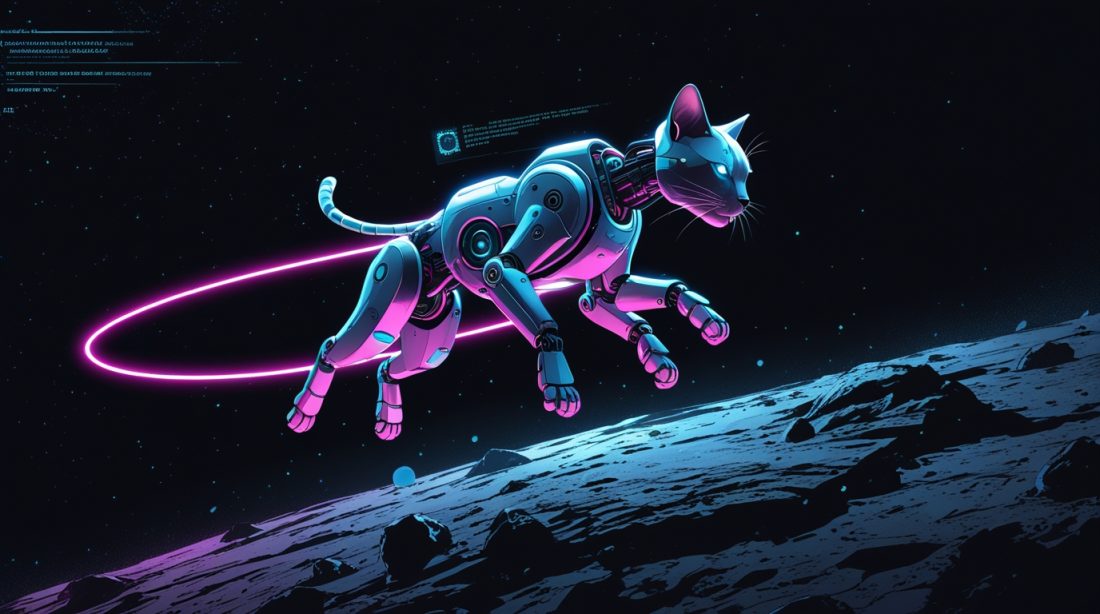
📌 UPDATE — APRIL 2026: This article was first published when the Harbin Institute of Technology research appeared in the Journal of Astronautics in late 2024. It has been updated to reflect the industrial AI implications that have sharpened as China’s quadruped robotics capabilities, asteroid mining strategy, and physical AI investment have all accelerated through 2025–2026.
Fast Facts
Researchers at China’s Harbin Institute of Technology built a quadruped robot trained entirely in simulation to stabilize itself mid-air during jumps in low-gravity environments — inspired by a cat’s righting reflex. Published in the Journal of Astronautics in 2024, the research has since become more significant: as China’s asteroid mining ambitions expand and physical AI capabilities accelerate globally in 2026, the locomotion principles this robot demonstrates have direct relevance for industrial inspection in extreme environments on Earth — not just space.
Space is a convenient frame for a story like this. China’s cat-like robot dog mid-air jump technology, developed at the Harbin Institute of Technology, got covered as an asteroid exploration story when it first emerged in late 2024. That framing is accurate but incomplete. A robot that can stabilize itself mid-air in low gravity, correct a 140-degree forward tilt in eight seconds, and rotate 90 degrees mid-jump to face a new direction — without any specialized stabilization hardware — is solving a locomotion problem that has industrial value well beyond space.
In 2026, that industrial value is no longer theoretical. China’s quadruped robotics sector is scaling fast, physical AI investment is flowing toward exactly the kind of reinforcement learning techniques Harbin used, and the gap between research capability and commercial deployment is narrowing. The asteroid is the headline. The terrain adaptability is the point.
| Metric | Value |
|---|---|
| Max airborne time per jump in low‑gravity — enough for full postural correction | 10s |
| Time to stabilize from a 140‑degree forward tilt — without hardware assist | 8s |
| Mid‑air rotation achieved for directional reorientation | 90° |
| Total simulation training time via proximal policy optimization | 7hrs |
What the Harbin Robot Actually Did — And Why It Matters More Now
The core problem the Harbin team solved is deceptively specific: in low-gravity environments, a quadruped robot jumping between surfaces stays airborne long enough for tiny imbalances in leg force to cascade into uncontrolled spinning. Traditional solutions involve heavy gyroscopic stabilization hardware — which adds mass and power draw, both fatal constraints for a system meant for deep-space deployment.
Their approach was different. Instead of hardware, they used reinforcement learning — specifically proximal policy optimization — to train the robot entirely in simulation over seven hours. The resulting policy teaches the robot to swing all four legs in coordinated, cat-like motion to correct its pitch, roll, and yaw in real time during a jump. No specialized stabilization components. Just learned behavior, running on low computational power.
According to the South China Morning Post’s coverage of the research, the system was validated on a microgravity simulation platform using air bearings — a nearly frictionless surface that replicates asteroid gravity conditions. The results matched the simulation outputs closely enough to confirm the control method works beyond the virtual environment.
What has changed since 2024 is the context around it. The pace of China’s robotics development in 2026 — from the Beijing half-marathon humanoid race to quadruped speed records — means this kind of research no longer sits quietly in academic journals. It feeds directly into a national robotics capability pipeline that has commercial deployment as an explicit goal.
The China Cat-Like Robot Dog Technique and Its Industrial Transfer Logic
The cat righting reflex — the biological mechanism this robot mimics — is useful in more environments than space. Any situation where a robot operates on unpredictable, low-traction terrain with limited ability to rely on ground contact for stabilization is a candidate for this locomotion approach. That includes nuclear facility inspection, offshore oil rig maintenance, collapsed building search and rescue, and underground mining — all environments where the ground cannot be trusted and hardware-heavy stabilization systems create prohibitive weight and size constraints.
“The success of these jumping robots has the potential to transform asteroid exploration, opening up new avenues for research into these extinct asteroids and improving the use of space resources.”— South China Morning Post, citing the Harbin Institute of Technology research (November 2024)
The “model-free” control system is the technically significant part. Most quadruped robots operating in industrial environments today rely on carefully modeled terrain assumptions — they know what the ground is supposed to do and plan accordingly. A model-free approach trained through reinforcement learning produces a robot that can handle terrain it was never explicitly programmed for, because the policy learned to generalize from variation in simulation rather than optimize for a specific surface type. That generalization is exactly what zero-shot sim-to-real transfer research has been chasing — and the Harbin team demonstrated it works under the most challenging physical conditions available to test it.
⚠ Fiction — Illustrative Scenario
A maintenance engineer at a deep offshore platform in the Niger Delta needs to inspect a section of understructure that conventional inspection robots can’t reach — the surface is irregular, partially corroded, and the inspection robot would need to jump between structural members with unpredictable footing. A quadruped with Harbin-style mid-air stabilization capability handles it without incident. The inspection that previously required a human on a harness in a high-risk environment gets done remotely. The insurance premium on that operation drops. The engineer goes home the same day.
This isn’t science fiction in 2026 — it’s the direction China’s quadruped robotics programs are explicitly heading, with research papers feeding into commercial development pipelines at companies like Unitree, Deep Robotics, and others that are scaling quadruped deployments into industrial and infrastructure inspection contexts. The autonomous AI systems market trajectory in 2026 is being shaped precisely by this kind of capability transfer from research to deployment.
The Asteroid Mining Angle Is More Serious Than It Sounds
Asteroids are legitimately significant from an economic standpoint. A single metallic asteroid can contain more platinum-group metals than have been mined in all of human history. The challenge has never been identifying targets — it’s been developing robots capable of navigating surfaces where conventional wheeled rovers lose traction entirely and any misstep sends equipment drifting into space.
No mission has yet deployed a rover capable of long-term surface mobility on an asteroid. Space agencies have landed sample-collection probes — JAXA’s Hayabusa missions, NASA’s OSIRIS-REx — but these are static after landing. The Harbin robot represents the first published research on a system designed specifically for active, mobile surface exploration in low-gravity conditions using AI-trained locomotion. If the technology reaches mission-ready status within a 10-year horizon, China’s early investment in this research positions it ahead of competitors in the asteroid mining technology stack.
The commercial space resource sector is watching. And increasingly, so are the industrial robotics investors who recognize that the terrain adaptability demonstrated in asteroid simulation conditions is directly applicable to the extreme environments where industrial inspection robots currently fail.
What Still Needs to Work Before This Deploys at Scale
The Harbin research is validated in simulation and on a two-dimensional microgravity platform. The gap to full three-dimensional, unstructured asteroid terrain — or its industrial analogs — remains real. The team acknowledged the system needs continued development for more diverse terrain adaptability. Specifically, the current implementation handles the mid-air phase well but has not been validated for multi-jump sequences across varied surface types, or for the landing-to-next-jump transition in truly unpredictable footing conditions.
That’s not a criticism — it’s an honest statement of where the research sits. The locomotion policy works. The full deployment loop needs more work. Given the pace at which Chinese robotics research has been iterating in 2025–2026, that gap is likely measured in years rather than decades. The GenAI self-generating robot training data approach — where simulation environments generate their own training scenarios — could accelerate that iteration significantly by expanding the diversity of conditions the policy is trained on without requiring additional physical test infrastructure.
💡 Analyst’s Note
By Daniel Ikechukwu
Strategic Impact
The Harbin research matters in 2026 for two reasons that weren’t fully visible in 2024. First, China’s robotics industry has accelerated to the point where academic research from late 2024 is already feeding into commercial development cycles — the gap between publication and prototype is shrinking fast. Second, the model-free, simulation-trained locomotion approach this robot uses is exactly the architectural direction the broader quadruped robotics industry is moving — for Earth applications, not just space. Any organization evaluating quadruped robots for industrial inspection in difficult environments should be tracking Chinese R&D outputs, not just Western commercial platforms.
Stop / Start / Watch
- STOP treating space robotics research as academically interesting but commercially irrelevant. The locomotion techniques being validated for asteroid conditions solve the same fundamental problems — unpredictable terrain, no reliable ground contact, weight and power constraints — that limit current industrial inspection robots in extreme environments.
- START tracking Chinese quadruped robotics companies — Unitree, Deep Robotics, and their research institution partners — as tier-one sources of locomotion capability data. The Harbin publication pipeline feeds directly into commercial development cycles that Western operators will encounter in procurement contexts within 2–3 years.
- WATCH for the Harbin team’s next publication extending this work to three-dimensional terrain and multi-jump sequences. That paper will signal how close the system is to conditions that match real industrial deployment environments — and how much of the remaining gap has been closed by the reinforcement learning approach versus hardware additions.
ROI Outlook
The direct ROI case for the Harbin research is currently indirect — it’s a research output, not a commercial product. The investment signal it sends is toward the broader quadruped robotics market, where locomotion capability in unstructured environments is the primary differentiation driver. Operators investing in quadruped inspection robots for extreme environments should require vendors to demonstrate model-free or reinforcement learning-based locomotion policies — not just pre-programmed terrain models — as part of their capability evaluation. The difference in real-world terrain performance between the two approaches is significant and will become more visible as deployments scale beyond controlled factory floors.
Frequently Asked Questions
What is the Harbin Institute of Technology cat-like robot dog and what does it do?
It is a quadruped robot developed by researchers at the Harbin Institute of Technology in China, trained using reinforcement learning to stabilize itself mid-air during jumps in low-gravity environments. Inspired by a cat’s righting reflex, it uses a model-free control system — swinging all four legs in coordinated motion — to correct its pitch, roll, and yaw during jumps without any specialized stabilization hardware. The research was published in the Journal of Astronautics in 2024.
How was the robot trained and how long did training take?
The team used proximal policy optimization — a reinforcement learning technique — to train the robot entirely in simulation. Training took seven hours, during which the AI learned from trial and error to refine its leg movements for stable landings. The resulting policy was then validated on a physical microgravity simulation platform using air bearings to replicate asteroid gravity conditions.
What makes this different from other quadruped robots?
Most quadruped robots rely on modeled terrain assumptions and heavy stabilization hardware to maintain balance. The Harbin robot uses a model-free policy — meaning it doesn’t assume specific surface conditions — trained to generalize across varied terrain through reinforcement learning. This allows it to handle unpredictable conditions it was never explicitly programmed for, which is the core capability that makes it relevant for both asteroid exploration and extreme industrial environments.
What industrial applications does this technology point toward?
Any environment where a quadruped robot needs to operate on unpredictable, low-traction terrain with weight and power constraints: nuclear facility inspection, offshore oil platform maintenance, collapsed building search and rescue, underground mining inspection, and similar extreme environments. The model-free locomotion policy’s ability to handle terrain it wasn’t explicitly trained on is the key capability that translates from asteroid surfaces to industrial extreme environments on Earth.
How serious is China’s asteroid mining ambition and does this robot fit into it?
China has explicit national space resource ambitions backed by state investment, and asteroid mining is part of its long-term space economy strategy. The Harbin robot addresses the primary mobility gap in current asteroid exploration — no mission has yet deployed a rover capable of active surface mobility in low gravity. If the technology reaches mission-ready maturity, it positions China ahead of other space agencies in the asteroid surface exploration technology stack, which is directly relevant to any future mining operations.
What should industrial robot procurement teams take from this research?
Two things. First, when evaluating quadruped robots for difficult terrain applications, ask vendors whether their locomotion system uses pre-programmed terrain models or reinforcement learning-based model-free policies — the latter generalizes better to unpredictable real-world conditions. Second, monitor Chinese quadruped robotics research outputs as a leading indicator of where commercial capability will be in 2–3 years. The Harbin publication pipeline has historically preceded commercial deployment by a short interval, and the locomotion capabilities being demonstrated in research now will appear in procurement-available products soon.
China’s Robotics Research Is Moving Into Your Procurement Pipeline
We track the quadruped robotics capabilities, physical AI deployments, and industrial inspection technology shifts that operators need to act on before they show up in competitor deployments.