Claude Ship launched in beta on November 23, 2026, and one of its agents, Claude Approvals, can approve routine GitHub pull requests on its own when a team’s written policy allows it. Anthropic (Nasdaq: ANT) says the second agent, PR Steward, is designed never to approve or merge, so fixing and approving stay separate jobs.
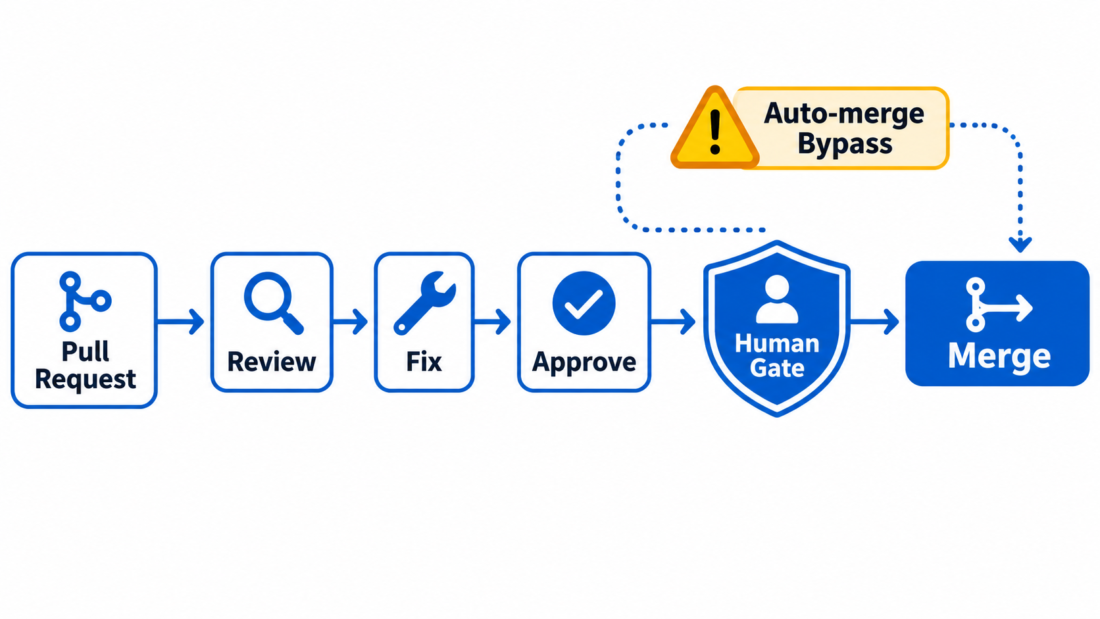
The risk sits in your GitHub settings, not the model. With auto-merge or a merge queue and a policy that needs no human, a change can merge with nobody acting. Start in observe mode and use the checklist below.
Anthropic’s Claude Ship arrived on Monday for Team and Enterprise organizations on GitHub. It bundles Code Review, now generally available, with PR Steward and Claude Approvals, both in beta. The headline is not faster reviews. An AI agent can now be an approver of record, so your approval policy becomes a security control.
Three Agents, Three Different Powers
Code Review posts severity-ranked findings at Quick, Standard or Deep levels chosen per repository. PR Steward pushes commits for failing checks, merge conflicts and review comments, then comments on what it changed and how to undo it. Claude Approvals is a check driven by a policy file in the repository, named .claude/approvals.yml in Anthropic’s documentation. The file sets how many people must approve changes to a path and where Claude may post an approving review. Anthropic likens it to a smarter CODEOWNERS file.
Enforcement is opt-in. The check blocks a merge only where you make it a required check in GitHub (Microsoft, Nasdaq: MSFT), and normally not in observe mode. That leaves four traps.
Four Traps Before You Enforce Claude Ship Approvals
Merges nobody reviews. Anthropic’s documentation warns that GitHub auto-merge or a merge queue, paired with a policy that does not require a person, can merge a change without anyone acting. See our analysis where we explain how to prove an AI rollout did not break production, because the same logging discipline applies here.
Silent loss of review coverage. Once the policy file reaches the default branch, in observe mode or enforced, automatic Code Reviews normally stop wherever no rule names claude/code_review.
Billing during observation. Observe mode is billed, a policy that uses Claude’s review triggers a billed Code Review even then, and PR Steward has no spend limit until an Owner sets one. See our analysis where we explain six controls to set before granting an agent access for the limit design.
Eligibility gates. The agents are unavailable to organizations with Zero Data Retention, the HIPAA configuration or customer-managed encryption keys. Anthropic also states they may miss bugs and security vulnerabilities.
Stat callout (Anthropic-reported, Nov 23, 2026)
2x+ merged PRs on Anthropic’s own Claude Code team from June to September, while the share reverted fell by more than 40%. One team, self-reported, not a customer benchmark.
$10,000 minimum promotional credits for eligible Enterprise organizations, claimable by January 15, 2027.
“We keep a human in the loop.”Vatsal Bhatt, Director of Engineering, TELUS (NYSE: TU), quoted in Anthropic’s launch post
⚠️ Hypothetical scenario, not a real event: A fintech lead in Lagos turns the approval agent on for a payments repository on Friday afternoon. A merge queue is active, and a settlement config file sits inside a folder the policy calls routine. The change merges at 9 p.m. with no human involved. Monday’s reconciliation shows duplicate settlements, and nobody can say who approved it.
The Policy Checklist to Copy
- One repository first. Enable Code Review, then PR Steward set to Manual (@claude steward), then Approvals, in that order.
- Set spend limits on day one for Code Review and PR Steward. Record the Code Review level (Quick, Standard, Deep) per repository.
- Write the policy by path tier (table below), and name
claude/code_reviewin every rule where you still want automatic reviews. - Run observe mode for 30 days (a suggested window, not an Anthropic figure). Log each PR where Claude’s decision differs from the human’s, then compute the agreement rate.
- Close the merge path. Turn off auto-merge and merge queue on any path where the policy needs no human, and require code-owner approval for Tier 3.
- Only then enforce: switch the policy out of observe mode and make Claude Approvals a required GitHub check.
| Tier (suggested) | Paths | Approval rule |
|---|---|---|
| 1 | Docs, tests, copy | Claude may approve alone |
| 2 | Application code | One human, Claude advisory |
| 3 | Auth, payments, secrets, infrastructure, CI workflows | Two humans, Claude never sole approver |
ROI formula: Net monthly value = (routine PRs Claude approves × minutes per human approval ÷ 60 × loaded hourly cost) − (usage-credit spend + classifier runs + incident cost). Observe mode is billed, so it gives you real inputs. Track revert rate beside it; Anthropic used reverts as its own guardrail.
Why Claude Ship Delegation Rules Beat Speed
See our analysis where we explain which task types to delegate to agents, since the same sorting sets your Tier 1 and Tier 3 lines. See our analysis where we explain the monitoring gaps outside auditors found before trusting an approval log you have never replayed. And see our analysis where we explain the 140-to-1 agent identity problem, because an approving agent is a new principal in your repository.
Teams that adopt Claude Ship well will treat the policy file like production code: reviewed, versioned and owned.
💡 CreedTec Analyst’s Note by Daniel Ikechukwu
Strategic Impact
The product separates fix power from approve power, which is the right design. The weak point is the merge path around it.
Stop / Start / Watch
- Stop: enabling auto-merge on any path where Claude can approve alone.
- Start: a 30-day observe window with a human-versus-Claude disagreement log.
- Watch: whether Anthropic publishes approval error rates beyond its own team’s revert share.
ROI Outlook
Value comes from routine pull requests only. Saved reviewer minutes add up, but token spend, classifier runs and incident cost scale too. For Claude Ship, a policy that saves 20 hours and causes one rollback can lose money, so measure both.
— Daniel Ikechukwu
Get the weekly agent-governance checklist. One copy-paste control per issue for engineering and procurement leads: subscribe to the newsletter.
Policy-as-code, AI observability and CI audit-logging vendors: this is the buyer moment. Sponsor and partnership inquiries: creedtec@creedtec.online.