Fast Facts
The Atlas GlobalFoundries pilot, announced November 17, makes the chipmaker the first customer outside automotive to test Boston Dynamics’ Atlas humanoid. Testing starts in early 2027, and no unit count, task list or commercial terms were published.
What buyers can copy is the structure: a proven robot, Spot, built trust first, and the humanoid enters as a skills workshop. The charter below turns that structure into a written program with pass lines and exit rules.
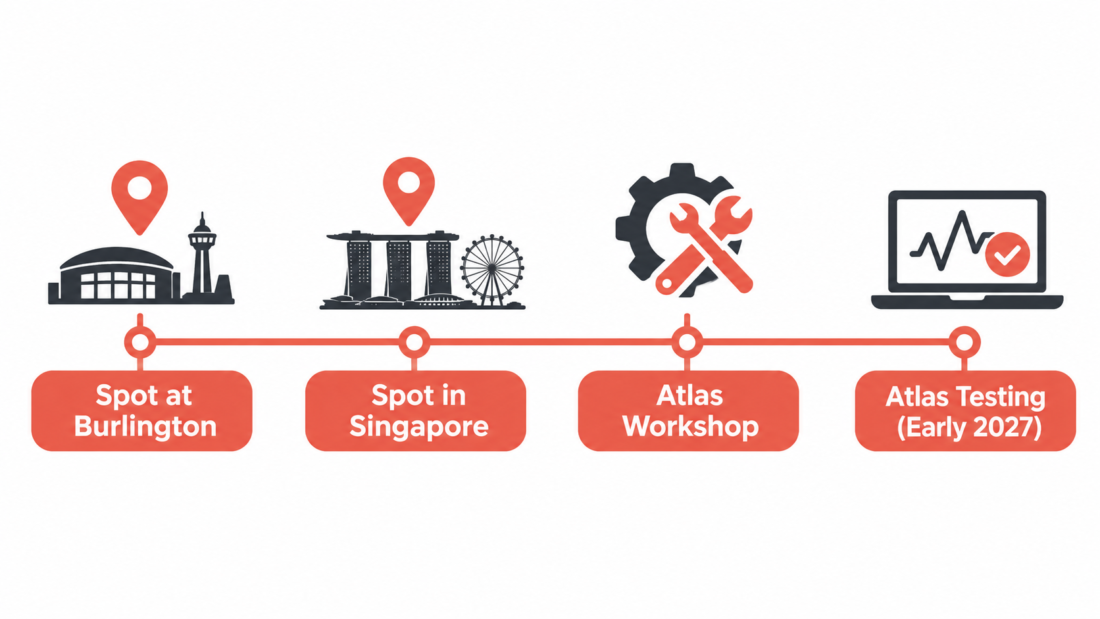
The announcement also expands Spot across GlobalFoundries fabs in Malta, New York, Burlington, Vermont, Dresden and Singapore. Spot is the evidence base, so it is worth reading before judging Atlas.
Fast Facts From the Announcement
- GlobalFoundries is the first customer outside the automotive industry to begin testing Atlas, through an early adopter program and a skills development workshop.
- In Singapore, two Spot robots covered nearly 900 km and completed over 90,000 sub-fab inspections at a 99% mission success rate.
- GlobalFoundries redeployed 875 routine inspections in two weeks and plans to more than double that.
“GlobalFoundries was one of our earliest customers to adopt Spot.”Zack Jackowski, Chief Product and Technology Officer, Boston Dynamics
| Metric | Figure / Timeline |
|---|---|
| Spot inspections in Singapore sub-fabs | 90,000+ |
| Spot mission success rate | 99% |
| Inspections redeployed in two weeks | 875 |
| Atlas testing begins | Early 2027 |
Source: Boston Dynamics and GlobalFoundries announcement, November 17, 2026, as reported by Design Development Today.
What the Atlas GlobalFoundries Pilot Means for Your Trial
The sequence matters. GlobalFoundries ran Spot at Burlington for over four years before testing a humanoid, so the Atlas GlobalFoundries pilot sits on a base of site data, safety sign-offs and trained staff. Most buyers skip that base. Our earlier read of Hyundai’s factory plans is the context; see our analysis where we explain Atlas humanoid factory deployment. Hardware limits still shape what the robot can do; see our analysis where we explain how Atlas’s hand drops a finger to fix dexterity.
Spot’s 99% success rate is a baseline, not a forecast for a humanoid. Ask what a humanoid must beat to justify its cost, starting from the spec sheet; see our analysis where we explain seven checks before you buy a humanoid. Inspection data also feeds predictive maintenance, which GlobalFoundries says Spot enabled; see our analysis where we explain how Spot reads analog gauges with Gemini AI.
Safety comes before tasks. See our analysis where we explain where humanoid robot safety standards stand today. Put those items in the program charter, so the Atlas GlobalFoundries pilot becomes a template for your own site rather than just a headline.
Atlas GlobalFoundries Pilot Template: Early-Adopter Program Charter (copy-paste)
Suggested starting values. Tune per site and task.
| Section | What to write down |
|---|---|
| 1. Scope | Name 2 to 3 tasks (for example, part transport). Everything else is out of scope until a written change. |
| 2. Baseline | Record the human or existing-robot result for each task for 4 weeks before the robot starts. |
| 3. Pass lines | Success rate no lower than baseline minus 5 points; human takeovers logged per shift; recovery time median and maximum. |
| 4. Site rules | Safety review signed before day one; cleanroom, ESD and access requirements confirmed in writing with the vendor. |
| 5. Data | Raw logs, video and takeover records delivered within 48 hours; vendor use of your data stated in the contract. |
| 6. Exit | Stop at 90 days unless pass lines are met on two consecutive weeks. No automatic conversion to purchase. |
⚠️ Hypothetical scenario: A Lagos bottling plant joins a humanoid early adopter program after reading about the Atlas GlobalFoundries pilot. The vendor offers a free workshop but no written baseline. Three months in, the robot moves crates, yet nobody can say whether it beats the forklift crew. The plant renews on enthusiasm, not data, and pays for a second quarter of unproven work.
💡 CreedTec Analyst’s Note by Daniel Ikechukwu
Strategic Impact
The announcement is a test, not a deployment, and it names no tasks. That is normal for an early adopter program, but it means the evidence will arrive after 2027 starts. Buyers should treat the structure as the lesson and wait for results before copying the scale.
Stop / Start / Watch
- Stop: reading a testing program as a production order.
- Start: collecting a 4-week baseline before any humanoid arrives.
- Watch: the task list, unit count and takeover data from the Atlas GlobalFoundries pilot once testing begins.
ROI Outlook
Illustrative math: 875 inspections at 10 minutes each is about 146 labor hours per two weeks. If a robot takes over that work at 99% success, the value is real, but a humanoid must earn its higher cost on harder tasks.
— Daniel Ikechukwu
Get the next playbook. One copy-paste robotics buying tool per issue, built for operators and procurement leads. Subscribe to the newsletter below.
For vendors: every buyer following the Atlas GlobalFoundries pilot will want telemetry and baselines. If you sell robot fleet management, pilot analytics or cleanroom-rated integration, email creedtec@creedtec.online to sponsor the next edition.