Fast Facts
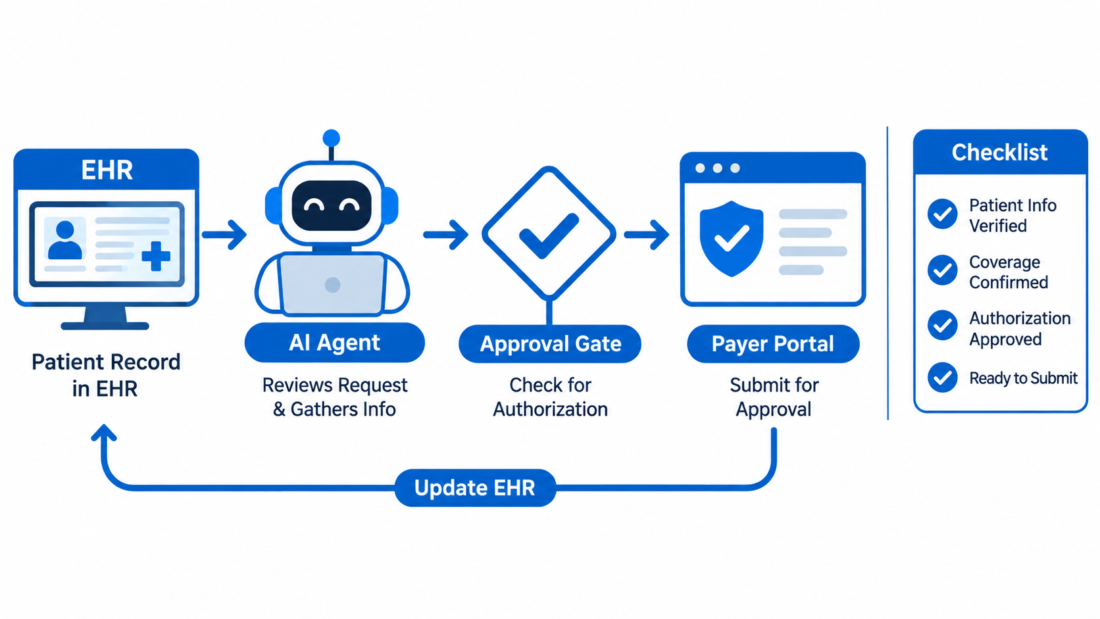
OpenAI announced on November 16 that its OpenAI healthcare agents can read screens, click and type across EHRs and payer portals to handle referrals and prior authorizations. CVS Health and Cigna Healthcare are named users, and OpenAI reports 94.3% on the HealthAdminBench benchmark for GPT-6 Astra.
The score is encouraging, but OpenAI has not published workflow-level error or intervention rates. Hospital and payer teams should gate any rollout with allowlists, approval steps and a shadow period, using the checklist below.
The agents run in ChatGPT for Healthcare, the free ChatGPT for Clinicians and the API, and they work through screens when no usable API exists. That is exactly why governance matters for OpenAI healthcare agents.
Fast Facts From the Launch
- Agents handle referrals, prior authorizations and discharge planning across existing clinical and payer software.
- OpenAI reports HealthAdminBench scores of 94.3% (GPT-6 Astra) and 91.8% (GPT-6 Luna); Luna costs 8.5 cents per task on that benchmark.
- OpenAI says reviewers rated 99% of 325 EHR inbox tasks completed by Astra as clinically safe, in its own evaluation.
“Moving from concept to deployment in under eight weeks shows what’s possible.”Madhu Nutakki, CIO, Cigna Healthcare, via Becker’s Hospital Review
| Metric | Value | Context |
|---|---|---|
| Astra benchmark score | 94.3% | HealthAdminBench (OpenAI-reported) |
| Luna cost per task | 8.5¢ | Benchmark cost per task, not a product price |
| Best end-to-end success | 36.3% | Highest reported result in the April Stanford-led paper |
| Healthcare plugins added | 20+ | Added to ChatGPT for Healthcare |
Sources: Becker’s Hospital Review; Beri.net summary of OpenAI’s release and the HealthAdminBench paper.
How OpenAI Healthcare Agents Change Your Rollout Plan
Two numbers sit side by side and should not be confused. OpenAI’s 94.3% is a share of rubric points. The April benchmark paper scored end-to-end success, where every subtask must be right, and its best result then was 36.3%, from older models. The paper also simplified logins and session timeouts, so live portals are harder. Treat the new scores as a promising signal, not a production error rate.
Monitoring is the control that matters once an agent can submit forms. See our analysis where we explain the blind spots outside auditors found in OpenAI agent monitoring. Access limits come next; see our analysis where we explain six controls to set before granting an agent access. Workspace administrators can choose which apps agents reach and which steps need human review, so the choices are yours to make.
Identity is the quiet risk when agents multiply; see our analysis where we explain the 140-to-1 agent identity problem. Orchestration decides whether a pilot becomes a deployment; see our analysis where we explain why agentic orchestration became the enterprise deployment gate. Rivals are moving too; see our analysis where we explain how Gemini’s agent for work got its own mailbox.
OpenAI Healthcare Agents Go-Live Gate: 5 Steps (copy-paste)
Values are suggested starting points. Set final numbers with your compliance team.
| Step | Action and parameter |
|---|---|
| 1. Allowlist | Enable only named apps per workflow. Default deny for everything else, including new plugins. |
| 2. Approval gates | Require human sign-off before any irreversible step: submit, send, sign or pay. Pause on ambiguous records. |
| 3. Shadow period | Run 30 days in suggest-only mode. Compare against staff results on at least [200] tasks per workflow. |
| 4. Pass lines | Error rate under [2%] on submitted items; human intervention rate tracked weekly; any wrong submission is logged and reviewed. |
| 5. Contract and logs | Confirm a BAA covers every plugin in use. Keep agent audit logs at least [12] months and test retrieval before go-live. |
Formula: cost per completed task = per-task fee + (review minutes × loaded staff rate ÷ 60). At 8.5 cents plus three review minutes at USD 0.50 per minute, review is about 95% of the cost.
⚠️ Hypothetical scenario: A Lagos private hospital group trials OpenAI healthcare agents to file insurer pre-approvals. The vendor cites a 94% benchmark score and staff switch the agent on for all clinics at once. Without approval gates, a mis-keyed procedure code reaches an insurer portal and claims stall for weeks. A 30-day shadow period would have shown the error pattern first.
💡 CreedTec Analyst’s Note by Daniel Ikechukwu
Strategic Impact
Screen-based agents remove the API barrier, which speeds adoption and widens the blast radius. The advantage goes to teams that pair OpenAI healthcare agents with strict gates, not to those that switch on the most workflows.
Stop / Start / Watch
- Stop: reading a benchmark score as a production error rate.
- Start: logging every agent action and every human override.
- Watch: whether OpenAI publishes workflow-level error and intervention rates for OpenAI healthcare agents, and what a real workspace price turns out to be.
ROI Outlook
Illustrative math: a clinic filing 2,000 authorizations a month at USD 1.60 all-in spends USD 3,200. If staff handled each at USD 6, the monthly gap is USD 8,800, but only if the error rate stays low.
— Daniel Ikechukwu
Get the next playbook. One copy-paste AI governance tool per issue, built for operators and security leads. Subscribe to the newsletter below.
For vendors: every buyer studying OpenAI healthcare agents needs action logging and approval controls. If you sell AI agent governance, audit logging or agent testing tools, email creedtec@creedtec.online to sponsor the next edition.