Fast Facts
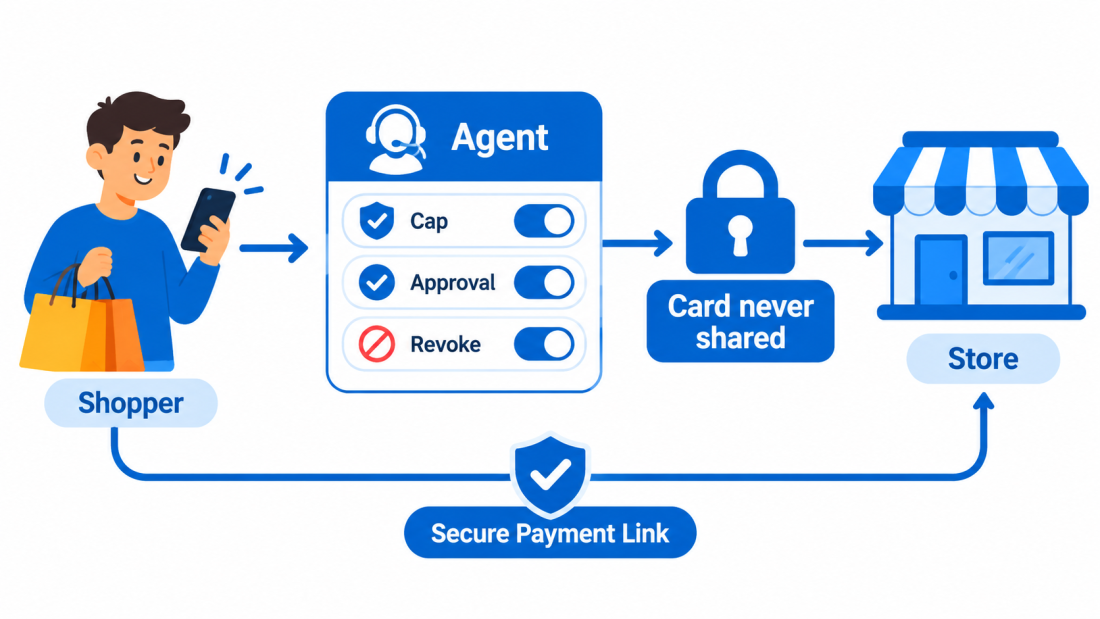
AI agent spending limits are the cheapest safety control available for agents that can buy things. Walmart showed a working model on October 21: each agent gets its own profile, purchases need approval by default, and customers can set a cap, with $50, $100 and $200 given as examples. The profiles are due about a month after the announcement.
This guide turns that example into six controls any buyer can demand from an agent vendor. Walmart’s design leaves gaps, notably on fraud liability, so treat it as a template to improve, not a finished standard.
Giving an agent a card is easy. Proving the agent stayed inside what you intended is harder. Walmart’s Agent Gateway, an MCP server for approved agents, makes AI agent spending limits concrete, and Amazon’s decision to block agents shows the opposite approach. This guide covers what to set, and what to ask.
What Walmart’s Agent Profiles Actually Do
Per Chain Store Age, each agent gets a dedicated profile inside a customer’s account, so its purchases appear on a separate line. The profile is created the first time an agent shops through the gateway, and the customer links it by signing in. Customers choose between approving every purchase or setting a spending limit, can view all agent purchases and can delete a profile at any time.
Walmart compares it to adding an authorized user on a credit card. Agents never receive payment-card details and cannot add or change payment methods. Agents that break the terms are blocked, and Walmart’s returns process applies even when an agent errs.
$50 | $100 | $200 example caps
Examples named in Walmart’s announcement as reported by Chain Store Age. Approval is the default, and Walmart may require extra approval even inside a cap.
“Agents must not take actions beyond what the shopper intends.”
— Walmart Agent Gateway terms
Six Controls Behind Good AI Agent Spending Limits
1. Give every agent its own identity. A separate profile keeps agent spend visible and auditable. See our analysis where we explain why agentic AI governance is failing on a 140-to-1 identity problem.
2. Default to approval, then raise the cap. Start with approve-every-purchase and loosen only after a clean record. A cap is a ceiling, not a target.
3. Limit scope, not just amount. Wolf Ruzicka of Unlimit argues in Silicon UK for machine-readable mandates covering spending caps, approved merchants, product categories, currencies, time periods and when human approval is needed. Walmart’s examples cover amount only.
4. Keep credentials away from the agent. Walmart’s agents never see card data. See our analysis where we explain why Visa, Mastercard and Ant agree on the problem but not the solution.
5. Make permission visible and revocable. Walmart lets customers change limits and delete a profile at any time. Ruzicka adds that one-time consent is not enough, and customers should be able to pause an agent quickly.
6. Keep a record and a route to redress. Ruzicka argues each transaction should carry the instruction, the limits and whether approval was obtained, to support disputes. Walmart’s returns process is a start, but its announcement does not describe fraud handling or liability allocation. See our analysis where we explain why banks block AI agents, where that liability gap is the sticking point.
Where AI Agent Spending Limits Still Fall Short
A cap limits damage, not intent. An agent can spend $50 on the wrong item as easily as the right one. Payment systems can confirm a transaction was valid, but not that you authorized this agent for this purchase, Ruzicka argues. That is why limits need pairing with scope and logs. See our analysis where we explain how Cloudflare just wired 20% of the web for AI agent payments, since the rails are arriving faster than the rules.
Platforms also disagree. Amazon blocked Meta’s Muse agent, per Cryptopolitan, citing customer security and user experience, while Walmart signed on as a connector. Buyers should expect inconsistent AI agent spending limits across merchants. See our analysis where we explain why Gemini agent for work gets its own mailbox and still no price, another case of identity shipping before the rules.
⚠️ Hypothetical scenario: A Lagos supplies shop lets an agent reorder stock using a shared business card. With no per-agent profile and no cap, a looping reorder runs overnight and charges the card repeatedly. The owner finds out at month end. The lesson is that AI agent spending limits belong in place before the first order, not after the first error.
💡 CreedTec Analyst’s Note by Daniel Ikechukwu
Strategic Impact
Walmart’s design makes the spending cap a default feature rather than an afterthought. For businesses, AI agent spending limits are becoming a procurement requirement. Vendors that cannot show caps, scope and logs will lose to those that can.
Stop / Start / Watch
- Stop: handing agents shared cards or open payment methods.
- Start: requiring a per-agent identity, a default-approval setting and a revoke switch in every agent contract.
- Watch: the November Agent Profiles launch and any published liability terms.
ROI Outlook
Controls cost little compared with one runaway order cycle. No fraud or error-rate data from Walmart is public, so no savings figure is defensible. The value is a bounded worst case.
— Daniel Ikechukwu
Agents that can pay need rules that can bind. Get the weekly AI systems briefing on what vendors leave out. Subscribe free
Sources
- Chain Store Age: Walmart to let AI agents shop for customers; sets guardrails
- Cryptopolitan: AI agents will get their own Walmart profiles with spending caps
- ShopiFreaks: Walmart launches Agent Gateway while Amazon keeps blocking agents
- Silicon UK (Wolf Ruzicka, Unlimit): AI agents can pay, can they prove they had permission