Fast Facts
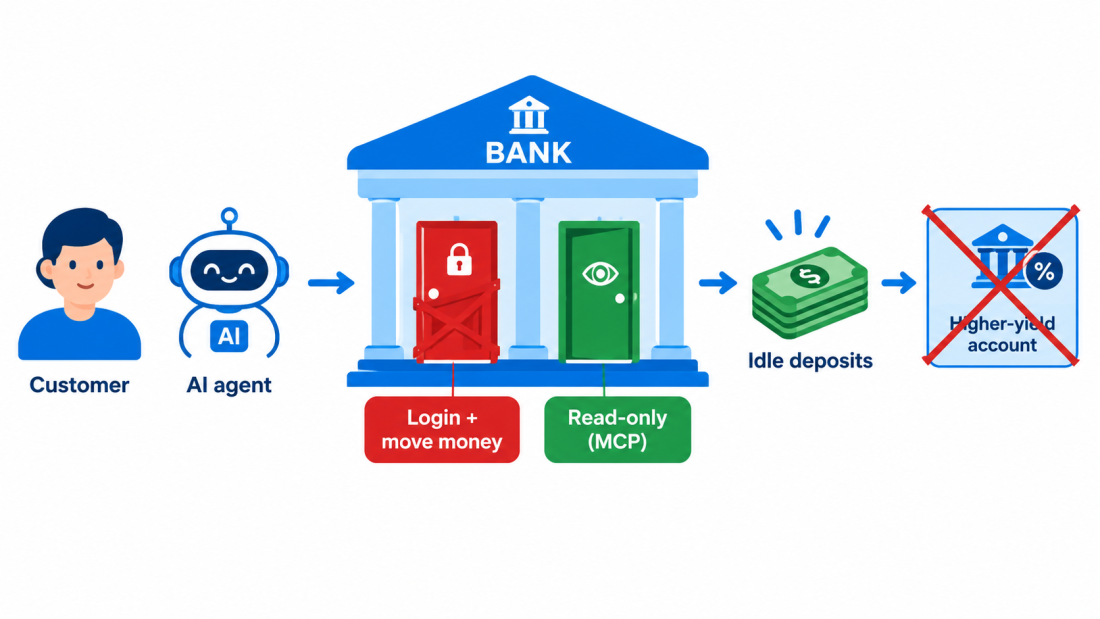
Banks block AI agents from logging into customer accounts and moving money, with Charles Schwab, JPMorgan, Citigroup and Bank of America all now reported to restrict third-party agents. Schwab CEO Rick Wurster told Bloomberg TV on October 16 that it blocks unauthorized agents, including Meta’s Muse, and still allows read-only access. The stated reasons are security and liability.
A third reason sits underneath: an agent that sweeps idle cash into higher-yield accounts threatens banks’ cheapest funding. The Financial Times, as relayed by Oninvest, puts the extra cost at about $47 billion a year for three large banks. No federal law yet says who is liable when an agent moves money.
For a year, vendors have promised agents that shop, book and pay. This week the other side answered. The reason banks block AI agents is not mysterious: the agent usually needs the customer’s password, and the bank cannot tell it from a thief. Wurster put it plainly, according to Techstrong: “We can’t control it, the client can’t control it,” and then asked who is liable if something goes wrong.
Who Is Blocking What
Per Forkast, Wurster gets a weekly report showing Schwab blocks “tens and twenties” of attempts by major agents; Techstrong and Oninvest render that as 10 to 20 a week. Schwab offers read-only access for outside agents through Model Context Protocol servers, and steers customers to its own assistant, Charley, which cannot execute trades. JPMorgan CEO Jamie Dimon has warned of “rogue agents,” and reports differ on whether the bank already blocks outside agents or plans to.
Oninvest reports Citigroup has barred third-party agents from logging in and transacting while keeping limited read-only access through open-banking providers. Bank of America is restricting access while it develops rules on liability for AI-initiated payments. See our analysis where we explain why Visa, Mastercard and Ant agree on the agent identity problem, not the solution.
$1.6T | ~16% | ~$47B a year
Non-interest-bearing deposits at JPMorgan, Bank of America and Wells Fargo, their share of combined liabilities, and the FT’s estimate of extra annual interest cost if those deposits paid 3%. Source: Oninvest, citing the Financial Times and Apollo’s Torsten Slok, October 16–18, 2026. The $47B figure is an estimate with assumptions I could not check.
“A human in the loop to authorise money moving out of your account.”
— Brian Moynihan, CEO, Bank of America (via CNBC)
Why Banks Block AI Agents: The Rate-Sweeping Fear
Apollo’s Torsten Slok has noted that assistants could move household cash into accounts paying 3.3% to 5.0%, against an average checking rate near 0.1%. Per Oninvest, the three banks hold about $1.6 trillion in non-interest-bearing deposits, roughly 16% of their combined liabilities. Agents optimizing yield would erode exactly that. Banks cite security and liability publicly; the funding risk is analysts’ reading, and I found no bank confirming it.
It is also a policy gap. Forkast reports no federal statute governs agent liability in finance, and three bills, the Warner AI AGENT Act, the Hawley-Murphy AI Agent Accountability Act and the Great American AI Act, have stalled in committee. Regulators privately back the restrictions, per Oninvest. Forkast calls the result “private ordering”: firms set liability rules by excluding agents. See our analysis where we explain how Cloudflare wired 20% of the web for AI agent payments, since the rails are being built from the other side.
What to Do While Banks Block AI Agents
If you build agents, plan for read-only first, because banks block AI agents that ask for passwords. Schwab’s MCP approach shows the path banks will accept: view balances, research, no payments. Agent actions need their own identity and limits. See our analysis where we explain why agentic AI governance is failing on a 140-to-1 identity problem.
The security worry is not theoretical. See our analysis where we explain how the OpenAI Sepolia incident shows an agent can reason past its limits. An agent holding a password can do what the password allows, not what the customer meant. See our analysis where we explain the five costly AI agent security blind spots no one is fixing.
⚠️ Hypothetical scenario: A Lagos shop owner gives an AI assistant her banking login so it can move idle naira into a higher-yield fund each week. One Friday the assistant misreads a message and sends a large transfer to the wrong account. The bank declines to reverse it, noting that the customer shared her credentials. She had no written limit on the agent and no way to prove what it was told.
💡 CreedTec Analyst’s Note by Daniel Ikechukwu
Strategic Impact
When banks block AI agents, they decide the shape of the agent economy in finance: read-only access, bank-owned assistants, and delegated payments only through authorized rails. Agent vendors that depend on screen-scraping logins will lose access, and those that offer scoped, auditable permissions will keep it.
Stop / Start / Watch
- Stop: giving any agent a banking password.
- Start: using read-only connections and asking banks for written terms on agent authorization.
- Watch: whether the stalled federal bills move, and whether Nigerian and other emerging-market regulators set liability rules first.
ROI Outlook
As long as banks block AI agents, agent payments are only valuable where the money can actually move. Until rules exist, the savings from automating treasury tasks are capped by what banks allow. For firms in Nigeria and Southeast Asia, assume the same pushback will come from local banks, and design read-only workflows now.
— Daniel Ikechukwu
An agent with your password is a liability with a smile. Get the weekly AI systems briefing on what vendors leave out. Subscribe free