This article is part of CreedTec’s Enterprise Automation TCO Week, a 4-day analytical series breaking down the hidden financial metrics behind the world’s largest Industrial AI and robotics ecosystems.
Fast Facts
ABB RobotStudio’s virtual twin cuts deployment costs by up to 40% and compresses time to market by up to 50%. Those numbers are documented and sourced. The gap in most factory capital recovery models isn’t the platform — it’s that CFOs build payback calculations against hardware cost alone, leaving the simulation’s error-prevention value entirely unaccounted for.
📊 By the Numbers
- Up to 40% — Deployment cost reduction from pre-validating automation cells in RobotStudio HyperReality before hardware installation (ABB/NVIDIA, March 2026)
- Up to 50% — Time-to-market acceleration achieved through virtual commissioning in the ABB/NVIDIA RobotStudio partnership (ABB/NVIDIA, March 2026)
- 80% — Reduction in programming cycle time reported by Foxconn engineers using RobotStudio for electronics assembly line virtualisation (AI CERTs, March 2026)
- 60,000 — Active engineering seats running RobotStudio globally, making it the most widely deployed industrial robot simulation platform (ABB, 2026)
The financial case for ABB RobotStudio virtual twin ROI has always been logical. Test in simulation, eliminate physical errors, deploy faster. What the logic rarely captures is the asymmetry of costs — the fact that a single avoided commissioning error can outvalue months of simulation subscription fees. That asymmetry is where the real capital recovery argument lives, and most factory ROI models aren’t built to see it.
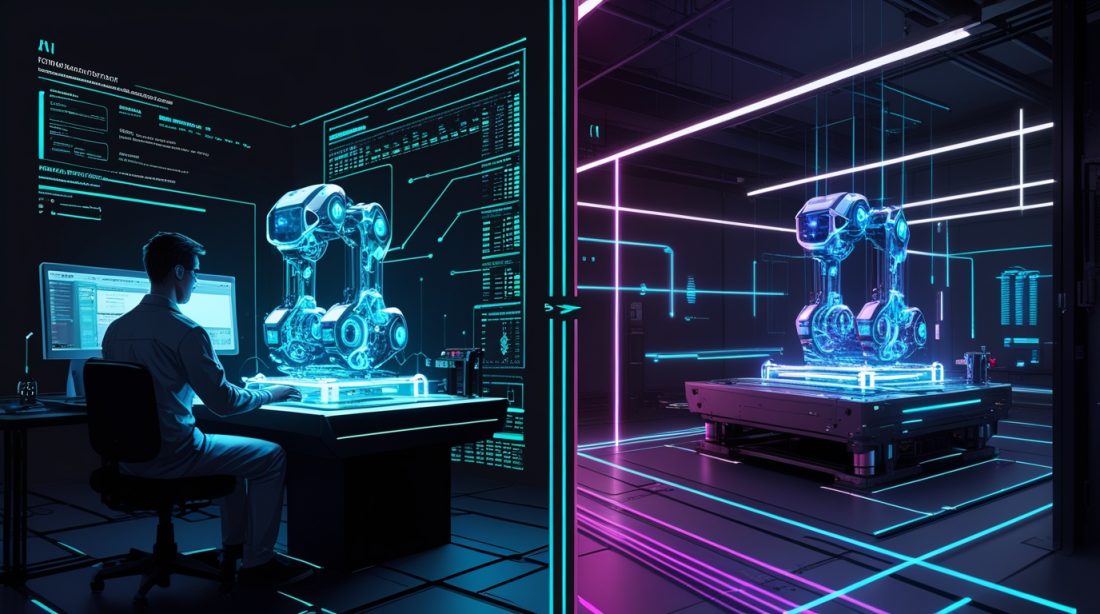
In March 2026, ABB and NVIDIA formalised what RobotStudio users had been proving in practice: that physically accurate simulation, embedded with Omniverse-grade physics, makes the virtual-to-physical transfer reliable enough to base production timelines on. The financial implications of that reliability are larger than the deployment cost savings headline suggests.
The Error You Don’t Make Is the Investment That Pays Fastest
Virtual commissioning’s financial logic starts with prevention, not efficiency. AMD Machines, a 30-year industrial automation integrator working with ABB RobotStudio, documented a single robot reach issue caught in simulation that would have cost $180,000 in expedited tooling modifications and three weeks of on-site rework if discovered after physical installation. The simulation caught it before a single piece of hardware was moved.
That $180,000 error-prevention event is not an outlier — it is the representative case for high-mix, high-tolerance assembly environments. Photorealistic digital twin training applications cut costs precisely because they surface these errors in the cheapest possible environment — before physical assets are committed. The capital recovery model that only counts deployment cost reduction misses this entirely.
Foxconn’s 80% Programming Gain Is the Procurement Number Worth Quoting
When ABB and NVIDIA launched RobotStudio HyperReality in early 2026, Foxconn’s pilot result gave procurement teams a concrete benchmark: engineers finished electronics assembly line programming 80% faster than standard cycles by virtualising the entire workflow before touching hardware. For a facility where programming downtime has a direct throughput cost, that compression has a calculable dollar value per line.
Marc Segura, President of ABB Robotics, framed the technical achievement clearly: “Combining RobotStudio with the physically accurate simulation power of NVIDIA Omniverse libraries, we have closed technology’s long-standing sim-to-real gap — a huge milestone to deploying physical AI with industrial-grade precision, for real-world customer applications.” That gap closure is what makes the Foxconn result transferable — the simulation metric that cuts factory AI costs is only reliable when the physics model is accurate enough to trust at deployment.
“High-fidelity simulation lets AI practice safely, then transfers learning without surprises.”
— Deepu Talla, VP for Robotics, NVIDIA — RobotStudio HyperReality Launch, 2026
The CFO Model That Misses Half the Return
Most capital approval models for robot simulation software follow the same structure: license cost versus projected deployment time savings. That framing captures roughly half the return. The other half — error prevention value, physical testing elimination, rework avoidance, and compressed validation cycles — doesn’t appear in a standard ROI template because it’s measured in costs that don’t occur, not costs that do.
Robotics simulation is now replacing physical prototyping across tier-one manufacturers precisely because the prevented-cost calculation is becoming easier to model. ABB’s documented 30% implementation time reduction from digital twin commissioning gives finance teams a conservative anchor. The Foxconn 80% programming efficiency gain gives them a ceiling. The honest capital recovery model sits somewhere between those two numbers — and either figure justifies the investment before error prevention is even added to the ledger.
⚠ Fiction — Illustrative Scenario
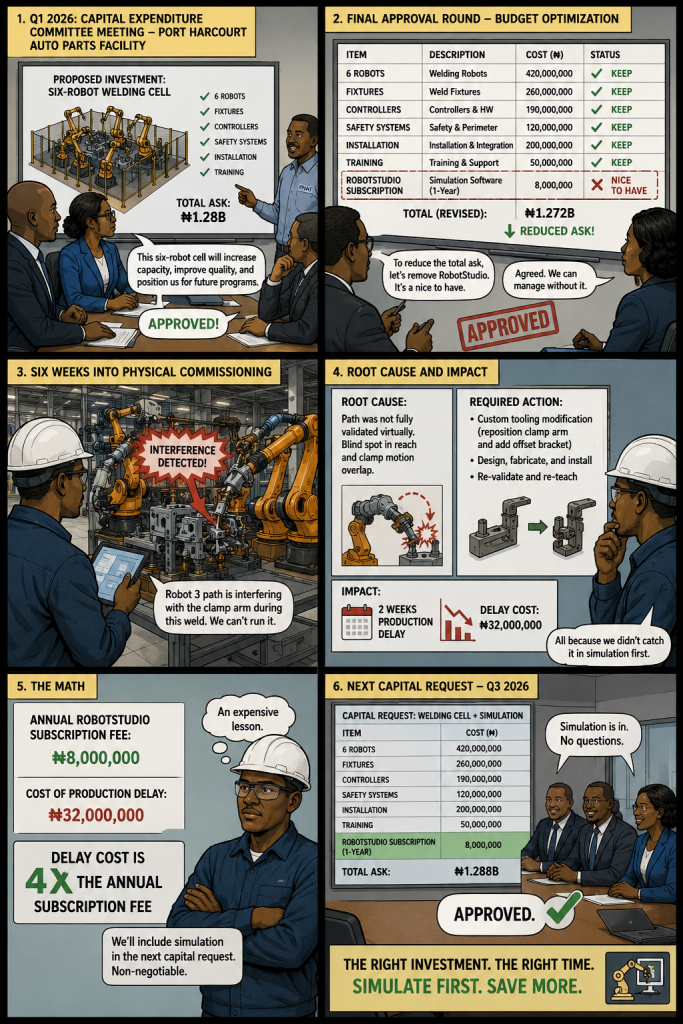
A capital expenditure committee at a Port Harcourt auto parts facility approves a six-robot welding cell in Q1 2026. The RobotStudio subscription is flagged as a “nice to have” and removed from the budget in the final approval round to reduce the total ask. Six weeks into physical commissioning, a path interference issue surfaces that requires custom tooling modification and two weeks of production delay. The cost of that delay exceeds the annual RobotStudio subscription fee by a factor of four. The next capital request includes the simulation line item. It passes without discussion.
The Emerging Market Case Is Stronger Than the Global Average
For facilities in Nigeria, Ghana, and Southeast Asia, the ABB RobotStudio capital recovery argument carries an additional weight that global benchmarks understate. In markets where specialised robotics engineers are scarcer and on-site rework costs carry longer delays due to parts availability and logistics constraints, the value of catching a commissioning error in simulation — rather than on the floor — is structurally higher than in a facility two hours from a major European integrator.
The physics simulation bottleneck that limits transfer accuracy in standard simulators is precisely what the ABB/NVIDIA HyperReality partnership addresses — and its value is proportional to the cost of getting it wrong in production. The sim-to-real transfer problem that has historically limited simulation confidence is now being closed by the same platform emerging market facilities are being offered for the first time.
💡 CreedTec Analyst’s Note
Daniel Ikechukwu — Strategic Impact
The ABB RobotStudio virtual twin ROI case is stronger in 2026 than at any prior point — not because the platform is newer, but because the sim-to-real accuracy gap that previously undermined confidence in virtual commissioning is now being directly addressed by the NVIDIA Omniverse integration. The financial argument has always been sound. The technical credibility to back it is catching up. Procurement teams that deferred simulation investment on accuracy grounds now have documented evidence that the gap has closed.
- Stop: Calculating robot deployment ROI against hardware cost and deployment time savings alone. Error prevention value must be in the model — it frequently exceeds both.
- Start: Requesting a virtual commissioning pilot on the next automation cell before hardware procurement is finalised. The pilot cost is recoverable from a single avoided rework event.
- Watch: ABB’s consumption-based pricing model for RobotStudio HyperReality — aligned with cloud GPU hours rather than flat subscription — which may shift the cost structure for smaller deployments and emerging market facilities significantly.
ROI Outlook: For facilities running high-mix or precision assembly environments, the virtual twin ROI case is compelling within 12 months at ABB’s documented 40% deployment cost reduction [1]. Waiting until physical commissioning to discover a collision error is no longer an engineering mistake—it is a boardroom failure.
Frequently Asked Questions
How does ABB RobotStudio’s virtual twin actually generate capital recovery?
Through three mechanisms: reduced deployment costs (up to 40% per ABB’s documented benchmarks), compressed commissioning timelines (up to 50% faster time to market), and error prevention value — the cost of physical rework events that simulation catches before hardware is installed. The third mechanism is often the largest but the least modelled in standard capital approval processes.
What should procurement teams include in an ABB RobotStudio ROI model?
Four line items: subscription or GPU-consumption cost, projected deployment time savings at the 40% benchmark, programming efficiency gains (the Foxconn 80% figure is a documented ceiling for electronics assembly), and an error prevention value calculated from the average cost of one commissioning rework event in your specific production environment. Most standard models only include the first two.
Does the ABB/NVIDIA HyperReality platform change the ROI case versus standard RobotStudio?
Yes — materially. The Omniverse physics integration closes the sim-to-real accuracy gap that historically forced conservative safety margins in virtual commissioning. Higher simulation accuracy means virtual results can be trusted more directly at deployment, which reduces the physical validation layer that eroded the time savings case for standard simulation tools.
Robotics capital analysis, simulation ROI frameworks, and deployment strategy — built for engineers and CFOs who need the numbers, not the pitch.