Fast Facts
Unitree rideable wall smashing robot, here: Unitree Robotics’s GD01—a rideable, wall-smashing mecha priced at 3.9 million yuan ($540,000–$650,000)—went viral in May 2026. But the machine isn’t the product. It’s a brand halo for a $7 billion IPO, designed to justify a valuation that competitors can’t touch. The real money flows through state procurement contracts like State Grid Corporation of China’s 6.8 billion yuan order, where Unitree’s 60% gross margins make every Western robotics firm’s business model look fragile.
Why Everyone Missed the Real Product
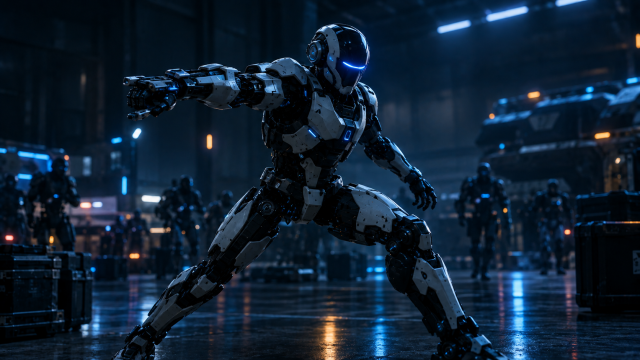
On May 12, 2026, Unitree Robotics released footage of the GD01—a 2.8-meter, 500-kilogram piloted mecha that walks on two legs, folds into a quadruped stance, and punches through cinder block walls. Elon Musk replied on X: “Cool.”
Unitree’s rideable wall-smashing robot dominated headlines. Coverage focused on the spectacle: the first production-ready manned mecha. A dream for anyone raised on Gundam, Pacific Rim, or Transformers. But the machine isn’t the product. The product is the IPO narrative.
Unitree Robotics filed for a $7 billion listing on the STAR Market in March 2026, seeking to raise 4.2 billion yuan ($610 million). The GD01 is a valuation device. As one Chinese industry analysis put it: “This press conference wasn’t about selling a product—it was a valuation roadshow. Define Unitree not as a hardware company, but as the only Chinese firm delivering a manned mecha, and the valuation ceiling disappears.”
Why the GD01 Is a Narrative Machine, Not a Revenue Machine
The math is unforgiving. Even at 10 units sold annually, the GD01 would generate just 39 million yuan in revenue—a rounding error against Unitree’s 1.71 billion yuan in 2025 sales.
But the GD01 is priced not for volume but for perception. It sits at the top of a product ladder: the Unitree Go2 at $1,600, the Unitree G1 at $15,000, the Unitree H2 at $29,900, and then the GD01 at $650,000. Each rung pulls the Unitree Robotics brand upward. The GD01 tells investors: “We can build what nobody else can.”
“The unveiling has sparked discussions regarding its market positioning, technological maturity and future prospects.” — Xinhua News Agency
Unitree has not disclosed battery life, maximum speed, payload capacity, or operating duration for the GD01. A marketing staff member acknowledged that “the price remains high, but it is only a preliminary reference as further functional improvements and cost reductions will take time.” The company explicitly describes the GD01 as a civilian platform and warns users to operate it in a “friendly and safe manner”—a disclaimer that itself signals the product is more marketing than market-ready.
Why the Real Money Flows Through State Procurement, Not Spectacle
While the GD01 grabbed headlines, Unitree has been quietly stacking state-backed procurement contracts. A subsidiary of China Mobile ordered $17.3 million worth of humanoid robots from Unitree and AgiBot in 2025—the largest single order in humanoid robot history.
Then came State Grid Corporation of China’s 2026 Embodied Intelligence Development Plan: a centralized procurement of 8,500 intelligent devices with a total investment of 6.8 billion yuan. The breakdown: 5,000 quadruped inspection robot dogs (1.5 billion yuan budget), 500 humanoid live-line work robots (2.5 billion yuan), and 3,000 dual-arm inspection robots (1.8 billion yuan). Unitree is listed among the selected suppliers alongside Deep Robotics, Zhipu, and Fourier.
This is the real economic engine. The GD01 spectacle builds brand recognition that helps secure state contracts. It’s a flywheel: viral attention → brand authority → procurement wins → revenue growth → IPO valuation.
Why Competitors Should Fear the Supply Chain, Not the Mecha
Unitree posted revenue of 1.71 billion yuan in 2025—a 335% year-on-year increase—with adjusted net profit of 600 million yuan. Gross margins approach 60%. For comparison, Tesla’s automotive gross margin hovers around 18%.
The secret sits in Unitree’s cost structure. Externally purchased components account for only 14–18% of costs. The company develops its own motors, reducers, dexterous hands, and LiDAR sensors. Unitree leverages China’s EV supply chain, where 40–60% of humanoid robot components overlap with electric vehicle parts—a sector where China holds global leadership.
“Unitree’s cost of making quadruped robots is lower than the selling price of comparable products from some other robot makers.” — 36Kr, citing an industry source
The GD01’s real message to competitors is not “we built a mecha.” It’s “we can build anything at margins you cannot match.”
The Desire Behind the Machine
⚠ Fiction: When Leo, a 34-year-old software engineer, watched the GD01 video, his hands gripped the phone tighter. He wasn’t calculating ROI. He was ten years old again, sitting cross-legged on a carpet, watching Optimus Prime transform on a CRT television. For a split second, the $650,000 price tag felt almost reasonable—because what price do you put on a childhood dream made metal?
The GD01 monetizes a power fantasy decade in the making. Mecha anime and science fiction films have spent generations conditioning audiences to desire piloting a giant robot. Unitree didn’t create this desire—it harvested it. The 3.9 million yuan price tag sits deliberately at the intersection of “unobtainable luxury” and “justifiable institutional purchase,” borrowing positioning from luxury automobiles and yachts.
Global Implications: The IPO That Redefines the Market
Unitree controls roughly 70% of the global quadruped robot market, having shipped over 23,700 units in 2024 and more than 5,500 humanoid robots in 2025—outselling Tesla. Chinese firms accounted for nearly 90% of global humanoid robot sales in 2025, with over 140 manufacturers and 330 models.
If Unitree’s IPO succeeds at a $7 billion valuation, it will create a pricing umbrella that Western competitors cannot match. The company that builds robots at 60% margins while others lose money will set the global cost baseline. Every procurement office evaluating robotics contracts will benchmark against Unitree’s prices—and most Western alternatives will fail the comparison.
💡 CreedTec Analyst’s Note
By Daniel Ikechukwu
Strategic Impact: The GD01 is a masterclass in valuation narrative engineering. Unitree has separated brand spectacle from revenue reality and used the former to inflate the latter. Western robotics firms that compete on engineering specs are playing the wrong game—they need competing narratives.
Stop / Start / Watch:
- Stop evaluating Unitree by the GD01’s commercial viability. It was never meant to generate meaningful revenue.
- Start tracking Unitree’s state procurement wins. The China Mobile and State Grid contracts reveal the real revenue pipeline.
- Watch the STAR Market IPO. If Unitree prices successfully at $7 billion, expect a wave of Chinese robotics IPOs that will reshape global capital flows.
ROI Outlook: Organizations benchmarking robotics procurement should model against Unitree’s pricing as the global floor. A $15,000 humanoid with 60% margins resets what “competitive” means for every industrial robotics RFP.
FAQ
How much does the Unitree GD01 cost?
The starting price is 3.9 million yuan, approximately $540,000–$650,000 depending on exchange rates.
Is the GD01 actually for sale?
Yes. Unitree confirmed to Wired that the GD01 is a genuine product available for purchase, though key specifications remain undisclosed.
What is the GD01 useful for?
Unitree markets it for industrial operations, emergency rescue, and cultural tourism. Practical applications remain unproven.
How does Unitree make money if the GD01 is just a marketing tool?
Unitree’s revenue comes primarily from its quadruped robot dogs (Go, A, B series) and humanoid robots (G1, H2, R1), which generated 1.71 billion yuan in 2025 revenue at 60% gross margins.
What’s the procurement angle for industrial buyers?
Unitree’s real commercial strength is in state-backed procurement contracts. State Grid’s 2026 plan allocates 6.8 billion yuan for embodied intelligence equipment, and Unitree is a key supplier alongside other domestic robotics firms.
Should Western procurement teams be concerned?
Yes. Unitree’s cost structure—with only 14–18% externally purchased components—creates a pricing floor that Western competitors cannot match without fundamental supply chain restructuring
Further Reading
- 5 Reasons Humanoid Robot ROI Drives the 2026 Cost-Saving Shift
- Humanoid Robot Paid Job: Simulation Training Cuts Costs by 40%
- South Korea Robot Density Supply Chain Risk 2026
- China’s Cat-Like Robot Dog Mid-Air Jump Technology
- Beijing Humanoid Robot Half-Marathon World Record 2026
📩 Don’t Let a $650,000 Marketing Stunt Distort Your Procurement Calculus
Join the CreedTec newsletter for weekly briefings on robotics market economics, state procurement intelligence, and IPO-driven valuation strategies that reshape global supply chains. The spectacle gets headlines. We give you the numbers.
[Subscribe Now]