🔴 Update — June 10, 2026
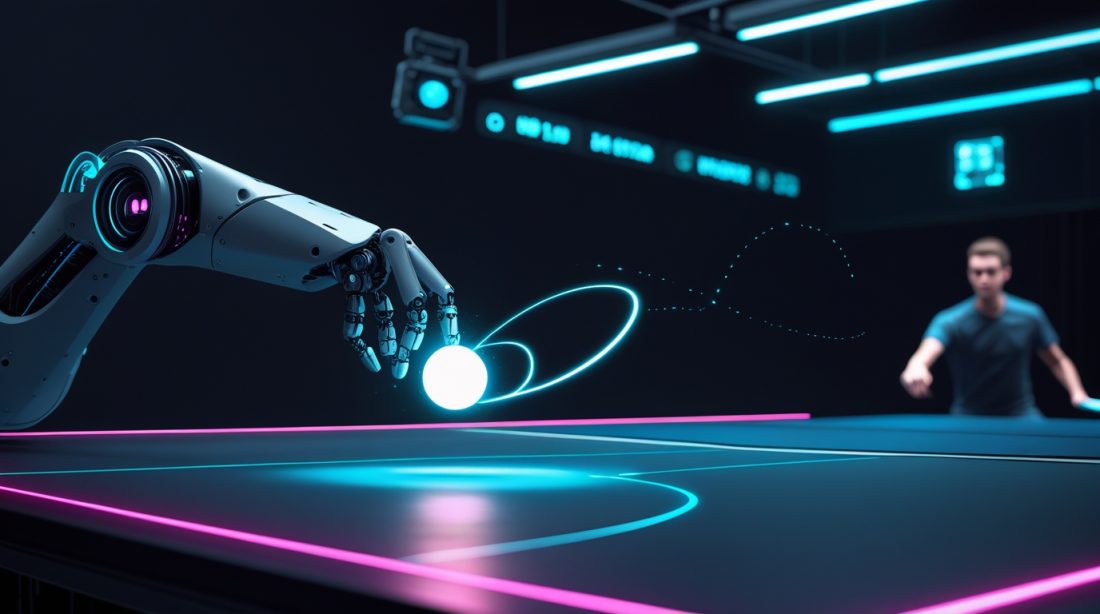
Sony Project Ace’s sim-to-real robot training update: Sony AI has published results from matches played between February and April 2026. Ace won against seven ranked professional players, including World No. 26 Miyuu Kihara and two-time Olympic silver medalist Miu Hirano (best world ranking: #5). Hirano said afterward: “It’s really strong. Is there really anyone who can beat this?” The technical improvements that made this possible — including updated physics models across all three simulation layers — directly validate the original argument of this article.
Fast Facts
- Sony AI published Project Ace in Nature on April 23, 2026
- First autonomous robot to beat elite human table tennis players
- Every outlet covered the win. Nobody covered what broke first
- The simulation physics model overestimated drag forces for fast shots
- The robot trained to overshoot the table in real matches
- Sony had to rebuild the physics model before the training pipeline worked
- 🔴 NEW: In December 2025, Ace won its first match against a professional player
- 🔴 NEW: Feb–April 2026: Ace beat 7 ranked professionals under official rules
- 🔴 NEW: Wins include World No. 26 Kihara and Olympic silver medalist Hirano (#5)
- 🔴 NEW: All three physics models (aerodynamics, table, racket) were updated to reach professional level — confirming this article’s original argument
📊 By the Numbers
| Stat | Value |
|---|---|
| 3/5 | Match wins vs elite players — initial Nature evaluation (April 2025) |
| 75% | Spin return rate — 450 rad/s shots handled |
| 200Hz | Ball tracking frequency — 8.5ms latency (improved from 10ms) |
| 19.6m/s | Max ball return velocity — professional-level speed |
| 7 | Professional players defeated in follow-up trials (March 2026) |
🔴 Ranked professional players beaten, Feb–April 2026 — including World No. 26 and World No. 5
TL;DR
Sony Project Ace’s sim-to-real robot training produced the first autonomous system to beat elite human table tennis players — published in Nature on April 23, 2026. But the most instructive part of this story isn’t the win. It’s what broke first: a physics model that overestimated aerodynamic drag for high-velocity shots, training the robot to miss the table. Sony fixed it, scaled it, and by April 2026 had beaten seven ranked professional players — including two-time Olympic silver medalist Miu Hirano. All three physics models had to be updated to get there.
The Simulation Failure Nobody Reported
Project Director Peter Dürr gave an unusually candid account of what went wrong during development. The team’s physics model — the simulation environment Ace trained in — worked well for slower shots. For high-velocity professional-level strikes, it overestimated drag forces. That single error meant the robot trained to return fast balls at trajectories that overshot the table entirely in real-world conditions. Simulation said it would land. Reality said it wouldn’t.
This is the sim-to-real gap in its most expensive form. Not a small generalisation error at the edges of the policy’s capability — a systematic failure at the exact speed range where elite competition actually happens. According to Sony AI’s own project blog, catching and correcting this required rebuilding the physics model for high-speed ball dynamics before the training pipeline could produce a robot capable of sustained elite-level competition.
The fix wasn’t algorithmic. It was physical — getting the drag coefficients right for balls travelling at 19.6 metres per second with 450 rad/s of spin. Only after that correction did the reinforcement learning produce policies that transferred from simulation to reality with the precision the competition environment demands. The physics simulation bottleneck that plagues robotics training showed up in one of the most sophisticated sim-to-real projects ever attempted — and it nearly broke the outcome.
What the Perception Architecture Actually Did
Once the physics model was corrected, Ace’s perception system could do its job. Nine high-speed cameras tracked the ball in 3D at 200Hz with 3.0mm accuracy and 10.2ms latency. Three event-based vision sensors using Sony IMX636 chips tracked spin at up to 450 rad/s — the kind of rotation that makes a table tennis ball behave like a moving physics problem most robots couldn’t even see, let alone return.
“This breakthrough is much bigger than table tennis. It represents a landmark moment in AI research, showing, for the first time, that an AI system can perceive, reason, and act effectively in complex, rapidly changing real-world environments.”— Peter Stone, Chief Scientist, Sony AI — Nature publication, April 23, 2026
The model-free reinforcement learning approach handled the decision layer — not rule-based shot selection, but a policy that learned through trial and error in simulation which shot to play given ball trajectory, spin state, and opponent position. A three-layer strategy architecture handled skill, tactics, and match strategy as integrated outputs rather than separate modules.
Professional player Kinjiro Nakamura noticed something unexpected during matches: Ace occasionally played shots that no human player had used before. Not mistakes — novel solutions the policy had discovered in simulation that happened to work in reality. Zero-shot sim-to-real transfer research has been chasing this property — Ace demonstrated it under the hardest real-world conditions available.
The Industrial Transfer Logic
Table tennis has a specific set of properties that make it a useful industrial proxy: high-speed object tracking, contact under physical uncertainty, adversarial unpredictability, and millisecond reaction requirements. These are precisely the conditions that make robotic manipulation in unstructured industrial environments hard — assembly tasks with variable component placement, pick-and-place in dynamic environments, quality inspection on fast-moving lines.
⚠ Fiction — Illustrative Scenario
A manufacturing engineer at an electronics assembly plant in Penang watches the Ace paper get published. Her team has been trying to train a robotic arm to handle components that arrive on the line at variable orientations and speeds. The physics model failure Sony documented, and how they fixed it, gives her a direct diagnostic framework for why their own sim-to-real transfer produces robots that handle slow-speed tasks well but degrade at production line speeds. The sports robot gave her the industrial debugging playbook.
Sony AI’s perception hardware — the event-based vision sensors that track spin at 450 rad/s — is directly applicable to high-speed industrial quality inspection. Detecting surface defects at production line speeds requires exactly the same low-latency, high-frequency visual processing Ace uses to track a spinning ball. The robot training data pipeline that supports this kind of perception system is where the next wave of industrial deployment investment is going.
🔴 After the Nature Paper: Professional Players Beaten (June 2026 Update)
When the Nature paper was published in April 2026, Sony AI was explicit: Ace had reached elite level but not professional level. That changed faster than the team publicly indicated.
In December 2025 — while the Nature paper was still under embargo — Ace won its first match against a professionally ranked player. Between February and April 2026, the team ran a structured campaign against nine opponents. According to Sony AI’s June 10 follow-up post, Ace won matches against seven of those nine players, all under official ITTF competition rules with licensed umpires.
The highest-ranked opponent was Miyuu Kihara, currently World No. 26 in women’s singles. Ace won 100% of matches against her. The most notable result came against Miu Hirano — a two-time Olympic silver medalist with a best world ranking of No. 5. Ace won 100% of matches against Hirano as well.
| Player | Best World Ranking | Date (2026) | Ace Win Rate |
|---|---|---|---|
| Nagao | #195 | Feb 17 | 100% |
| Shiomi | #32 | Feb 26 / Mar 18 | 75% / 100% |
| Ono | #296 | Mar 4 | 0% |
| Okano | #179 | Mar 18 | 100% |
| Kihara | #13 | Mar 25 | 100% |
| Ryuzaki | #99 | Mar 25 | 33.3% |
| Igarashi | #211 | Mar 25 | 50% |
| Hirano | #5 | April 21 | 100% |
“I think this robot has the potential to rank in the top ten among women. In a steady rally, the robot doesn’t make any mistakes at all.”— Miu Hirano, two-time Olympic silver medalist, best world ranking #5, after losing to Ace (April 21, 2026)
Hirano’s post-match assessment carried an observation that goes beyond competitive evaluation. On facing a robot versus a human opponent:
“When playing against a human, it’s easy to spot weaknesses. Because people have emotions and psychology, I think things like, ‘If I serve here, they’ll definitely be waiting there.’ But with a robot, I can’t engage in that kind of mind game. Robots have no emotions. Even if it makes a mistake, it just resets.”— Miu Hirano, Sony AI Project Ace blog, June 10, 2026
She also noted: “Until now, table tennis machines have been on a completely different level from human players, so I’d never seen adult players use them, but at this level, it’s truly usable for practice. If this robot were installed at the training facilities of top players, I think there would probably be players who’d want to use it for practice.” That is the first time a top-ranked professional player has described a robotic system as viable training infrastructure at their level.
🔴 The Technical Improvements — and Why They Confirm the Original Argument
The improvements Sony made between the April 2025 Nature matches and the February–April 2026 professional matches are the most important part of this update for anyone building sim-to-real robotics systems — because they directly validate the original argument of this article.
All three physics models were updated. Sony updated the aerodynamics model, the table contact model, and the racket contact model. Both the analytical physics equations and the machine learning correction layers for each were improved. The need for updates across all three simultaneously demonstrates what the article argued in April: the physics model is not a one-time fix. It is an iterative constraint that must keep pace with the operating conditions being trained on.
The neural network scaled significantly. Policy network weights increased approximately 2x to ~4.5 million parameters. The critic network scaled approximately 8x to ~51.5 million parameters. A single policy network replaced the bank of separate networks used in the original Nature matches, producing nine distinct skills while eliminating the variance from sampling multiple networks.
Serve optimization switched from Genetic Algorithm to Bayesian Optimization — a probabilistic model that learns what makes a serve competitive and samples toward novelty. This produced a higher-variety serve game that transferred more reliably from simulation to reality.
Hardware saw a further 4kg weight reduction through extended topology optimization of base components, alongside motor upgrades to the first and second joints for higher torque and acceleration. This directly improved Ace’s ability to generate spin — the dimension where professional players still outperform the system.
Perception latency improved from ~10ms to ~8.5ms — a 15% reduction that meaningfully changes reaction time at professional-level ball speeds.
The through-line: every improvement traced back to either physics model accuracy or hardware capability under physical load. Neither was a software-only fix. This is the sim-to-real gap in its full form — physics, hardware, and policy must improve together, and they must improve at the velocity ranges the operational environment actually demands.
What Ace Has Not Solved Yet
Hirano assessed that Ace “still around 50th place” among men’s players — competitive but not dominant. Ono (#296) beat Ace in the February 2026 session. Ryuzaki (#99) won two of three matches. The spin generation gap remains: Sony’s own data shows that professional players generate substantially higher spin values than Ace can currently produce, even as ball speed has equalized. If spin generation is the hallmark of elite-to-world-class performance, it is the remaining technical frontier.
Ace also still tends to hit earlier after the bounce than human players — a behavior that “just emerged” from the learning process. The team expects this to improve as exploration broadens. These are not failures; they are the documented boundaries of the current system. That kind of transparency is itself a contribution to the sim-to-real research community.
💡 CreedTec Analyst’s Note
By Daniel Ikechukwu — Updated June 25, 2026
Strategic Impact: The professional player victories confirm what the original article argued: physics model accuracy is the critical variable in sim-to-real transfer quality — and the gap it creates is systematic, not marginal. Sony’s June update is the first documented case of a robotic system beating a top-10 world-ranked player under official rules. For robotics teams building high-speed manipulation systems, the Ace publication trail is now the most complete public record of what sim-to-real transfer failure looks like, how to diagnose it, and what fixing it produces.
- ⛔ Stop: Assuming simulation failures manifest as visible performance degradation at normal operating speeds. Sony’s drag force error produced a robot that trained well and failed specifically at the high-velocity edge. Industrial equivalents — failure at production line speed rather than slow-speed testing — follow the same pattern. The Ace experience is a named failure mode now.
- ✅ Start: Treating physics model validation at full operational velocity ranges as a mandatory, iterated step — not a one-time commissioning check. Sony updated all three physics models twice across the project lifetime. Industrial teams running high-speed manipulation pipelines should plan for the same.
- 👁 Watch: Spin generation as the next frontier. Sony’s data shows ball speed has equalized between Ace and professionals, but spin has not. The robotics teams that close the spin gap will reach world-champion level performance. The hardware implications — joint torque, racket surface, actuation dynamics — are the same categories that limit industrial manipulation robots in high-dexterity tasks.
ROI Outlook: The direct commercial value of Ace remains in its transferred technologies: event-based vision sensors validated at elite physical AI tasks; model-free RL with iterated physics models producing reliable real-world generalisation; and the failure documentation trail that is now the most complete public debugging reference for high-speed sim-to-real gaps in the robotics industry. Hirano’s assessment — that Ace is now viable training infrastructure for top professional players — is the first ROI signal from a physical AI system that an elite human practitioner has accepted as operationally useful.
Frequently Asked Questions
What is Sony Project Ace and what did it achieve?
Project Ace is Sony AI’s autonomous robot table tennis system, published in Nature on April 23, 2026. It is the first autonomous system to beat elite human table tennis players under official ITTF rules. As of April 2026, it has also beaten seven professionally ranked players including World No. 26 Miyuu Kihara and two-time Olympic silver medalist Miu Hirano (best world ranking #5).
What was the physics model failure in Project Ace’s sim-to-real training?
Sony’s simulation overestimated aerodynamic drag forces for high-velocity shots. This trained the robot to return fast balls at trajectories that overshot the table in real matches. The error was identified through competition with increasingly strong human opponents, and the physics model was rebuilt before the training pipeline produced competition-ready performance. To reach professional-player level, all three physics models — aerodynamics, table contact, and racket contact — required further updates.
Has Ace beaten professional table tennis players?
Yes. Between February and April 2026, Ace won matches against seven ranked professional players under official competition rules. This includes World No. 26 Miyuu Kihara (100% win rate) and two-time Olympic silver medalist Miu Hirano (best world ranking #5, 100% win rate). Ace lost to Ono (#296) and achieved a mixed record against Ryuzaki (#99) and Igarashi (#211).
Has Ace reached world-champion level?
Not yet. Hirano assessed Ace at approximately top-10 women’s level and around 50th place in men’s — competitive but not dominant at the highest tier. The remaining technical gap is primarily spin generation: Sony’s data shows professional players still generate substantially higher spin values than Ace can currently produce, even though ball speeds have equalized.
What industrial applications does this research point toward?
Three direct transfer areas: high-speed visual inspection using event-based sensors at production speeds; manipulation in dynamic environments using model-free RL trained on variable physical interactions; and sim-to-real training methodology for high-velocity tasks, where Ace’s iterated physics model correction process is the most complete public diagnostic template for industrial teams experiencing degradation at operational speeds.
What should robotics procurement teams take from the Ace research? (Commercial question)
When evaluating vendors’ sim-to-real training claims, ask specifically about physics model validation at your operational velocity ranges — and ask whether the physics models are updated across the full simulation stack (environment physics, contact dynamics, actuator dynamics). Sony updated all three model layers twice. Industrial manipulation robots trained in simulation may carry systematic failure modes that only appear at production line speeds, not test speeds. The Ace experience is now the best-documented public example of what that failure looks like and how to fix it.
📬 CreedTec Weekly
We track the robotics training breakthroughs, physics simulation failures, and deployment-ready capabilities that industrial teams need to know before they show up in procurement decisions. Subscribe to CreedTec’s weekly briefing. → creedtec.online