Fast Facts— Key Takeaways
While the robotics industry obsesses over humanoid form factors, Renault deployed a deliberately simpler headless robot at its EV factory in France — and it is already doing backbreaking work that human workers cannot sustain. The Calvin-40, developed by New York-based Wandercraft, is bipedal but headless, using waist-mounted cameras and LED status indicators instead of a head.
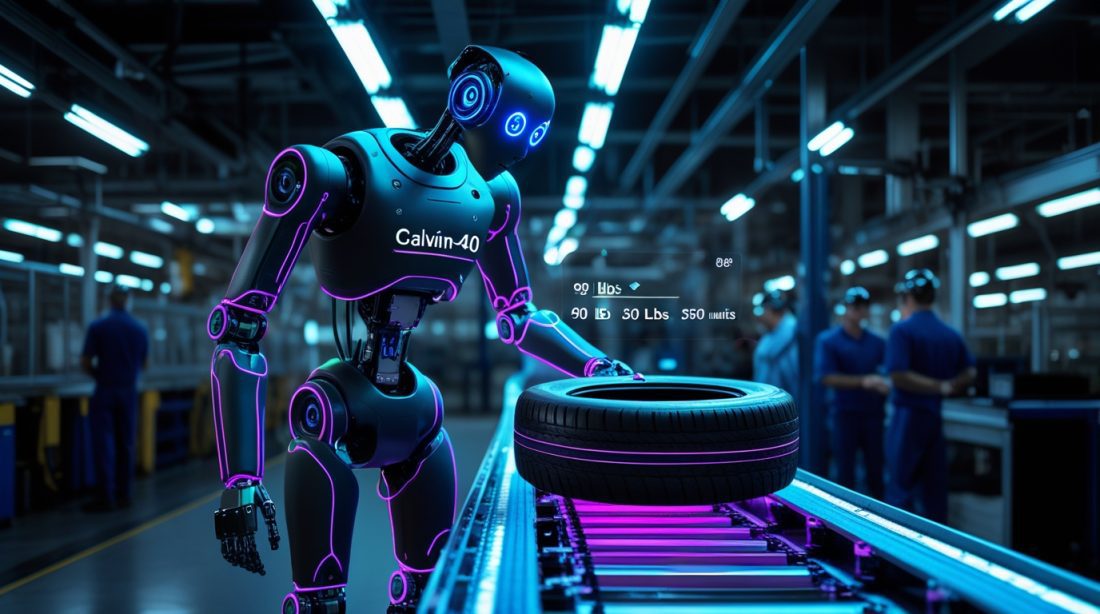
- The Calvin-40 can lift up to 90 pounds (40kg) several hundred times a day without rest — starting with tire placement on the conveyor belt.
- Renault plans to scale from the initial unit to 350 Calvin-40 robots within 18 months across its EV production facilities.
- The deployment targets a 30% reduction in production hours per vehicle and a 20% cut in production costs over five years.
- The deliberate choice to go headless — removing expensive perception hardware that adds cost without adding task-specific value — is the strategic decision every manufacturer should examine.
- Renault’s move directly challenges the assumption that more human-like robots produce better factory outcomes.
There is a question underneath the Renault deployment that the robotics industry has been avoiding: if a robot does not need a head to do its job, why are manufacturers paying for one?
The headless robot factory deployment at Renault’s electric vehicle plant in France is the clearest evidence yet that form factor decisions in industrial robotics are not engineering questions — they are financial ones. The Calvin-40, built by Paris-based startup Wandercraft — a company founded in 2012 and previously known for medical exoskeletons that help people with mobility impairments walk — is bipedal because bipedal locomotion navigates factory floors built for human workers. It is headless because the specific tasks it was deployed to perform — lifting tires, placing components on conveyor belts, absorbing the repetitive physical load that causes human musculoskeletal injuries — do not require the perception hardware that a head provides.
That deliberate simplification is not a compromise. It is a cost and reliability decision. Every component removed from a robot is a component that cannot fail, does not require calibration, and does not add to the bill of materials. According to InsideEVs, the Calvin-40 uses waist-mounted video cameras and LED lights to communicate its operational status — both of which are simpler, more rugged, and cheaper to maintain than a head-mounted perception suite.
Renault invested $75 million for a minority stake in Wandercraft in June 2025, and is now scaling to 350 units across its Douai factory and wider EV production facilities within 18 months. That deployment decision was made after seeing the first unit work. The numbers evidently justified the expansion.
The Task-First Design Logic Behind Renault’s Headless Choice
Most coverage of Renault’s Calvin-40 deployment focuses on what the robot looks like — headless, slightly unnerving, nothing like the humanoid demos that dominate robotics press coverage. The more important question is why Wandercraft and Renault designed it that way, and what that decision reveals about where factory robotics value actually comes from.
The Calvin-40’s primary task at the Renault EV plant is physically demanding and highly repetitive: placing tires onto the conveyor belt that carries them to the assembly line. According to InsideEVs, the robot lifts up to 40 kilograms several hundred times per day without rest. That workload is exactly the category of task that causes chronic injury in human workers over months and years of shifts — and exactly the category where a robot’s ability to repeat without fatigue, without pain, and without sick days generates immediate, measurable value.
A head adds value when a robot needs to navigate unstructured environments, recognise novel objects, or interact with humans in unpredictable ways. The Renault tire placement task requires none of those capabilities. The environment is structured. The task is defined. The relevant perception is positional — where is the tire, where is the conveyor — which waist-mounted cameras handle with less hardware complexity than a head-mounted system.
“Honestly, I am not interested in having humanoid robots. I am only focused on value as efficient and affordable automation devices.”
— Thierry Charvet, Chief Industry and Quality Officer, Renault Group, March 2026
This is the same logic that underpins RJ Scaringe’s decision to build purpose-built factory robots at Mind Robotics rather than humanoids. The form factor should follow the task requirements, not the other way around. Renault’s deployment is the production-scale validation of that argument — and it arrived before most humanoid manufacturers have shipped their first commercial unit.
350 – Calvin-40 headless robots Renault plans to deploy across its EV production facilities within 18 months — targeting 30% reduction in production hours per vehicle and 20% cost reduction over 5 years
What 350 Units in 18 Months Tells You About Renault’s Confidence in the Deployment Economics
The scale of Renault’s planned rollout is the data point most manufacturers should focus on. Going from one unit to 350 in 18 months is not a cautious expansion. It is a commitment. It means the first unit produced results compelling enough — in productivity, reliability, and cost — to justify the capital and integration work required to deploy at that scale across an active production facility.
According to InsideEVs, Renault’s targets are explicit: 30% reduction in production hours per vehicle, and 20% production cost reduction over five years. Those are not aspirational projections — they are the numbers Renault’s finance team approved the 350-unit deployment against. If the economics did not support the targets, the rollout would not have been sanctioned.
Compare this to the BMW Spartanburg humanoid pilot, which produced strong production data over 10 months before expanding to a second facility. Both deployments confirm the same pattern: the manufacturers committing to robot deployment at volume are doing so because the first unit produced measurable, financeable returns — not because the technology looked impressive in a demo.
The contrast with humanoid manufacturers is instructive. Tesla’s Optimus, Boston Dynamics’ Atlas, Figure AI’s Figure 02 — all are impressive hardware with genuine long-term potential. None have a 350-unit deployment commitment from a major OEM based on production results yet. Renault’s Calvin-40, specifically because it was designed to do one task extremely well rather than to demonstrate general-purpose flexibility, got there first.
The Form Factor Decision Every Manufacturer Needs to Make Before Buying a Robot
The Renault deployment reframes the robot procurement question in a way that matters for every manufacturer evaluating automation options in 2026. The question is not “humanoid or non-humanoid?” — it is “what does this specific task actually require, and what is the simplest hardware that delivers it reliably?”
That question sounds obvious, but the humanoid hype cycle has made it surprisingly easy to lose sight of. The implicit assumption in much of the industry discussion is that human-like robots are inherently more capable and therefore more valuable. Renault’s headless robot is a direct empirical challenge to that assumption. The Calvin-40 is doing work that Tesla’s Optimus has not yet been deployed to do at production scale — not because Optimus is less capable, but because Renault matched the form factor to the task rather than deploying the most sophisticated available technology and hoping it fit.
Understanding the real drivers of humanoid robot ROI makes clear why task specificity is the variable that matters most in the early deployment phase. Renault’s 30% production hour reduction target does not require general-purpose dexterity — it requires reliable, high-repetition physical performance on defined tasks. The Calvin-40 is built for exactly that. Its headlessness is a feature, not a limitation.
⚠ Fiction — Illustrative Scenario
A procurement manager at a mid-size automotive parts supplier attends a robotics trade show in Q2 2026. She reviews demonstrations from three humanoid robot vendors — all impressive, all priced at $80,000–120,000 per unit, all with deployment timelines extending into 2027. She also meets Wandercraft’s team, reviews the Renault deployment data, and evaluates the Calvin-40 for two specific tasks on her production floor: component transfer between workstations and loading of sub-assemblies onto inspection conveyors.
Both tasks involve defined routes, known weights, and structured environments. The Calvin-40 is available, proven at production scale, and priced at a third of the humanoid alternatives. She recommends a six-unit pilot for the two target tasks. This scenario is speculative and illustrative but reflects the procurement logic that Renault’s deployment data makes credible for task-matched robot selection.
The Broader Signal — What Renault’s Decision Tells the Entire Robotics Industry
Renault is not a robotics research lab. It is a volume automaker in a brutally competitive European market, trying to cut costs by 20% over five years while maintaining production quality. When a company in that position commits to 350 units of a specific robot design, it is making a statement about what works in practice — not what looks impressive in theory.
The statement is this: in a factory environment, the robot that does its specific job reliably at the lowest total cost of ownership wins. Not the most capable. Not the most human-like. The most fit for purpose.
According to RobotLab’s 2026 robotics trend analysis, the robots that succeed commercially will be the ones that can operate day after day in imperfect environments with predictable maintenance cycles — not the most exotic designs. Renault’s Calvin-40 deployment is the production-scale confirmation of that thesis.
For manufacturers evaluating humanoid robot applications beyond the publicity, the Renault deployment adds an important data point: the first robot to scale at a major automaker was not a humanoid. It was a headless biped designed for one category of task, deployed at volume because the economics worked. That sequence — task definition first, form factor second, scale based on proven results — is the deployment template that delivers production ROI.
The Skild AI foundation model approach and the Mind Robotics purpose-built platform both reflect the same underlying logic: the question of which robot architecture wins in manufacturing is settled by production data, not by investor presentations or trade show demonstrations. Renault now has 350 units of production data in progress. That is an asset no amount of humanoid PR can replicate.
Global Implications
Renault’s headless robot deployment carries implications beyond France. European automakers are under simultaneous pressure from Chinese EV competition, tightening emissions regulations, and labour cost structures that make automation economically urgent in a way it has not been in previous decades. The 20% production cost reduction target over five years is a survival metric as much as an efficiency goal. For manufacturers in emerging markets — including Nigeria, India, and Southeast Asia — the Renault model offers a more immediately relevant template than humanoid deployments.
A purpose-built robot designed for one high-volume, physically demanding task, available at a price point that pencils out without requiring premium humanoid hardware budgets, is a more accessible starting point for the first wave of factory automation investment. The principle Renault has validated — task-matched form factor over general-purpose sophistication — is universally applicable regardless of where the factory sits.
The robotics industry in 2026 is running two parallel narratives. One is about humanoid robots and the long-term vision of general-purpose automation. The other is about the robots already doing real work on real production lines today — less glamorous, less photographed, and measurably more deployed.
Renault’s Calvin-40 sits firmly in the second narrative. It is headless, purposeful, and scaling to 350 units because it works. In an industry where the gap between announcement and production deployment is measured in years, that matters more than any demo video. The automaker that built a dumber robot made the smarter move — and the production data is starting to prove it.
Further Reading — Related Articles
- → Humanoid Robots in Small Town Factories 2026 — What the BMW Spartanburg Pilot Reveals for Every Manufacturer
- → The Real Drivers of Humanoid Robot ROI in Factory Deployments
- → Humanoid Robot Applications Beyond Public Gimmicks — What Real Deployment Looks Like
- → Skild AI Robotics Manufacturing Foundation Model — What a $14B Valuation Says About Where the Industry Is Heading
- → AI-Powered Industrial Automation — The Mind Robotics and Rivian Strategy Explained
Frequently Asked Questions
What is the Renault Calvin-40 headless robot and what does it do?
The Calvin-40 is a bipedal headless industrial robot developed by New York-based startup Wandercraft and deployed by Renault at its electric vehicle factory in France. It lifts up to 40 kilograms several hundred times per day, starting with tire placement on the conveyor belt leading to the assembly line. It uses waist-mounted cameras for vision and LED lights to communicate operational status instead of a head-mounted perception system.
Why did Renault choose a headless robot instead of a humanoid like Tesla’s Optimus?
Renault’s task requirements — high-repetition, high-weight lifting in a structured factory environment — do not need the perception capabilities that a head provides. Removing the head reduces hardware cost, eliminates a potential failure point, and simplifies maintenance without reducing task performance. The decision was made based on what the specific job requires, not on what the most sophisticated available technology offers.
How many Calvin-40 robots is Renault deploying and what are the targets?
Renault is scaling from its initial unit to 350 Calvin-40 robots across its EV production facilities within 18 months. The deployment targets a 30% reduction in production hours per vehicle and a 20% reduction in production costs over five years.
Does a headless robot perform better than a humanoid in factory environments?
For specific, high-repetition physical tasks in structured environments — the category where Renault deployed the Calvin-40 — a purpose-built headless robot outperforms a general-purpose humanoid on cost, reliability, and deployment speed. Humanoids offer advantages in unstructured environments requiring flexible perception and navigation. The right answer depends entirely on task requirements, not form factor preference.
What should manufacturers learn from Renault’s headless robot deployment?
The primary lesson is to define the task before selecting the form factor. Renault identified a specific, high-volume, injury-generating task, mapped the minimum hardware required to perform it reliably, and deployed accordingly. The result was a 350-unit commitment based on production results rather than technology sophistication. That sequence — task first, form factor second, scale based on proven results — is the template that delivers measurable factory ROI.
How does Renault’s robot deployment affect procurement decisions for other manufacturers?
It establishes a production-scale benchmark for task-matched robot deployment at a major OEM. Manufacturers evaluating automation options should examine whether their highest-priority automation tasks require humanoid capability or whether a simpler, purpose-built design would deliver better ROI at lower cost. Renault’s 30% production hour reduction target, approved for 350 units, provides a real financial reference point for similar high-repetition, high-weight industrial tasks.
The robot that fits the task beats the robot that fits the demo every time.
Renault just committed to 350 units of a headless biped while the humanoid debate continues. The manufacturers making smart deployment decisions now are doing it based on task requirements and production economics — not on which robot generates the best press coverage. CreedTec tracks the real deployment data, form factor decisions, and ROI benchmarks that separate production results from pilot announcements.
Subscribe to CreedTec →