Fast Facts — Key Takeaways
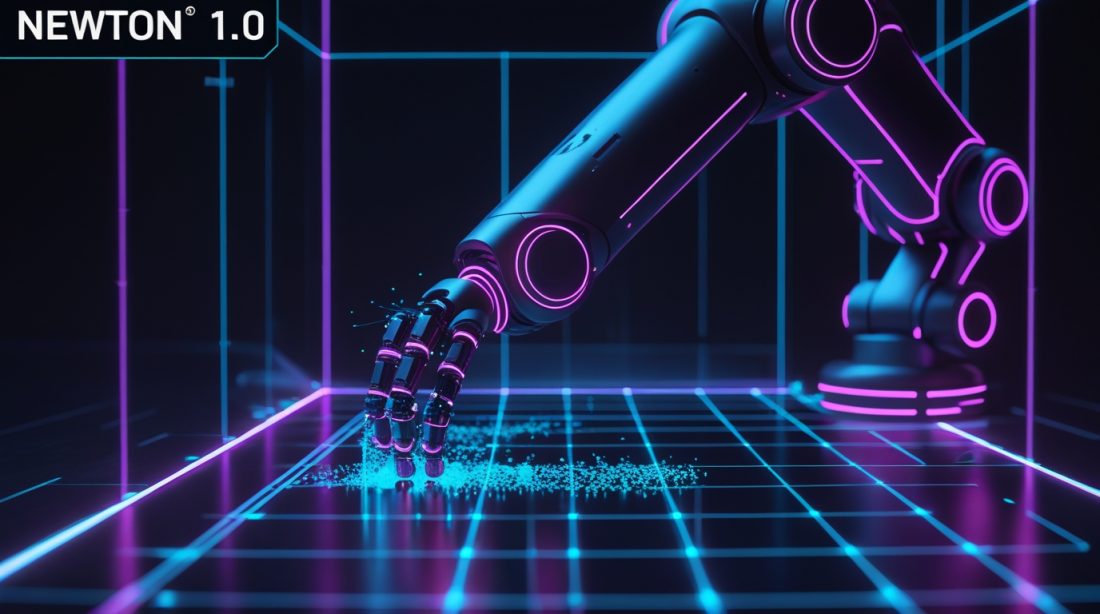
At GTC 2026 on March 17, NVIDIA released Newton 1.0 — a production-ready, open-source physics engine built for robot training. Co-developed with Google DeepMind and Disney Research, it is already in production use at Skild AI and Samsung.
- 475x faster than Google DeepMind’s MJX for manipulation tasks on NVIDIA RTX PRO 6000 Blackwell GPUs.
- 252x faster than MJX for locomotion tasks — covering both major categories of industrial robot training.
- Skild AI is using Newton to train reinforcement learning policies for GPU rack assembly — connector insertion, board placement, fastening at tight tolerances.
- Samsung is using Newton’s deformable simulation for cable manipulation in refrigerator assembly lines.
- The robotics simulation market is approaching $28 billion in valuation. Newton addresses the speed and fidelity gap that has kept simulation training behind real-world data collection for years.
The central problem in robot simulation training has always been this: physics engines that are accurate enough to produce transferable policies are too slow to train at scale, and engines fast enough to run millions of iterations are too inaccurate to produce robots that work reliably in the real world.
That trade-off has defined the sim-to-real gap for years. The NVIDIA Newton 1.0 physics engine is the most direct attempt yet to close it — and the GTC 2026 release comes with production data from real industrial deployments that makes the claim credible.
NVIDIA released Newton 1.0 GA at GTC 2026, delivering a production-ready physics simulation engine that clocks 475x faster than Google DeepMind’s MJX for manipulation tasks on the new RTX PRO 6000 Blackwell workstation GPUs. That speed advantage is not happening at the cost of fidelity — it is happening because Newton was built specifically to handle the contact-rich simulation demands that existing engines handle poorly.
For teams training robots to perform assembly tasks, cable handling, connector insertion, or any manipulation work where contact forces and deformation dynamics matter, Newton changes the training economics significantly. What previously took days of simulation time now takes minutes. That is not a marginal improvement — it changes what is feasible to train and how often teams can iterate on their policies.
What Newton 1.0 Actually Does Differently — and Why Speed Alone Doesn’t Explain the Advantage
The 475x speedup headline is attention-grabbing but it only tells part of the story. The more important question is what produces that speed without sacrificing the physics accuracy that determines whether a trained policy actually transfers to real hardware.
According to Dataconomy, Newton bundles multiple physics solvers behind a unified API. Two stand out for industrial applications. MuJoCo Warp extends Google DeepMind’s established MuJoCo simulator with full GPU parallelisation — delivering the 252x locomotion and 475x manipulation speedups. Kamino, contributed by Disney Research, handles closed-loop mechanisms like parallel linkage legs that break most competing simulators — a capability directly relevant to robotic grippers and multi-joint assembly tools.
The collision detection architecture is where Newton separates itself for tight-tolerance manufacturing tasks. The collision detection system introduces signed distance field (SDF) collision that ingests CAD meshes directly, eliminating the convex hull approximations that lose geometric detail on tight-tolerance parts. For connector insertion tasks — where the margin for error is measured in fractions of a millimetre — this is the difference between a policy that works in simulation and one that transfers to the production line.
“Humanoids are the next frontier of physical AI, requiring the ability to reason, adapt and act safely in an unpredictable world. With these latest updates, developers now have the three computers to bring robots from research into everyday life — with Isaac GR00T serving as robot’s brains, Newton simulating their body and NVIDIA Omniverse as their training ground.”
— Rev Lebaredian, VP of Omniverse and Simulation Technology, NVIDIA
Newton also includes hydroelastic contact modeling borrowed from Toyota Research Institute’s Drake engine — generating distributed pressure across contact patches rather than point approximations. For tactile manipulation where real-world friction behaviour determines success or failure, that distinction is operationally significant. Add deformable simulation for cables, cloth, and volumetric materials through Vertex Block Descent, and Newton covers the full physical complexity of the assembly tasks that have historically been hardest to train in simulation.
475x – Newton’s speed advantage over MJX for manipulation tasks on NVIDIA RTX PRO 6000 Blackwell — reducing simulation training from days to minutes for contact-rich industrial assembly policies
The Real Validation — Skild AI and Samsung Already in Production With Newton
An engine’s benchmark numbers matter. What matters more is whether real teams are using it to train robots that work on actual production lines. Newton 1.0 arrives with two production deployments that provide exactly that validation.
According to Blockchain News’s GTC coverage, Skild AI is using Newton with Isaac Lab to train reinforcement learning policies for GPU rack assembly — specifically connector insertion, board placement, and fastening with tight tolerances. These are precisely the tasks where Newton’s SDF collision system and hydroelastic contact modeling provide the fidelity advantage over competing engines. The fact that Skild AI — one of the best-capitalised robotics AI startups in the market — is building its production training pipeline on Newton is a significant endorsement.
Samsung’s deployment through Lightwheel targets a different challenge: cable manipulation in refrigerator assembly lines. Samsung will generate synthetic training data for vision-language-action models using Newton’s cable simulation. Lightwheel is calibrating SimReady assets against real-world measurements for Samsung’s refrigerator assembly workflows, where water-hose connector insertion requires accurate 1D deformable behaviour. That use case highlights Newton’s deformable simulation capability — an area where most physics engines produce results too inaccurate to generate training data that transfers reliably.
These are not pilot demonstrations. They are production training pipelines at two organisations operating at serious scale. The physics simulation bottleneck that has constrained robot training for years is being addressed directly — and the Skild AI and Samsung deployments are the first credible evidence that Newton’s architecture delivers on its fidelity claims in real manufacturing contexts.
Newton Inside the Broader NVIDIA Robotics Platform — What the GTC 2026 Stack Means for Training Teams
Newton does not exist in isolation. At GTC 2026, NVIDIA announced a set of releases that position Newton as the physics foundation of a broader training stack. Understanding how the pieces connect matters for teams evaluating whether to build their simulation pipeline around it.
According to The Decoder’s GTC analysis, NVIDIA’s strategic thesis is explicit: turn robotics’ data problem into a compute problem. Instead of relying on expensive real-world data collection, teams should use simulation pipelines and synthetic data generation to replace it — making raw compute power the bottleneck for training better models rather than the size of a physical robot fleet.
Newton integrates natively with Isaac Lab 3.0, also released in early access at GTC. Newton integrates natively with Isaac Lab 3.0, NVIDIA’s open-source robot learning framework, which was also released in early access on Monday. The practical implication: teams author training environments once, validate across different physics engine backends, then deploy. Newton becomes a swappable physics layer rather than a locked dependency — which reduces the risk of building a training pipeline around a single solver that underperforms on specific task types.
The installed base context is also significant. NVIDIA said its Isaac and Omniverse frameworks now reach an installed base exceeding 2 million robots globally. Newton is not entering a nascent ecosystem — it is being inserted into a platform that already has the scale to make adoption frictionless for teams already using Isaac infrastructure.
⚠ Fiction — Illustrative Scenario
A robotics team at a contract electronics manufacturer in Malaysia has been training a manipulation policy for PCB connector insertion for six months. Using their existing physics engine, each training run takes 4-5 days and the resulting policies fail on roughly 30% of connector types due to inaccurate contact modelling at tight tolerances. After migrating to Newton’s SDF collision system and MuJoCo Warp backend, their training cycle drops to under 3 hours per run.
Policy accuracy on connector insertion improves to 94% on first deployment. The team’s iteration speed goes from two training cycles per month to more than forty. This scenario is speculative and illustrative but reflects the training economics that Newton’s architecture and benchmark data are designed to produce.
What the $28 Billion Simulation Market Means for Teams Choosing Their Physics Engine Now
The robotics simulation market is approaching $28 billion in valuation according to GTC industry analysis. That scale reflects a fundamental shift in how robot development works: simulation is no longer a shortcut or a research tool — it is the primary training environment for production robot policies. The physics engine sitting at the foundation of that environment is now a strategic infrastructure decision.
The sim-to-real transfer challenge has historically been the reason teams kept expensive real-world data collection in their training pipelines even as simulation got faster. Newton’s SDF collision, hydroelastic contact, and deformable simulation capabilities are a direct attack on the fidelity gaps that caused sim-to-real failures — the same gaps documented in the digital simulation work for underwater robots and other contact-intensive environments.
For teams currently using MuJoCo directly, the migration path is clear: MuJoCo Warp is Newton’s primary backend, meaning existing models and environments port without a full rewrite. For teams using other engines, the open-source availability under the Linux Foundation and the Apache 2.0 licence removes the adoption barrier that has historically kept organisations on legacy platforms.
The embodied world models driving the next generation of robotics training require exactly the kind of high-fidelity, high-throughput physics simulation that Newton provides. Teams building training pipelines now are making infrastructure decisions that will define their model quality and iteration speed for the next three to five years. Newton’s production status, its adoption by Skild AI and Samsung, and its integration with NVIDIA’s broader Isaac platform make it the most credible open-source option in that decision set as of March 2026.
Understanding how digital simulation platforms for training autonomous robots close the gap between virtual training and real-world performance makes clear why physics fidelity at speed is the defining capability. Newton is the first production-ready engine to deliver both at the same time — and the GTC 2026 deployment data confirms it is already working in the environments that matter most.
Global Implications
Newton’s open-source release under the Linux Foundation is significant for robotics teams outside the top-tier US and European labs. GPU-accelerated simulation at this fidelity level was previously accessible only to organisations with large compute budgets and deep NVIDIA partnerships. The Apache 2.0 licence and pip-installable distribution means research labs at universities in Singapore, Nigeria, India, and across the developing world now have access to the same physics engine underpinning Skild AI’s production training pipeline.
The compute requirement remains a barrier — NVIDIA GPU hardware is not cheap — but the software infrastructure gap that previously kept emerging market robotics teams two or three generations behind is closing. As cloud GPU access continues to commoditise, Newton’s architecture positions teams who adopt it now to scale their simulation capabilities in line with global hardware cost trends rather than against them.
The physics simulation bottleneck in robot training has been a known constraint for years. Every team working on manipulation policies has had to choose between a fast engine that produces poor sim-to-real transfer and a slow engine that produces accurate results too slowly to iterate at scale. Newton 1.0 is the first production-ready engine that does not force that choice.
The GTC 2026 timing is deliberate. NVIDIA is positioning Newton as the physics foundation of its entire physical AI platform — below Isaac Lab, below GR00T, below Cosmos — the layer that everything else depends on being accurate and fast enough to make training at scale viable. The Skild AI and Samsung deployments confirm it works. The 2 million robot installed base on Isaac and Omniverse confirms the distribution path. And the open-source licence confirms NVIDIA wants the standard, not just the revenue.
Further Reading — Related Articles
- → The Physics Simulation Bottleneck — How Inaccurate Engines Are Costing Robot Teams Months of Development Time
- → Digital Simulation Platforms for Training Underwater Autonomous Robots — The Costly Gap Most AUV Teams Are Ignoring
- → Sim-to-Real Transfer Breakthrough Delivers 66% Better Robot Performance
- → Embodied World Models for Robotics Training — The Architecture Behind the Next Generation of Robot Policies
- → Humanoid Robots in Small Town Factories 2026 — What the BMW Spartanburg Pilot Reveals for Every Manufacturer
Frequently Asked Questions
What is NVIDIA Newton 1.0 and when was it released?
Newton 1.0 is a production-ready, open-source, GPU-accelerated physics engine for robot simulation and training. It was released at NVIDIA GTC 2026 on March 17, 2026, transitioning from beta to stable release. It is co-developed by NVIDIA, Google DeepMind, and Disney Research, and hosted under the Linux Foundation with an Apache 2.0 licence.
How much faster is Newton than existing physics engines?
Running MuJoCo Warp on the NVIDIA RTX PRO 6000 Blackwell GPU, Newton achieves up to 475x the speed of MJX for manipulation tasks and up to 252x for locomotion tasks. These benchmarks compare against Google DeepMind’s MJX, the closest existing alternative for GPU-accelerated MuJoCo simulation.
Who is already using NVIDIA Newton in production?
Skild AI is using Newton with Isaac Lab 3.0 to train reinforcement learning policies for GPU rack assembly including connector insertion, board placement, and fastening at tight tolerances. Samsung, working with Lightwheel, is using Newton’s deformable simulation for cable manipulation training in refrigerator assembly lines.
How does Newton improve sim-to-real transfer compared to other engines?
Newton uses signed distance field (SDF) collision that ingests CAD meshes directly — eliminating convex hull approximations that lose geometric detail on tight-tolerance parts. It also includes hydroelastic contact modelling for distributed pressure simulation and Vertex Block Descent for deformable objects like cables and cloth. These capabilities address the specific physics inaccuracies that cause trained policies to fail when deployed on real hardware.
Is Newton free to use and how do I get started?
Yes. Newton is open-source under the Apache 2.0 licence, hosted on GitHub under the Linux Foundation. It can be installed via pip with the command: pip install “newton[examples]”. It requires an NVIDIA GPU (Maxwell or newer) with driver 545 or newer. It integrates natively with Isaac Lab and Isaac Sim as a swappable physics backend.
Should our team migrate to Newton from our current physics engine?
If your team is currently using MuJoCo directly, migration to Newton is low-friction — MuJoCo Warp is Newton’s primary backend and existing models port without a full rewrite. If you are training manipulation or locomotion policies where sim-to-real transfer has been a persistent problem, Newton’s SDF collision and hydroelastic contact capabilities address the most common causes of transfer failure. The production deployments at Skild AI and Samsung provide meaningful validation for manufacturing-relevant task types.
Your simulation pipeline is now the bottleneck — not your compute budget.
Newton 1.0 removes the speed-versus-fidelity trade-off that has defined robot training for a decade. The teams building on it now will set the policy quality and iteration speed benchmarks their competitors have to match. CreedTec tracks the simulation infrastructure decisions, training platform shifts, and deployment results that determine which robotics teams pull ahead.
Subscribe to CreedTec →