Fast Facts
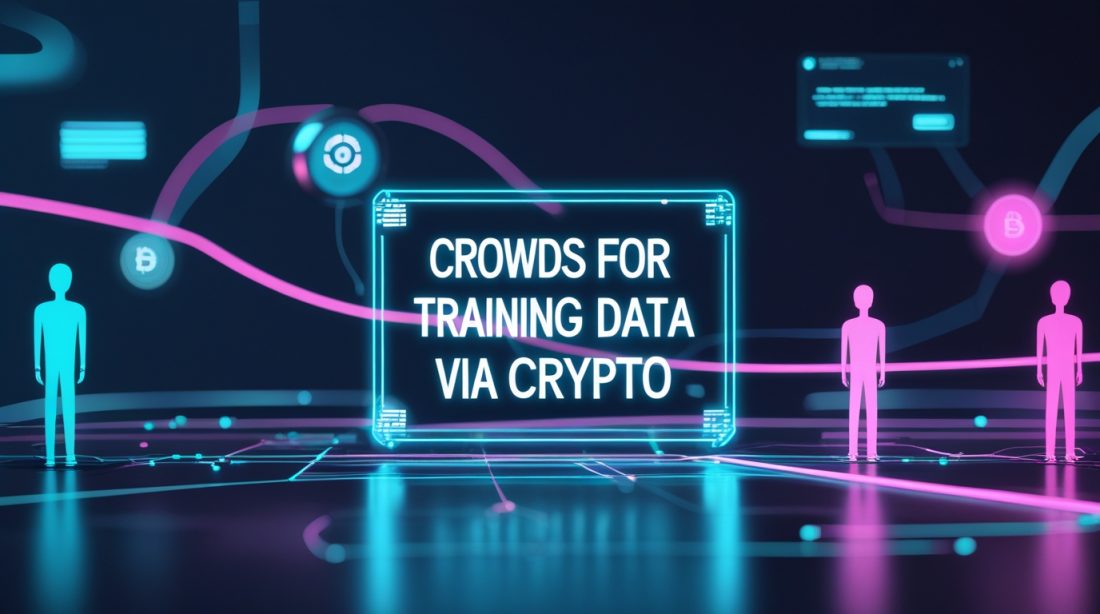
The industrial AI sector is pivoting from synthetic datasets to human-verified, real-world information. New platforms now allow factories to pay crowds for training data via crypto, turning edge-case scenarios and human expertise into tradeable assets on the blockchain. This shift solves the “last mile” problem of AI accuracy by leveraging decentralized physical infrastructure networks (DePIN) and tokenized incentives. For the average person, this transforms tacit knowledge—from language fluency to understanding local traffic patterns—into a direct source of income.
In the winter of 2025, I watched a logistics robot at a German packing plant repeatedly fail to identify a wet cardboard box. The sensor data was perfect. The lighting was optimal. But the AI, trained on millions of pristine, synthetic images, had never seen a box that looked like a squishy, reflective mess. According to a study published in Nature cited by PublicAI, models trained exclusively on synthetic data risk “performance collapse” when faced with the chaotic variables of the real world .
This is the dirty secret of the Industry 4.0 revolution: machines are stupid in ways we aren’t. They cannot infer. They cannot rely on common sense. And for the longest time, the only way to fix this was to either pay expensive, centralized labeling firms or hope the data magically appeared.
That model is breaking. In 2026, the industrial sector is discovering that the most efficient way to train a fleet of autonomous machines is to bypass the corporate structure entirely and pay the crowd directly. The new wage? Cryptocurrency.
The 1% Problem: Why Simulation Isn’t Enough Anymore
Why are factories struggling to train AI despite having so much data?
We need to address a core tension here. Industrial sensors generate petabytes of information, but training data is different from operational data. A sensor knows the temperature of a bearing; it doesn’t know that the bearing is making a “funny sound” that a human mechanic would recognize as catastrophic failure.
The industrial AI community is facing a crisis of edge cases. You cannot simulate every scenario. How does a delivery drone navigate a street fair? How does a warehouse bot react to a spilled liquid it has never encountered? According to the team at Pundi AI, the “black box” nature of most data piping makes it impossible to determine if training data is reliable for these unique scenarios.
Historically, fixing this required sending a team of annotators to the factory floor. Now, the factory is turning the process inside out. By choosing to pay crowds for training data via crypto, manufacturers are tapping into a global workforce that exists within the context of the problem. They are sourcing “human-in-the-loop” verification at scale .
Tokenizing Tacit Knowledge
How does paying with crypto change the quality of industrial data?
I remember speaking with a sensor engineer in Detroit (a composite character based on industry conversations) who joked that his hardest job wasn’t building the hardware, it was finding people to label the data the hardware collected. The old model was extractive: users generated data, and corporations monetized it. The new model, enabled by blockchain, is transactional.
Platforms like Tagger are pioneering the concept of “Proof-of-Human-Work,” where the native token (TAG) is emitted based on actual data processing labor, not speculative mining . Similarly, PublicAI utilizes a “stake-slashing mechanism”—contributors stake tokens, and if they submit bad data, they are penalized . This aligns economic incentives with quality assurance.
When a factory pays crowds for training data via crypto, they aren’t just buying an answer; they are buying a stake in the outcome. The contributor wants the AI to succeed because the value of the tokens they earn is tied to the health of the ecosystem. It transforms data labeling from a gig economy grind into a form of micro-investment in industrial infrastructure.
The DePIN Connection: Data from the Physical World
Why is 2026 the tipping point for this trend?
The infrastructure to support this shift has quietly gone mainstream. We are seeing the rise of DePIN (Decentralized Physical Infrastructure Networks). These networks use crypto tokens to incentivize people to deploy real-world hardware or share real-world data.
Consider the partnership between Presens Network and Pundi AI. Presens collects anonymized presence signals from millions of devices to understand human activity patterns . This isn’t web-scraped data; it is spatial, temporal, and physical. A factory building a last-mile delivery AI can now buy access to real-world foot traffic patterns, verified on-chain, rather than relying on simulated pedestrian models.
Furthermore, the recent collaboration between OpenMind and Circle to create payment infrastructure specifically for autonomous agents means that soon, the machines themselves will be participants in this economy . A robot low on charge will eventually be able to pay a charging station directly using USDC. If a robot can pay for energy, it can certainly pay a human for the data needed to navigate a tricky loading dock.
The Fear of Irrelevance and the Desire for Agency
What motivates a person to sell their data to a machine?
To understand why this model works, you have to apply financial logic to human nature. The dominant fear in the industrial workforce today is obsolescence. The narrative has long been “AI is coming for your job.”
But when a factory pays crowds for training data via crypto, it reframes the relationship. The worker becomes the teacher. The driver becomes the trainer for the autonomous fleet.
The AMO Block roadmap for 2026 illustrates this perfectly. They are rolling out “Drive-to-Earn 2.0,” where Tesla owners can earn tokens by contributing driving patterns and sensor data to help train autonomous systems . The desire for financial upside overcomes the fear of replacement. People want agency in the transition. By monetizing their own behavior, they feel they have a stake in the new industrial order.
This taps into a basic strength of human nature: the desire to be useful. Annotating data feels like teaching. And as any educator will tell you, you often learn more than the student.
The Architecture of Trust
How do factories ensure they aren’t buying garbage data?
Trust is the currency of the industrial world. A faulty sensor can shut down a production line. Faulty training data can cause a robot to injure a worker. This is why the “via crypto” part of the equation is non-negotiable.
Blockchain provides an immutable audit trail. Academic research from the Universität Stuttgart demonstrates that decentralized authentication and blockchain traceability are crucial for establishing trust in cross-company industrial data collaboration . You cannot fake the ledger.
Furthermore, platforms like PublicAI use cross-chain architecture (BSC, Solana, NEAR) to ensure that data workflows are scalable and transparent . Meanwhile, research out of the Universidad Politécnica de Madrid highlights how NFTs can be used to represent datasets, meaning that ownership is clear and data can be derandomized only by the legitimate buyer . This solves the “valueless sub-product” problem, where companies previously gave away data for free because they had no mechanism to trade it fairly .
For the factory, paying via crypto isn’t just a cool feature; it is a procurement strategy that guarantees provenance. They know exactly which crowd worker provided which label, and that worker’s reputation—and staked tokens—are on the line.
Opportunities in the New Data Economy
(Note: The following is a fictional anecdote for illustrative purposes.)
A friend of mine in Jakarta recently started annotating audio data for a logistics AI. The AI struggled with understanding local accents when giving delivery instructions. He earns roughly $15 a week in crypto—nothing life-changing in the West, but significant there. He told me, “The AI doesn’t replace me; it pays me to understand me.”
This is the opportunity. For the industrial analyst, the shift toward decentralized data sourcing suggests several high-value trends:
- The Rise of the Micro-Validator: Quality control will shift from centralized QA teams to distributed crowds using slashing mechanisms.
- Data as a Liquid Asset: Industrial data will trade on spot markets. Need 10,000 images of wet cardboard boxes? You’ll post a bounty in stablecoins and have them in hours, not weeks.
- Machine-Facing Payments: As highlighted by the FABRIC Foundation, we are moving toward a “machine economy” where robots are independent economic agents . The data they buy today will fuel the work they do tomorrow.
The Inevitable Evolution
The factory of the future won’t be a walled garden of silence. It will be a noisy, transactional marketplace where humans and machines exchange value constantly. When a factory pays crowds for training data via crypto, it is acknowledging a simple truth: silicon needs carbon to learn.
The rise of DePIN, the maturation of stablecoin payments (like Circle’s USDC), and the desperation for high-quality, edge-case data have converged in 2026. The trend is not about replacing humans with robots; it is about creating a symbiotic financial loop where human experience becomes the most valuable feedstock for industrial intelligence.
The question is no longer if your data is valuable, but whether you are getting paid for it.
Frequently Asked Questions
1. Is this just another form of Mechanical Turk with crypto payments?
No. While the labor aspect is similar, the tokenization adds a layer of ownership and quality assurance. Contributors often need to stake tokens, aligning their financial interest with data accuracy, which is critical for industrial safety.
2. How do factories handle sensitive proprietary information when using crowds?
Platforms utilize privacy-preserving algorithms and NFT-based access controls. As detailed in recent academic models, data can be randomized and stored on networks like IPFS, with the decryption seed only available to the NFT holder, ensuring sensitive specifics remain hidden .
3. What kind of industrial data is most in demand right now?
Currently, there is a massive demand for “edge-case” visual data (damaged goods, unusual weather conditions), regional language audio for voice-controlled logistics, and spatiotemporal data for autonomous navigation in complex environments .
4. How do I get started contributing data?
You can look into platforms like Tagger, PublicAI, or Pundi AI. These platforms often have interfaces where you can connect a Web3 wallet (like MetaMask) and browse available data collection or annotation tasks that pay in native tokens .
Subscribe to Industrial AI Analysis
Stay ahead of the curve. We analyze the financial logic behind the machines.
Further Reading & Related Insights
- The Rise of the Industrial AI Data Marketplace → Directly complements your theme by showing how industrial data is becoming a tradable asset, aligning with tokenized crowdsourced training data.
- Decentralized AI Revenue: The Automation Profit Shift → Explores how decentralized models are reshaping industrial AI economics, echoing your analysis of crypto‑based incentives.
- SingularityNET’s Industrial AI Marketplace Surge → Reinforces the idea of blockchain‑enabled industrial data exchange, relevant to DePIN and Proof‑of‑Human‑Work mechanisms.
- Strategic AI Infrastructure Investment → Connects to the infrastructure side of your article, showing how investment in AI and blockchain systems underpins new decentralized data economies.
- How Industrial AI is Powering $44 Billion in Revenue by 2025 and the Rise of Crypto AI Agents → Provides context on how crypto‑enabled AI agents are already driving revenue, aligning with your point about machines becoming economic participants.