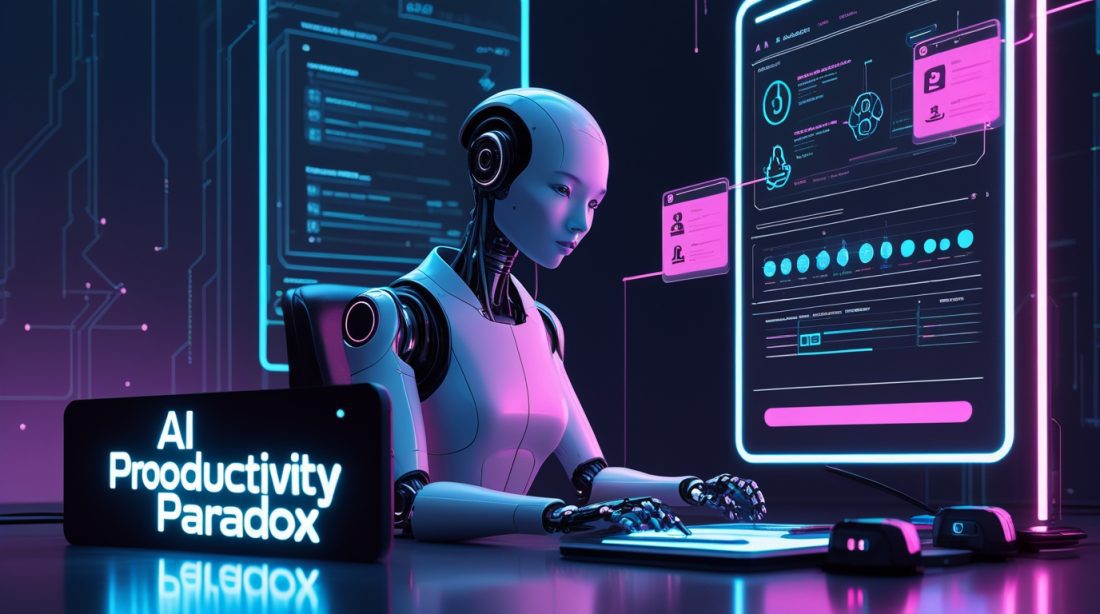
The promise was straightforward: artificial intelligence would automate routine tasks, freeing human workers for creative and strategic pursuits, potentially leading to shorter workweeks. As we move deeper into 2026, a more complex reality dominates the industrial landscape. Evidence reveals that AI doesn’t reduce work—it profoundly intensifies it. This is the core of the AI productivity paradox: while AI generates measurable efficiency gains, it simultaneously expands the scope, complexity, and cognitive demands of the work that remains for humans.
For industrial analysts and operators, this isn’t about job loss predictions; it’s about understanding a fundamental restructuring of work. The intensification occurs along three primary fronts: the redistribution of tasks within roles, the explosive growth of a supporting physical infrastructure, and the elevated human skills required to manage a hybrid human-machine environment.
Why AI Doesn’t Eliminate Jobs: The Great Task Reallocation
A foundational study tracking AI adoption from 2010 to 2023 found that AI’s impact is often on specific tasks within jobs rather than on whole occupations. When AI automates a few tasks within a role, employment in that role can actually grow. The reason is task reallocation: with routine components handled by AI, workers refocus on activities where humans retain an advantage, such as complex problem-solving, oversight, and innovation. This finding shatters the simple automation-replacement narrative.
Research from Denmark involving 25,000 workers provided granular insight into this phenomenon. When AI saves time, approximately 80% of workers reallocate those saved minutes to other job duties. They don’t work less; they work differently. In some cases, workers even spend more time on the very tasks they automated, often due to employer encouragement to achieve higher-quality outputs. This “reinstatement effect” suggests that AI doesn’t finish work—it changes the finish line, creating demand for more sophisticated, complementary human effort.
Table: The Reallocation of Work in the AI Era
| What AI Automates | What Humans Reallocate To | Industrial Example |
|---|---|---|
| Routine data processing & analysis | Interpreting insights, strategic decision-making | From monitoring sensor data to optimizing plant-wide production flow |
| Generating standard reports & documentation | Auditing AI outputs, complex communication | From drafting maintenance logs to validating AI-generated safety reports |
| Initial diagnostic checks & triage | Deep-rooted cause analysis & solution design | From identifying a machine fault to engineering a permanent fix |
Why AI Demands a New Physical Infrastructure: The Unseen Work Boom
The “work” of AI extends far beyond the office or factory floor. The digital revolution requires a physical one, creating massive new sectors of labor. Analysts project that AI will be a primary driver growing US data center power capacity from approximately 30 gigawatts in 2025 to over 90 gigawatts by 2030. This new demand is larger than the current entire power consumption of California.
This infrastructure buildout is not passive. It involves intense, skilled work in energy engineering, construction, chip fabrication, and advanced cooling systems. As OpenAI’s CEO Sam Altman noted, “The cost of AI will converge to the cost of energy”. This statement underscores a universe of work: securing power contracts, building substations, negotiating with utilities, and pioneering next-generation energy sources like small modular reactors to keep data centers running. The hyperscalers leading this charge are no longer just tech companies; they are becoming major industrial power players and employers.
Why Human Work Becomes More Complex: The Rise of the AI Shepherd
The most significant intensification is cognitive. As AI handles execution, the human role evolves into that of a shepherd, auditor, and integrator. For 17% of AI users, the technology has created entirely new categories of work focused on managing the AI itself. These roles include:
- AI Quality Auditors: Professionals dedicated to reviewing, fact-checking, and correcting AI outputs.
- AI Integration Architects: Workers who design prompts, embed AI into workflows, and optimize collaboration.
- Data Insight Translators: Specialists who interpret AI-generated patterns into actionable business strategy.
This shift demands higher-order skills. As Sebastian Heinz of Statworx stated, 2026 marks the end of AI’s “grace period,” where the focus shifts from experimentation to the grueling work of DataOps and AgentOps—making systems function reliably within complex organizations. The work is no longer about performing the task but about ensuring the AI agent does it correctly, ethically, and effectively within a broader process. This requires continuous monitoring, evaluation, and intervention, a form of work that is more mentally demanding and less easily quantified than the tasks it replaced.
Navigating the Intensified Workplace
For industrial organizations, the imperative is clear: success depends on managing work intensification strategically.
- Redesign Workflows for Augmentation, Not Just Automation: Follow the insight from David Caswell, who noted that 2026 will see a shift from task automation to end-to-end agentic workflows. Design processes where AI agents and humans are partners, with clear handoff points for judgment and creativity.
- Invest in Human-Centric Skills Development: The greatest risk is a skills gap. As the World Economic Forum’s Gunter Beitinger warns, the primary organizational risk is “insufficient reskilling”. Training must advance critical thinking, AI system oversight, and ethical governance alongside technical AI fluency.
- Measure the Right Outcomes: Move beyond simple productivity metrics. Track work quality, innovation rates, employee capacity for strategic work, and system reliability. As Erik Brynjolfsson predicts, 2026 will see the rise of high-frequency ‘AI economic dashboards’ to track these nuanced impacts.
The Path Forward
The AI productivity paradox reveals that the future of industrial work is not one of leisure enabled by machines, but of complex partnership with them. The work becomes less about manual or routine cognitive labor and more about management, judgment, and adaptation. This places a premium on uniquely human skills and places new responsibilities on leaders to manage this transition thoughtfully. The goal is not to reduce work but to elevate its meaning and impact, ensuring that the intensified work of the AI era drives sustainable growth and innovation.
Frequently Asked Questions (FAQs)
Q1: If AI is so productive, why isn’t it leading to massive job losses?
Research indicates that while AI can automate specific tasks, it often leads to task reallocation within existing jobs rather than full role elimination. Companies using AI tend to grow faster, which can sustain or expand headcount, offsetting displacement. The work is transformed and intensified, not simply erased.
Q2: Does AI actually increase overall productivity?
Studies show clear time savings for individual workers; one found generative AI users saved an average of 5.4% of their work hours. However, translating these micro-gains into measured macroeconomic productivity is complex. Gains may be absorbed by increased work complexity, quality improvements, or on-the-job leisure, creating the “productivity paradox” where gains are real but not always captured in traditional metrics.
Q3: Who benefits economically from AI productivity gains?
Currently, there is a stark disconnect. Research from Denmark found that while AI saved workers significant time, only 3-7% of those productivity gains translated into higher earnings for the workers. This suggests the economic benefits are largely being captured by firms or through consumer prices rather than worker wages.
Q4: What is the biggest trend shaping the future of work with AI in 2026?
A key trend is the shift from using AI for discrete tasks to deploying agentic AI for end-to-end workflow automation. This means AI systems that can understand a goal, plan steps, and execute complex sequences of tasks. This fundamentally reorganizes work around human oversight of AI-driven processes, intensifying the need for coordination and judgment skills.
Further Reading & Related Insights
- Unsettling Humanoid Robot with Realistic Face → Connects to the human-AI trust and workplace adaptation theme, showing how design choices in humanoid robots affect acceptance and collaboration.
- Industrial Autonomous Vehicle Simulation → Highlights how simulation is reshaping industrial work, complementing the paradox by showing AI’s role in intensifying infrastructure and operational demands.
- Need to Protect Industrial AI Infrastructure → Reinforces the infrastructure angle, linking AI productivity gains to the hidden labor of securing and maintaining industrial systems.
- Point Bridge Sim-to-Real Transfer Breakthrough Delivers 66% Better Robot Performance → Provides context on how sim-to-real advances intensify development cycles, aligning with the paradox of AI creating more complex work.
- Amelia AI Failure Case Study: 2026’s Critical System Governance Lesson → Offers a governance cautionary tale, underscoring the oversight and auditing roles that intensify human work in the AI era.
Fast Facts
The “AI productivity paradox” describes the 2026 reality that AI automates tasks but intensifies overall work. It leads to task reallocation (not elimination), creates massive new infrastructure jobs, and elevates human roles to AI shepherds and auditors. Success requires redesigning workflows for human-AI collaboration and investing in critical thinking and oversight skills.
Stay ahead of the curve in industrial AI analysis. Subscribe to our newsletter for in-depth insights on how technology is reshaping the foundational industries of the global economy. [Subscribe to Our Newsletter]