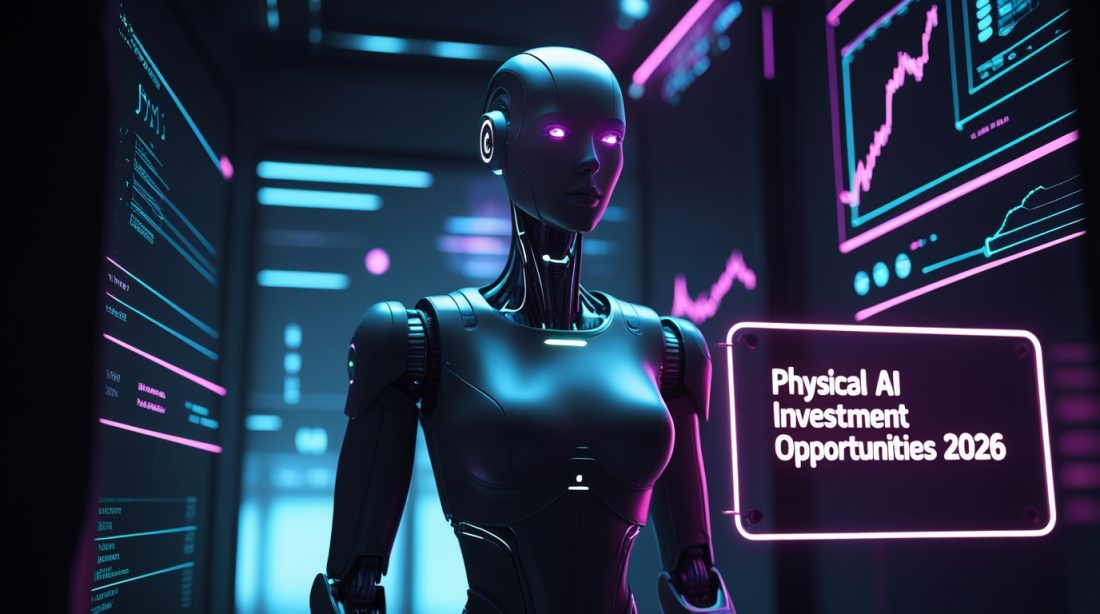
It is a peculiar quirk of human nature that we fear the intelligence of robots, yet we eagerly invest in the companies trying to build it. Fear and greed—two sides of the same coin—are currently driving a capital shift toward physical AI investment opportunities 2026; a sector that, until recently, was viewed as a money-losing venture even for Google.
In late February 2026, Alphabet made a strategic decision that ended five years of independence for its robotics software subsidiary, Intrinsic . The company is being reabsorbed into Google proper. For the market, this signaled that physical AI has moved from the “moonshot” division at X to the core profit-generating engine of the search giant . But for those of us watching the industrial landscape, the question isn’t what Google is doing—it is why now, and where does the money flow?
As an analyst focused on industrial AI, I see this as a consolidation phase. When Google first sold Boston Dynamics in 2017, it was seen as a retreat . But Google wasn’t retreating from robotics; it was retreating from hardware. They realized that the margins in robotics are not in the metal actuators or the hydraulic joints—they are in the operating system. They are in the “brain.”
Wendy Tan White, CEO of Intrinsic, noted that combining with Google’s infrastructure will “unlock the promise of physical AI for a much broader set of manufacturing businesses and developers” . This is the classic Android playbook: make the platform so accessible that hardware manufacturers have no choice but to stand on it.
Why Is Google Absorbing Intrinsic Now?
The timing of this integration is not arbitrary. It coincides with a massive inflection point in how we view AI. For the last two years, the market has been obsessed with generative AI that manipulates symbols—text, images, sound. But the next frontier, as NVIDIA’s Jensen Huang has repeatedly stated, is physical AI .
Physical AI refers to models that understand the laws of physics, that can interact with the three-dimensional world. Intrinsic’s core product, Flowstate, allows developers to program robots without writing thousands of lines of code . By plugging this directly into Google DeepMind’s Gemini, Google is effectively creating a universal translator between human intent and robotic action.
The demo with Boston Dynamics’ Atlas robot at CES 2026 was a proof of concept . Atlas, powered by Gemini, wasn’t just performing pre-programmed moves; it was reasoning about its environment. This is the shift from automation to autonomy.
The Android Strategy in a Post-Mobile World
To understand the financial logic here, one must look at Google’s greatest strength: leverage. Google does not need to build a better robot than Tesla; it needs to make sure that every robot built—whether by Tesla, Foxconn, or a small Midwest manufacturing startup—runs on Google.
This strategy preys on a specific human desire among business owners: the desire for optionality and the fear of lock-in. Hardware manufacturers do not want to be locked into Tesla’s ecosystem or NVIDIA’s walled garden. Google is offering a neutral party (in theory) that provides the intelligence while they keep the manufacturing.
The partnership with Foxconn is instructive here . Foxconn manufactures electronics for everyone. They need a flexible AI that can adapt to different product lines rapidly. Google’s platform, combined with the cloud scalability of Google Cloud, offers that flexibility. It reduces the risk for Foxconn that their assembly lines will become obsolete with the next product cycle.
How the Competitive Landscape Shapes Physical AI Investment Opportunities 2026
Every player in this space has a distinct weakness that Google is trying to exploit.
- NVIDIA has the hardware and the simulation tools (Cosmos), but they sell picks and shovels. They don’t own the application layer. Hardware companies fear becoming dependent on NVIDIA’s pricing power.
- Tesla has the data and the manufacturing prowess, but they are a competitor to other carmakers. If you are Ford, you will never put Tesla’s brain in your factory robots.
- OpenAI has the models, but they lack the go-to-market infrastructure and the enterprise trust that Google Cloud has built over decades.
Google’s strength is its ubiquity. Its weakness, historically, has been its inability to stick with projects. By pulling Intrinsic back into the mothership, Google is signaling to the market that this time, they are committed .
Three Physical AI Investment Opportunities in 2026
For the reader looking to apply financial logic to this narrative—to understand where value accrues—consider these three angles.
1. The Platform Providers (The Brains)
Just as Android captured the value of the mobile ecosystem without making a single phone, Google aims to capture the value of the robotics ecosystem. The opportunity here is in the software layer. Companies that provide the operating systems, the simulation environments, and the model fine-tuning tools will see exponential demand. Intrinsic’s Flowstate, now supercharged by Gemini, is the prime example .
2. The Simulation and Digital Twin Specialists
Physical AI requires a massive amount of training data. However, you cannot crash a million robots in the real world to teach them. You need simulation. According to industry analysis, the market for “world models” like NVIDIA Cosmos is set to explode. These tools allow robots to practice tasks millions of times in a virtual space before touching a real assembly line.
3. The Hardware Enablers (The Senses and Muscles)
While software captures the headlines, the hardware that enables it becomes a high-volume commodity. If Google succeeds in making AI accessible, the cost of entry for robotics drops. This increases demand for cameras, LIDAR sensors, servo motors, and grippers. The companies that supply these components—particularly those that can make them cheap and reliable—will ride the wave of democratized robotics.
The Human Element: Why This Matters
I recall a conversation late last year with a plant manager in the automotive sector. He pointed to a corner of his factory where a robotic arm had been sitting idle for six months. “It’s a perfectly good arm,” he said. “But we don’t have the programmer to retask it. So it just sits.”
This is the human pain point that Google is solving. It is not about replacing humans; it is about unblocking them. The fear of job loss is real, but the immediate reality is a shortage of skilled automation engineers. By allowing a factory worker to describe a task in natural language and have the robot execute it, Google is unlocking latent productivity. This aligns with the desire for efficiency and the fear of stagnation.
Final Verdict
Google’s decision to absorb Intrinsic is a strategic admission that the future of computing is physical. It is a move to standardize the chaos of the robotics industry. For investors and industrial strategists, the signal is clear: the value is moving up the stack.
We are entering a phase where the differentiation between tech giants will not be in who makes the shiniest object, but in whose logic governs the physical world. As Aaron Saunders, former CTO of Boston Dynamics, joins Google to bridge hardware and software, the pieces are falling into place . The race for the universal robot brain has officially begun.
Frequently Asked Questions (FAQ)
Q: What is “Physical AI”?
A: Physical AI refers to artificial intelligence systems that understand and interact with the three-dimensional world. Unlike chatbots that process text, physical AI powers robots, autonomous vehicles, and industrial machines to perceive, reason, and act in real environments .
Q: Why did Google sell Boston Dynamics years ago but is now investing in robotics again?
A: Google sold Boston Dynamics because it was a hardware business with low margins and a long commercialization timeline. Today, Google is focusing on software and AI models (the “brain”) rather than building the physical robots themselves, which offers higher scalability and margins .
Q: What is Intrinsic’s Flowstate?
A: Flowstate is a software platform developed by Intrinsic that allows users to design robotics workflows without extensive coding. It aims to make industrial robots accessible to non-experts, aligning with the goal of democratizing automation .
Q: Who are Google’s main competitors in this space?
A: The main competitors include NVIDIA (with its Cosmos world model and chips), Tesla (with Optimus and factory automation), and OpenAI (which has made significant investments in physical intelligence) .
Q: How can businesses benefit from this trend?
A: Businesses, particularly in manufacturing and logistics, can benefit from lower barriers to automation. As AI platforms become standardized, integrating and retasking robots will become cheaper and faster, reducing downtime and increasing flexibility.
Subscribe to the CreedTec Industrial AI Newsletter
Stay ahead of the curve. Get weekly analysis on physical AI, robotics investments, and industrial automation trends delivered to your inbox.
Further Reading & Related Insights
- Auto Giant Signs 7-Robot Deal: Why The Agility Robotics Toyota RaaS Deal Matters → Provides a direct case study of the Robots-as-a-Service (RaaS) model in action, validating the shift from CapEx to OpEx that makes automation accessible—a key enabler for the widespread adoption of Google’s future robot “brain.”
- Point Bridge Sim-to-Real Transfer Breakthrough Delivers 66% Better Robot Performance → Complements the discussion of simulation as a critical investment opportunity, showing how advancements in “world models” and virtual training directly improve real-world robot performance and reduce costs.
- Industrial AI Strategy Analysis: How Robots, Tariffs, and Human Skills Define 2026’s Competition → Broadens the perspective to the competitive landscape, analyzing how industrial AI strategy (like Google’s platform play) interacts with global trade and workforce dynamics to determine market winners.
- Embodied World Models for Robotics Training → Explores the core technology behind Physical AI—the simulation environments where robots learn physics and practice tasks—highlighting the “simulation and digital twin” investment angle mentioned in your article.
- Hyundai Atlas Humanoid Robot Factory Deployment → Offers a competitive counterpoint by showcasing how a hardware-focused rival (Hyundai) is scaling humanoid deployment, underscoring the fragmented landscape Google aims to unify with its software platform.