Fast Facts — Key Takeaways
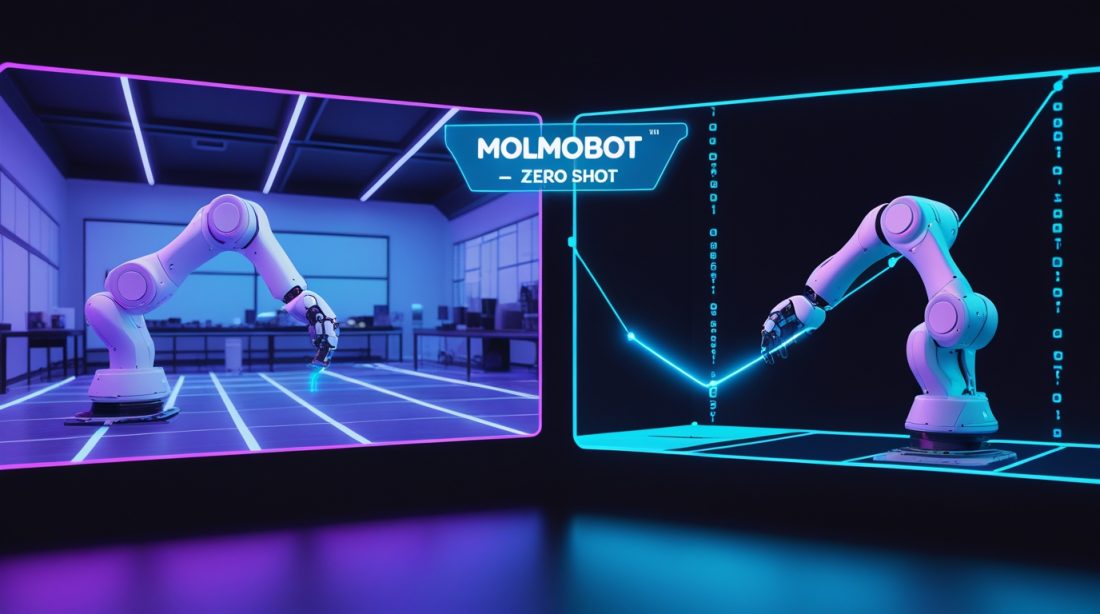
MolmoBot zero-shot sim-to-real transfer — released by the Allen Institute for AI (Ai2) on March 12, 2026 — demonstrates that robots trained entirely in simulation can outperform models trained on expensive real-world demonstration data. No human teleoperation. No real-world fine-tuning. No task-specific adaptation.
- MolmoBot achieved a 79.2% success rate on real-world pick-and-place tasks — outperforming Physical Intelligence’s π0.5, which was trained on large-scale real-world data.
- The training pipeline generated 1.8 million expert robot trajectories entirely in simulation — using 100 NVIDIA GPUs to produce 130 hours of robot experience for every hour of compute time.
- MolmoSpaces — the simulation ecosystem underpinning MolmoBot — contains 230,000+ indoor scenes, 130,000+ object assets, and 42 million physics-grounded grasp annotations.
- Everything is fully open source — models, data, pipelines, benchmarking tools — available on Hugging Face and GitHub.
- The result challenges the long-held assumption that sim-to-real transfer always requires real-world data to bridge the gap.
MolmoBot’s zero-shot sim-to-real transfer answers a question the robotics community has debated for years: can a robot trained entirely in simulation perform reliably in the real world without any real-world fine-tuning? On March 12, 2026, the Allen Institute for AI gave the field its most definitive answer yet — and that answer is yes, under the right conditions.
The implications are significant. Real-world robot training data is expensive, slow to collect, and concentrated in well-resourced labs. Google DeepMind’s RT-1 required 130,000 episodes collected over 17 months by human operators. The DROID dataset involved 76,000 teleoperated trajectories gathered across 13 institutions — roughly 350 hours of human effort. These costs are not incidental. They are the primary reason that robotics foundation model development has remained concentrated within a small group of organisations with the capital and infrastructure to sustain them.
MolmoBot’s result directly challenges that economic model. By generating trajectories procedurally within a system called MolmoSpaces, the Ai2 team bypasses the need for human teleoperation — producing 1.8 million expert manipulation trajectories at a fraction of the cost of real-world collection. If that approach holds across a broader range of tasks and environments, the constraint in robotics development shifts from data collection budgets to compute access and simulation design quality — a fundamentally more democratisable bottleneck.
The Assumption MolmoBot Challenges — and Why It Has Shaped the Entire Field
The prevailing belief in robot learning has been that simulation alone produces policies that fail in the real world. The gap between physics engines and physical reality — variations in material properties, lighting conditions, sensor noise, and the infinite variability of real environments — has historically caused simulation-trained policies to break down the moment they encounter conditions outside their training distribution.
The standard response to this sim-to-real gap has been domain randomisation: vary simulation parameters aggressively so the robot learns robust behaviour across a range of conditions rather than overfitting to one simulated environment. But even with aggressive randomisation, most approaches still required at least some real-world demonstration data before deployment — treating simulation as a pretraining tool rather than a complete training solution.
“Most approaches try to close the sim-to-real gap by adding more real-world data. We took the opposite bet: that the gap shrinks when you dramatically expand the diversity of simulated environments, objects, and camera conditions.”
— Ranjay Krishna, Director of PRIOR Team, Allen Institute for AI, March 2026
That opposite bet is what MolmoBot tests — and validates. The key insight is that manipulation policies benefit more from diversity across objects, configurations, and viewpoints than from photorealistic rendering. MolmoSpaces was built to deliver that diversity at scale: 230,000+ indoor scenes, 130,000+ object assets, procedurally varied lighting, camera angles, object placements, and physics parameters across every training run.
The result is a model that has seen so many variations of the same task — in so many different simulated environments — that the real world represents just another variation rather than a fundamentally different distribution. That is the conceptual shift behind zero-shot transfer, and it is what makes MolmoBot’s results meaningful beyond the benchmark numbers.
What the 79.2% Real-World Success Rate Actually Means
According to AI Intelligence News, MolmoBot achieved a 79.2% success rate on tabletop pick-and-place evaluations on the Franka FR3 — outperforming π0.5, Physical Intelligence’s model trained on large-scale real-world demonstration data. That comparison is the most significant data point in the entire release.
π0 and π0.5 represent the current state of the art in real-world trained manipulation models. They are the benchmark that well-resourced labs measure themselves against. The fact that a simulation-only trained model — using a fraction of the data collection cost — achieves competitive or superior performance on the same benchmarks is the result that changes the economic calculation for every team building robot training infrastructure.
79.2% – MolmoBot’s real-world pick-and-place success rate on the Franka FR3 — trained entirely in simulation, zero real-world demonstrations, outperforming models trained on large-scale physical data
The mobile manipulation results on the Rainbow Robotics RB-Y1 extend the finding beyond tabletop tasks. Door opening, drawer manipulation, cabinet interaction — all performed on unseen objects and environments without fine-tuning. MolmoBot achieves zero-shot transfer to real-world static and mobile manipulation tasks on unseen objects and environments without any fine-tuning, achieving competitive performance with prior methods including π0 and π0.5 under standard benchmarking protocols.
The open-source release amplifies the significance. Everything — models, simulation infrastructure, grasp annotations, data generation pipelines, and benchmarking tools — is publicly available. This is not a research result that stays locked inside Ai2. It is infrastructure that any lab, any startup, and any manufacturer’s robotics team can build on immediately.
MolmoSpaces — The Simulation Infrastructure That Made It Possible
MolmoBot’s results depend on MolmoSpaces — the simulation ecosystem Ai2 built to produce the diversity that makes zero-shot transfer work. Understanding MolmoSpaces is essential to understanding what MolmoBot actually proves and what its limits are.
According to MLQ’s analysis, MolmoSpaces unifies over 230,000 indoor scenes from datasets including iTHOR-120, ProcTHOR-10K, and Holodeck, with more than 130,000 object models curated from Objaverse and THOR. It features over 42 million 6-DoF grasp annotations across 48,000 objects. The platform supports physics engines including MuJoCo and is compatible with ManiSkill and NVIDIA Isaac Lab via USD conversion — making it directly interoperable with the broader simulation ecosystem that teams like NVIDIA are building with Newton.
The 100 NVIDIA GPUs running MolmoSpaces produced 130 hours of robot experience for every hour of compute time. That ratio is what makes simulation-first training economically viable at scale. Seventeen months of human teleoperation collapses to days of GPU compute. The constraint shifts from human availability and institutional coordination to raw compute access — which is commoditising faster than human robotics expertise.
This connects directly to what the NVIDIA Newton 1.0 physics engine launch demonstrated at GTC 2026: the simulation infrastructure layer is being built at pace specifically because teams building robotics foundation models now depend on it. MolmoSpaces and Newton are complementary pieces of the same shift — both designed to make simulation the primary training environment rather than a preprocessing step.
⚠ Fiction — Illustrative Scenario
A mid-size contract manufacturer in South Korea runs a components assembly line requiring a pick-and-place robot capable of handling 40 different part types across three workstation configurations. Under traditional training approaches, building a capable manipulation policy for this deployment required three months of teleoperated data collection across all 40 parts — coordinating operators across two shifts, renting specialised hardware, and managing a data pipeline that consumed 60% of the robotics team’s engineering time.
Under a MolmoBot-style simulation-first approach, the team generates procedural training environments covering all 40 parts, three workstation layouts, and variations in lighting and placement — producing 1.2 million training trajectories in 11 days of GPU compute. The resulting policy transfers zero-shot to the production line. Deployment timeline drops from 14 weeks to 5. This scenario is speculative and illustrative but reflects the deployment economics that MolmoBot’s results make credible for manufacturing environments.
The Limits of the Result — What MolmoBot Does Not Yet Prove
The honest analysis of MolmoBot’s results requires acknowledging what they do not claim. MolmoBot focuses on manipulation and articulation — pick-and-place, drawer opening, door manipulation. Navigation is explicitly out of scope. The tasks tested are structured and well-defined within MolmoSpaces’ simulation environment, which is designed around indoor scenes with rigid and articulated objects.
The real-world transfer results are impressive but tested on two specific robot platforms in controlled benchmarking conditions. The harder question — how MolmoBot performs in genuinely unstructured industrial environments with novel objects, unexpected occlusions, and the physical variability of a real factory floor — remains to be answered at production scale.
The sim-to-real transfer challenge has historically been most severe precisely in the unstructured, variable environments that manufacturing and logistics deployments involve. MolmoBot’s results suggest the gap is narrowing significantly — but the benchmark conditions and the messiness of real production environments are not the same thing yet.
What MolmoBot does prove — definitively — is that the assumption requiring real-world data as a prerequisite for capable manipulation is no longer universally valid. That proof changes the research priorities, the infrastructure investments, and the competitive economics of robot training for every team in the field. Understanding how embodied world models are reshaping robotics training shows why this result lands at exactly the right moment — as the simulation infrastructure layer matures enough to support the diversity that zero-shot transfer requires.
The broader implications for teams building robot training pipelines are explored in our analysis of digital simulation platforms for autonomous robot training — where the same sim-to-real gap question has been the central challenge for AUV deployment teams operating in environments far less structured than indoor manipulation scenarios.
Global Implications
MolmoBot’s fully open-source release is the most globally significant aspect of the result. The expensive, proprietary data collection pipelines that have kept robotics foundation model development concentrated in a handful of well-funded US and Asian labs are no longer the only path to capable manipulation policies. A university lab in Nigeria, a startup in Malaysia, or a manufacturer’s internal robotics team in Brazil can now build on MolmoSpaces and MolmoBot without the capital required to run 17-month teleoperation campaigns.
The compute requirement remains a real barrier — 100 NVIDIA GPUs is not cheap — but cloud GPU access continues to commoditise faster than robotics expertise. The open infrastructure that MolmoBot provides means the talent gap, not the data gap, becomes the limiting factor for teams outside the traditional robotics research centres. That is a meaningful shift in who can build capable physical AI systems.
The field has spent years treating the sim-to-real gap as a fundamental constraint — something to be managed and minimised rather than eliminated. MolmoBot’s March 2026 result does not eliminate it entirely, but it demonstrates convincingly that the gap is not fundamental. It is a function of simulation diversity. Build a rich enough virtual world and the real world becomes just another environment the robot has already trained for.
That shift in framing — from managing a gap to designing richer simulations — changes where the investment in robotics training infrastructure needs to go. Not more human teleoperation. Not more physical robot time. More compute, more procedurally generated environments, and more open infrastructure that the entire field can build on together.
Further Reading — Related Articles
- → NVIDIA Newton 1.0 Physics Engine — The Simulation Breakthrough That Makes Robot Training 475x Faster
- → Sim-to-Real Transfer Breakthrough Delivers 66% Better Robot Performance
- → Embodied World Models for Robotics Training — The Architecture Behind the Next Generation of Robot Policies
- → Digital Simulation Platforms for Training Autonomous Robots — The Costly Gap Most Teams Are Ignoring
- → The Physics Simulation Bottleneck — How Inaccurate Engines Are Costing Robot Teams Months of Development Time
Frequently Asked Questions
What is MolmoBot and who built it?
MolmoBot is an open-source robot manipulation model suite built by the Allen Institute for AI (Ai2) and released on March 12, 2026. It is trained entirely on synthetic simulation data — no real-world demonstrations — and achieves zero-shot transfer to real robots performing pick-and-place, door opening, and articulated object manipulation tasks on previously unseen objects and environments.
What is zero-shot sim-to-real transfer in robotics?
Zero-shot sim-to-real transfer means a robot policy trained in simulation can perform tasks on real hardware without any additional real-world training or fine-tuning. Most previous approaches required at least some real-world demonstrations after simulation pretraining to bridge the gap between virtual and physical environments. MolmoBot demonstrates that sufficient simulation diversity can eliminate that requirement for manipulation tasks.
How does MolmoBot compare to models trained on real-world data?
On tabletop pick-and-place benchmarks using the Franka FR3, MolmoBot achieved a 79.2% success rate — outperforming Physical Intelligence’s π0.5, which was trained on large-scale real-world demonstration data. This result challenges the assumption that real-world training data is necessary to achieve competitive manipulation performance.
What is MolmoSpaces and how does it enable MolmoBot’s results?
MolmoSpaces is the open simulation ecosystem that generates MolmoBot’s training data. It contains over 230,000 indoor scenes, 130,000+ object assets, and 42 million physics-grounded grasp annotations. By training across massive diversity in objects, environments, lighting, camera angles, and physics parameters, it produces policies that generalise to real environments without task-specific adaptation. It is compatible with MuJoCo, ManiSkill, and NVIDIA Isaac Lab.
Is MolmoBot available for commercial or research use?
Yes. MolmoBot and MolmoSpaces are fully open source — models, training data, data generation pipelines, and benchmarking tools are all available on Hugging Face and GitHub. The open release is designed to allow researchers, developers, and robotics teams to build on and extend the work without proprietary data or infrastructure dependencies.
What are the current limitations of MolmoBot’s approach?
MolmoBot currently focuses on manipulation and articulation tasks — navigation is out of scope. The zero-shot transfer results were validated on two specific robot platforms in benchmarking conditions. Performance in genuinely unstructured industrial environments with novel objects and unexpected variability remains to be validated at production scale. The compute requirement — 100 NVIDIA GPUs — is also a barrier for resource-constrained teams, though cloud GPU access is reducing this over time.
The robots that will work in your facility are being trained in simulation right now.
MolmoBot’s results shift the constraint in robotics from expensive data collection to simulation design quality. The teams building richer virtual worlds today will deploy capable robots faster and cheaper than teams still running teleoperation campaigns. CreedTec tracks the simulation breakthroughs, open-source releases, and training infrastructure decisions that determine which robotics teams pull ahead.
Subscribe to CreedTec →