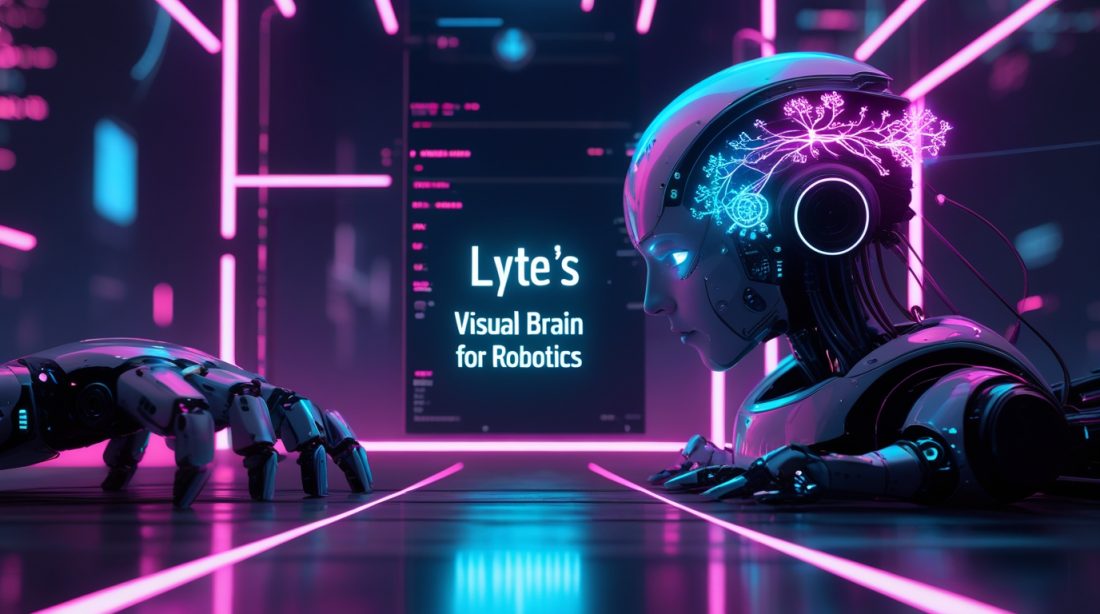
“Now in his third act, Shpunt said he believes Lyte will serve as the ‘visual brain’ for robotics, acting as both the eyes and visual cortex.” — Bloomberg, January 5, 2026
What happens when the team behind one of the world’s most deployed computer vision systems—Apple’s Face ID—turns its attention to industrial robots? The answer is Lyte, a startup that emerged from stealth this week with a $107 million war chest and a mission to give machines a human-like understanding of their surroundings. This move signals a pivotal shift: the race for superior robot perception, a long-standing bottleneck in automation, is now being led by veterans of consumer-grade, safety-critical vision systems.
Why a “Visual Brain for Robotics” Changes the Industrial AI Game
For all their precision, today’s industrial robots often operate in carefully controlled environments. They struggle with the unpredictability of a real warehouse floor—a fallen box, shifting shadows, or a human coworker stepping into the path. This perception gap limits flexibility and safety, confining automation to repetitive, structured tasks.
Lyte’s founders, Alexander Shpunt, Arman Hajati, and Yuval Gerson, know a thing or two about reliable vision. They were key architects of Apple’s Face ID, a system used by hundreds of millions to securely unlock devices in any lighting condition. At Lyte, they’re applying that expertise to a far more complex canvas: the dynamic, messy physical world.
How Lyte’s “Visual Brain” Works: From Sensors to Understanding
Lyte isn’t just building better cameras; it’s architecting a unified perception system. Their platform, LyteGalaxy, combines custom sensing hardware (LyteVision), edge computing, and software into a single stack. This integration is designed to deliver what the company calls “4D perception”—understanding space, color, and motion in real time over a single connection.
The goal is to provide robots with a consistent, lag-free operating view of their environment, allowing them to make decisions “at the speed of reality”. In practice, this could mean a logistics robot navigating a crowded aisle without hesitation or a manufacturing arm safely adjusting its grip on an irregularly shaped part.
The Industrial Impact of a Reliable Visual Brain for Robotics
The implications for sectors like manufacturing, logistics, and advanced mobility are profound. A reliable “visual brain” could finally enable the widespread deployment of collaborative robots (cobots) that work safely alongside humans in shared spaces. It also addresses a critical barrier to scalability: reducing the immense time and cost currently required to manually program robots for every new task or environment.
- Fiction for illustration: Consider a palletizing robot in a distribution center. Today, if a package slips off the conveyor belt at an odd angle, the robot might fail to recognize it, causing a jam that halts the line. With advanced perception, the robot would instantly identify the anomaly, adjust its path, and safely retrieve the package, maintaining workflow without human intervention.
Critical Considerations for Deployment and Governance
For industry leaders evaluating such a foundational platform, the roadmap to deployment will involve navigating well-understood challenges in advanced automation. Success will depend not only on the technology’s capabilities but on proactively addressing operational and governance frameworks from the outset. The risks fall into distinct but interconnected categories.
A Framework for Proactive Risk Assessment
The following table outlines key risk categories for a platform like Lyte’s “visual brain,” extrapolated from current research in robotics, cybersecurity, and neurotechnology.
| Risk Category | How It Could Manifest for Lyte | Supporting Evidence from Related Fields |
|---|---|---|
| Security & Cyber Threats | The “visual brain” becomes a target for hacking, sabotage, or data theft. A compromised robot’s perception could be maliciously altered. | Experts warn brain-computer interfaces create novel risks because “criminals could access the brain directly via an electronic device”. Securing a critical industrial “brain” would be paramount. |
| Safety & Unpredictable Failures | System misinterprets a complex scene (e.g., fails to bind visual features correctly), leading to a collision or dangerous action. The robot’s intent may become unclear to human workers. | Research into human-robot interaction finds user stress increases when “the user did not know what the robot was going to do next”. A black-box “brain” could exacerbate this. |
| Privacy & Autonomy Erosion | The rich visual data processed could be used for worker surveillance beyond safety, infringing on privacy. Over-reliance could degrade human operators’ skills and situational awareness. | Scholars argue that technologies that read neural data threaten a “loss of people’s core sense of identity and autonomy”. While not neural, pervasive visual analytics pose similar ethical questions. |
| Societal & Economic Impact | Accelerated automation could lead to significant workforce displacement in logistics and manufacturing. It could also concentrate advanced capabilities with only the largest firms that can afford it. | A common critique of advanced tech is its potential to “exacerbate social inequalities” and create new forms of “digital dementia” or cognitive deskilling. |
How Lyte and its industrial partners address these considerations will be a key determinant in the technology’s adoption timeline and its ultimate impact on the factory floor.
The Road Ahead and the Bigger Picture
Lyte’s emergence underscores that the race for superior robot perception is intensifying. For industrial operators, the message is now twofold: the next wave of productivity gains will come from advanced perception, but harnessing it safely will require equal investment in the security, reliability, and ethical governance frameworks outlined above. As former Apple engineers tackle this challenge, the line between consumer-grade precision and industrial robustness is beginning to blur—promising a future where robots can see and understand our world, provided we build the necessary safeguards around their new vision.
TL;DR
Lyte, a startup founded by three key engineers behind Apple’s Face ID, has emerged with $107M in funding. They are building a unified “visual brain” for robots—combining sensors, compute, and software—to solve the critical perception problems that limit robots in dynamic, real-world industrial environments.
FAQ
What is Lyte’s “visual brain”?
It’s Lyte’s term for its integrated perception system (LyteGalaxy platform), which aims to give robots a unified, real-time understanding of their 3D environment, including space, color, and motion, much like a human’s visual cortex.
Who are Lyte’s founders?
Lyte was founded in 2021 by Alexander Shpunt, Arman Hajati, and Yuval Gerson, all former Apple employees who were central to the development of the Face ID system.
How much funding has Lyte raised?
The company has raised approximately $107 million from investors as it comes out of stealth mode.
Why is this important for manufacturing and logistics?
Superior robot perception allows for safer, more flexible, and scalable automation. Robots can work in unstructured environments, collaborate with humans, and adapt to new tasks without extensive reprogramming, addressing major cost and efficiency barriers.
Stay ahead of the curve on how AI is transforming physical industries. Subscribe to our newsletter for expert analysis on the latest breakthroughs in robotics, automation, and Industrial AI.
Further Reading & Related Insights
- Voice AI Audio Interfaces → Complements the shift in human-machine interaction, showing how audio and vision together redefine industrial workflows.
- Industrial AI Strategy Analysis: How Robots, Tariffs, and Human Skills Define 2026’s Competition → Connects robot perception advances to broader industrial competitiveness and strategy.
- Mobile Manipulation Robot Rescues Frontline Worker 2025 → Highlights practical robotics applications in dynamic environments, aligning with Lyte’s “visual brain” mission.
- Three Lives of a Robot: Industrial AI → Explores the lifecycle of industrial robots, reinforcing the importance of perception systems for adaptability.
- Why Domain Randomization in Industrial Robotics Is the Secret Weapon Behind Smarter, More Resilient Automation → Provides context on training strategies for resilient robot perception, complementing Lyte’s approach to real-world vision.