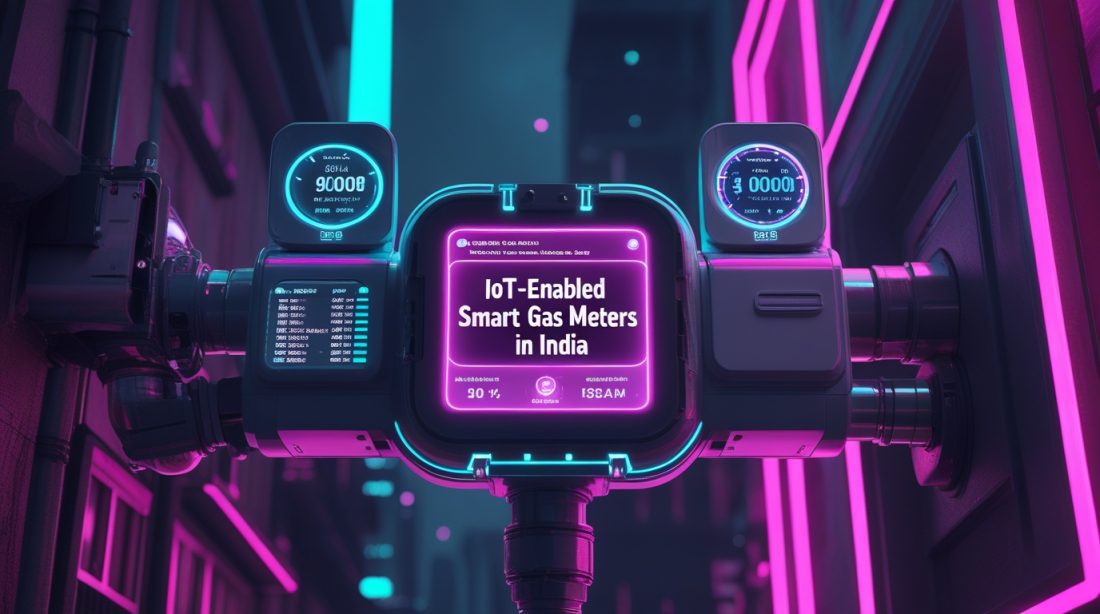
Imagine overseeing a city gas network where nearly 30% of the distributed fuel is lost before it ever reaches a customer’s stove—vanishing through leaks, theft, or billing errors. This isn’t a hypothetical scenario but the pressing reality of “Lost and Unaccounted Gas” (LUAG) that Indian City Gas Distribution (CGD) companies face. This massive operational and financial drain is the core challenge now being targeted by India’s most significant utility modernization effort since electricity smart meters: the nationwide rollout of IoT-enabled smart gas meters in India.
Forget viewing these devices as simple digital replacements for analog dials. Their transformative power lies in becoming constant data-generating nodes on a massive industrial Internet of Things (IoT) network. The real story isn’t the meter itself, but the continuous stream of consumption, pressure, and flow data it provides. When processed with modern analytics, this data shifts utility management from reactive guesswork to predictive, AI-driven intelligence. It answers the fundamental industrial question: how can we transform a leaky, opaque pipeline into a precise, accountable, and efficient energy delivery system?
This shift is gaining formidable momentum. The Petroleum and Natural Gas Regulatory Board (PNGRB) projects the CGD sector will become India’s largest natural gas consumer, accounting for one-third of total national volume by 2030. To serve this demand efficiently, companies like Vi Business are expanding their IoT portfolios with dedicated smart gas metering solutions, leveraging Narrowband-IoT technology to connect meters and provide real-time operational insights.
Why India’s Smart Gas Meter Rollout Is Accelerating Now
The drive for smart gas metering aligns with broader national goals. The government’s Revamped Distribution Sector Scheme (RDSS), with an outlay of approximately ₹3.04 trillion, demonstrates a massive financial commitment to modernizing utility infrastructure, even as it primarily targets electricity. This creates a policy and technological blueprint that the gas sector can follow.
Market analysis forecasts the India smart gas meter market growing from $134.16 million in 2025 to $187.47 million by 2035. This growth is propelled by more than policy; it’s driven by urgent operational needs:
- Revenue Protection: A direct attack on LUAG directly boosts the financial health of CGDs.
- Customer Demand: A growing commercial segment—the fastest-growing application area—seeks precise energy management for cost control.
- Infrastructure Scaling: As CGD networks expand to new cities and consumers, building them as smart, data-native systems from the start is more efficient than retrofitting later.
The ‘Why’ Behind the Technology: From Meter Reading to Predictive Intelligence
The primary technological shift is from simple Automatic Meter Reading (AMR)—which currently holds the largest market share—toward full IoT connectivity, the market’s fastest-growing segment. IoT-enabled meters provide two-way communication, enabling not just data collection but also remote commands, like safe disconnection in case of a leak or non-payment.
This flow of granular data is what fuels higher-order industrial intelligence. For example, AI/ML platforms can analyze consumption patterns to:
- Identify anomalies suggestive of leaks or theft in near real-time, drastically improving response times and safety.
- Enable predictive maintenance for distribution infrastructure by correlating data from meter endpoints with network performance.
- Provide consumers with insights into their usage, fostering conservation without compromising service.
“Digital metering is reshaping how utilities operate, and Smart Gas Metering is the next frontier in India’s utility transformation.” — Arvind Nevatia, Chief Enterprise Business Officer, Vi.
Overcoming Integration Hurdles: The Path to Scalable Deployment
The journey is not without obstacles. A significant challenge is integration complexity with legacy systems and grid operations. Furthermore, the regulatory landscape, while supportive, is still evolving. Model bid documents for smart metering projects prescribe specific frameworks, such as 10-year DBFOOT (Design, Build, Finance, Own, Operate, and Transfer) contracts and requirements for empanelment certificates. Navigating these requires expertise.
Successful deployment hinges on:
- Robust Communication Networks: Dependable, widespread IoT connectivity, like NB-IoT, is the backbone.
- Data Security: Protecting the vast amount of generated consumption and network data is paramount to maintaining system integrity and customer trust.
- Consumer Engagement: Translating raw data into actionable, user-friendly insights for both utility operators and end-users is critical for long-term adoption.
The Strategic Outlook: More Than Just a Meter Replacement
The strategic implication of India’s smart gas meter expansion extends beyond operational fixes. It represents a foundational step in building a data-driven, resilient, and efficient national gas grid. This infrastructure is crucial for managing a cleaner fuel mix as India works toward its 2070 net-zero emissions target.
For industrial analysts, the key metrics to watch are no longer just the number of meters deployed. The real indicators of transformation will be the percentage reduction in LUAG, the improvement in billing accuracy (which can reach up to 98%), and the emergence of new data-driven services for commercial and residential consumers.
Table: Key Market Segments and Drivers for Smart Gas Meters in India
FAQ: Understanding India’s Smart Gas Metering Push
What is the main benefit of an IoT-enabled smart gas meter versus an older automatic meter?
While automatic meters (AMR) collect data for billing, IoT-enabled meters enable two-way, real-time communication. This allows utilities to remotely monitor for leaks, manage network pressure, and offer consumers detailed usage insights, moving from mere reading to active network management.
How do smart gas meters help reduce India’s Lost and Unaccounted Gas (LUAG)?
They combat LUAG by providing precise, tamper-evident consumption data to eliminate billing errors and pilferage. More importantly, their continuous data stream can be analyzed to quickly identify anomalous flow patterns indicative of leaks or theft in the distribution network, enabling a rapid response.
Are smart gas meters secure? Could they be hacked?
Cybersecurity is a paramount concern for utilities. Reputable solutions incorporate fortress-grade data security, encryption, and secure communication protocols (like NB-IoT) to protect data integrity and prevent unauthorized access. The industry is increasingly investing in cybersecurity enhancements as deployments scale.
What role does AI play in smart gas metering systems?
AI and machine learning transform raw meter data into actionable intelligence. They power predictive maintenance algorithms to foresee pipeline issues, analyze consumption for demand forecasting, and disaggregate usage patterns to provide tailored insights to consumers and utilities.
Fast Facts
The strategic rollout of IoT-enabled smart gas meters in India is a core effort to modernize city gas networks. Primarily aimed at slashing massive gas losses (LUAG) and improving billing accuracy, this expansion is creating the essential data foundation for AI-driven utility management. While challenges like system integration persist, the shift is paving the way for greater efficiency, safety, and a more resilient, data-smart national gas grid.
Stay ahead of the curve on how data and AI are transforming critical infrastructure. Subscribe to our newsletter for in-depth analysis on industrial technology trends delivered directly to your inbox.
Further Reading & Related Insights
- AI Cybersecurity Threats to IoT Devices → Explores vulnerabilities in IoT networks, directly relevant to securing smart gas meters against hacking.
- Audit-Driven IIoT Adoption Crisis → Highlights governance and compliance challenges in industrial IoT rollouts, echoing India’s regulatory hurdles.
- How to Fix IIoT Data Latency and Achieve Real-Time Visibility → Addresses the critical need for real-time data in utility networks, aligning with predictive intelligence from smart meters.
- Industrial IoT Platform Driving Emerging Market Growth → Shows how IoT platforms are scaling in emerging markets, complementing India’s nationwide rollout.
- Industrial Wi-Fi Zoning for Reliable IIoT Networks → Focuses on connectivity reliability, a backbone requirement for NB-IoT smart gas metering systems.