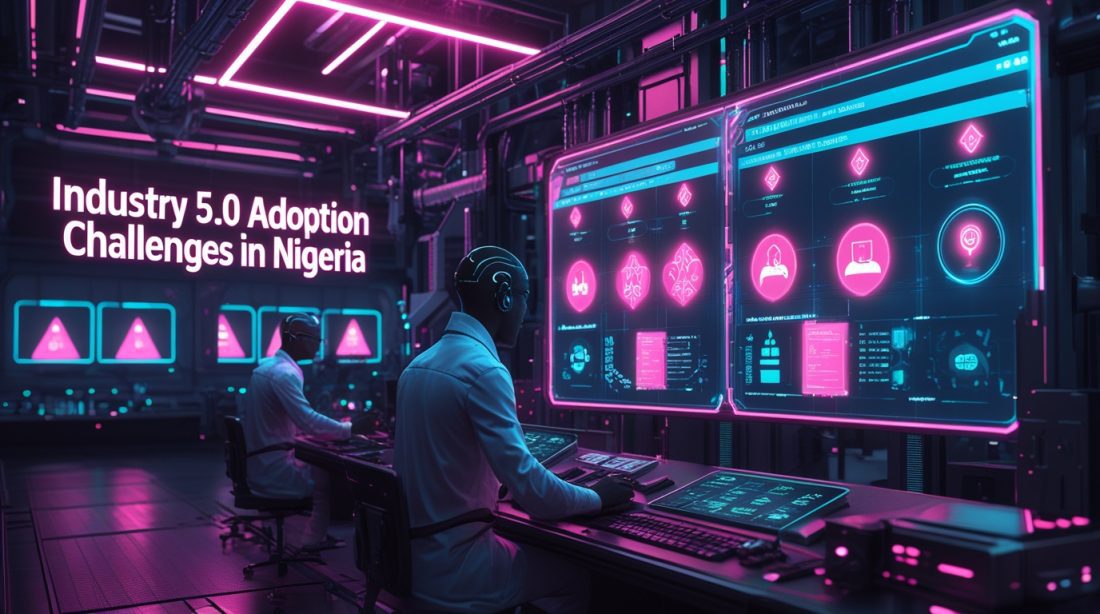
In a world racing toward full automation, Nigeria’s manufacturing future hinges on a more nuanced question: how can it harness industrial AI not to replace its human workforce, but to elevate it? The global shift to Industry 5.0—a paradigm prioritizing human-centricity, sustainability, and resilience alongside technology—presents a strategic imperative for Africa’s largest economy. Successfully navigating the Industry 5.0 adoption challenges in Nigeria is critical, as this is not merely an adoption of new tools but a necessary evolution to translate billions in new industrial investment into sustainable productivity and competitive advantage. The central argument is clear: Nigeria’s successful implementation depends on creating a synergistic partnership between its growing technological infrastructure and its vast human capital.
The integration maintains your original argument while positioning the keyword as a central theme of the analysis. If you would like this keyword woven into other specific sections, feel free to point them out.
Why Industry 5.0 is Nigeria’s Strategic Manufacturing Imperative
The foundational motivation for embracing Industry 5.0 is the need to move beyond efficiency alone. While smart manufacturing in Nigeria is accelerating—with 84% of manufacturers planning major IoT expansions and reporting 45% less unplanned downtime—the goal is now shifting toward resilience and international competitiveness . The Nigerian manufacturing sector attracted significant investment as part of a broader $5bn inflow, driven by policy reforms aimed at improving the business climate . To protect and multiply this investment, factories must evolve into agile, human-centered ecosystems that can withstand global supply chain shocks and meet sophisticated export standards.
This transition is supported by a powerful business case. Early adopters of connected systems in Nigeria, such as a Lagos-based textile manufacturer, have demonstrated transformative results, including a 78% improvement in product quality consistency and a 61% reduction in unplanned downtime . These gains provide the essential capital and operational stability needed to fund the next phase: integrating AI that collaborates with, rather than sidelines, the workforce.
The Human-Centered AI Framework: Beyond Automation to Augmentation
The core of Industry 5.0 in a Nigerian context is redefining the role of the operator. The objective is human-machine collaboration in Nigerian factories, where technology acts as an augmentative force. This is a deliberate pivot from a pure automation focus (Industry 4.0) to a model where collaborative robots (cobots) and AI handle dangerous, repetitive, or data-intensive tasks, freeing skilled workers for problem-solving, innovation, and oversight .
- From Supervisor to Partner: In advanced global models, AI vision systems detect microscopic defects, but the human operator remains responsible for final validation and deciding corrective actions . This preserves critical human judgment and expertise.
- Upskilling as an Investment: A major global barrier to AI adoption is a lack of internal expertise, cited by 45% of manufacturers . Forward-thinking corporations are responding not just with hiring, but with large-scale upskilling. For instance, Toyota launched a software academy with 100 courses focused on AI and data security, viewing workforce development as a core strategic pillar . For Nigeria, where technical skill gaps are a documented challenge, such a commitment to continuous training is non-negotiable for Industry 5.0 success .
Table: Contrasting Industry 4.0 and Industry 5.0 for Nigerian Manufacturing
| Feature | Industry 4.0 Focus in Nigeria | Industry 5.0 Vision for Nigeria |
|---|---|---|
| Core Driver | Connectivity, data collection, and automation for efficiency. | Human-AI collaboration for resilience and personalized value. |
| Workforce Role | Operators monitoring automated systems. | Skilled collaborators and decision-makers augmented by AI. |
| Primary Benefit | Increased productivity and cost reduction (e.g., lower downtime). | Enhanced competitiveness, job quality, and adaptive capacity. |
| Key Technology | IoT sensors, cloud data platforms. | Collaborative robots (cobots), AI-powered decision support, AR for training. |
| Outcome | Smart, data-informed factories. | Agile, sustainable, and people-centric production ecosystems. |
Navigating the Tripartite Path to Implementation
Successfully navigating Industry 5.0 adoption challenges in Nigeria requires alignment among three key stakeholders: Industry, Government, and the Workforce, each with distinct roles and incentives .
- Industry’s Role: Strategic Integration and ROI Focus: Nigerian industrial leaders must move beyond pilot projects to scaled integration with clear return on investment. Globally, high-performing companies are those that fundamentally redesign workflows around AI and commit significant digital budgets to these technologies . The focus should be on use cases with proven, tangible value in the local context, such as AI-driven predictive maintenance—which has delivered hundreds of millions in savings for global manufacturers—or automated quality inspection .
- Government’s Role: Enabling Policy and Infrastructure: The government’s function is to create a conducive ecosystem. This includes developing regulatory frameworks for industrial AI that ensure safety and ethics while encouraging innovation, and providing incentives for technology adoption and workforce reskilling programs . The announced focus on leading the African Continental Free Trade Area (AfCFTA) underscores the need for policies that make Nigerian smart factories continental leaders .
- Workforce’s Role: Adaptive Learning and Engagement: The workforce must engage in continuous skill adaptation. The transition promises to reduce physical strain and mundane tasks, but it demands new competencies in data literacy, system interaction, and digital troubleshooting. As one analysis notes, the “Operator 5.0” is envisioned as a worker who leverages technological assistance to perform tasks more effectively while maintaining safety .
FAQ: Industry 5.0 and Nigerian Manufacturing
- Is Nigeria ready for Industry 5.0, or is it still catching up on Industry 4.0?
The process is concurrent. Many Nigerian manufacturers are actively building Industry 4.0 foundations through massive IoT deployment, which generates the data essential for future AI applications . Industry 5.0 is the strategic framework guiding this technological investment toward sustainable and human-centric outcomes. - Will AI and automation in Nigerian factories cause widespread job losses?
The Industry 5.0 model emphasizes job transformation over outright displacement. The goal is AI augmentation of manufacturing jobs in Nigeria, where technology handles repetitive tasks, allowing workers to focus on higher-value activities like supervision, maintenance, process optimization, and customization. Global surveys show that while some roles may change, organizations using AI primarily see shifts in skill requirements rather than drastic reductions in workforce size . - What is the most feasible first step for a Nigerian manufacturer?
The most practical step is to strengthen data infrastructure. Reliable, scalable data collection and management (Industrial DataOps) is the bedrock of any effective AI application . Investing in robust IoT connectivity and data platforms to enable predictive analytics for maintenance or quality control offers a clear path to quick wins and ROI, building confidence for more advanced collaborative applications.
Fast Facts
Navigating the Industry 5.0 adoption challenges in Nigeria is central to transforming recent industrial investments into lasting competitiveness. Success requires integrating advanced AI with a deliberate focus on augmenting the human workforce, necessitating aligned action from industry, government, and workers to build resilient and productive smart factories.
Stay Ahead of Nigeria’s Industrial Transformation
The shift to human-centric smart manufacturing is accelerating. Subscribe to our newsletter for monthly analysis, exclusive case studies from Nigerian factories, and insights on leveraging AI for sustainable industrial growth.
📩 Subscribe Now
Further Reading & Related Insights
- AI Robotics in Nigeria Agriculture → Connects Industry 5.0 with Nigeria’s agricultural sector, showing how AI robotics can augment human labor.
- China Domestic Robot Training Base 2025 → Highlights global infrastructure for AI and robotics training, relevant to Nigeria’s industrial adoption path.
- Managing Orphaned AI Models: Industrial Risk → Explores governance and sustainability challenges in AI, aligning with Nigeria’s need for resilient frameworks.
- AI Bubble Narrative: Industrial AI ROI → Examines hype versus reality in industrial AI investment, reinforcing the ROI imperative for Industry 5.0.
- How Human-in-the-Loop Workflows Save Millions → Demonstrates the value of human-AI collaboration, a cornerstone of Industry 5.0’s human-centric vision.