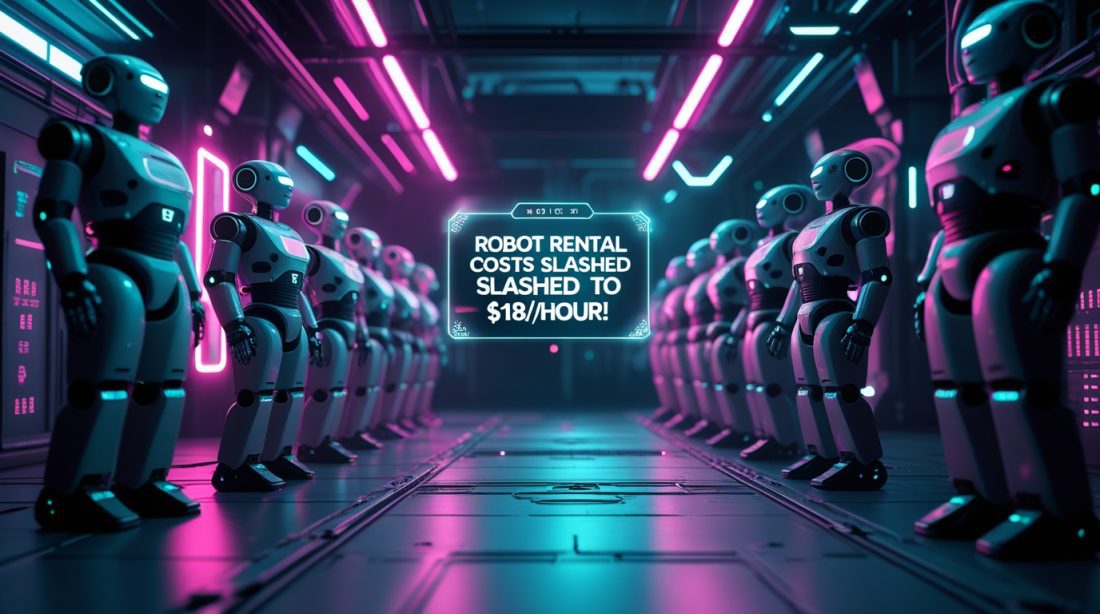
Industrial robot rental costs are undergoing a seismic shift, making the promise of automation accessible to businesses that have long been priced out. The headline-grabbing figure of an $18-an-hour robot worker from Tutor Intelligence is not a futuristic fantasy but a concrete signal of a maturing market. A market projected to grow from $1.5 billion to $4 billion by 2031 is not just expanding—it is fundamentally changing who can participate. This shift moves industrial automation from a capital-intensive purchase reserved for giants to a flexible operational expense, a transformation with profound implications for the resilience and competitiveness of the small and medium-sized businesses (SMBs) that form the backbone of U.S. manufacturing.
Why the Upfront Cost of Automation Has Been a Deal-Breaker
For decades, the barrier to automation was not desire, but daunting economics. A single industrial robot could require a capital outlay of up to $500,000, an impossible sum for a family-owned factory. Beyond the sticker price, hidden costs multiplied: specialized programming, safety infrastructure like cages, and dedicated maintenance personnel. This created a classic “robot graveyard” problem—expensive equipment purchased with hope that gathered dust due to complexity and integration challenges.
The financial risk was simply too high for SMBs operating on thin margins. As Mike O’Donnell of MAGNET notes, these companies often succeeded for years with the status quo and were hesitant to “bet big” on a technology that required deep expertise they didn’t possess. The result was a stark automation divide, where only the largest corporations could leverage robotics for efficiency, leaving smaller players at a growing competitive disadvantage.
The Economic Shift: Calculating the Real Impact of Industrial Robot Rental Costs
The “Robots as a Service” (RaaS) model shatters the old financial logic. By converting a massive capital expenditure (CapEx) into a predictable operating expense (OpEx), it removes the single biggest hurdle to entry. Companies like Tutor Intelligence, Formic, and Hirebotics provide the robot, installation, programming, maintenance, and repairs for a simple hourly or monthly fee.
The impact is immediate and tangible. For S&F Foods, a frozen food maker outside Detroit, renting a palletizing robot for approximately $23 an hour solved a critical labor problem. The backbreaking job of lifting heavy boxes led to high turnover; automating it allowed the company to retain workers by moving them to more engaging tasks. Similarly, Polar Manufacturing in Chicago leases a robot for an effective rate of $8 per hour to feed a metal press—a task cheaper than the local minimum wage and one that freed a human worker for more valuable work.
This model aligns incentives perfectly. The rental company is motivated to ensure the robot is productive and reliable, as their revenue depends on its uptime. For the factory, there is no long-term commitment; they can test automation on a specific task with minimal risk. “To be able to step in with a subscription model makes automation a lot friendlier,” confirms Dustin Pederson, CFO of Locus Robotics.
Why Key Industries Are Rapid Adopters of Robot Rentals
The flexibility of rental is fueling adoption across sectors with variable demand and tough labor conditions. Market analysis segments this growth by both application and end-user, revealing clear patterns.
Material Handling and Palletizing: This is the most common entry point, as seen with S&F Foods. These are repetitive, physically taxing jobs with high injury and turnover rates. Robots excel at the precise, uncomplaining work of moving boxes, and their deployment is often framed as a worker-retention strategy, not just a cost-saving one.
Automotive and Electronics Manufacturing: Even in highly automated industries, rental provides crucial flexibility. Companies can scale robotic capacity for a new model launch or a surge in orders without permanent investment. The automotive sector remains a dominant end-user, leveraging rentals for tasks like welding and assembly.
Food and Beverage & Pharmaceuticals: These regulated industries benefit from robots’ consistency and hygiene. Rental allows them to implement automation for packaging or dispensing without the upfront capital and to easily upgrade to meet evolving sanitary standards.
A Personal Anecdote (Fictionalized for Illustration):
*Imagine a third-generation owner of a Midwestern automotive parts supplier, Maria. She’s watched larger competitors automate, but a $300,000 robot arm was never in the cards for her 50-person shop. When a major client demanded a 30% increase in output, the traditional solution—hiring and training a night shift—was slow and risky. Instead, Maria leased a collaborative robot for a multi-month project. For a known hourly cost, it handled the overnight machining feed operation. The contract was simple, the provider handled all the tech support, and when the order was fulfilled, the robot left. For Maria, rental didn’t just solve a capacity crunch; it proved the value of automation on her terms, paving the way for future strategic investments.*
What Challenges and Regulations Could Slow Adoption?
Despite its promise, the robot rental market is not without headwinds. Industry analysts point to a lack of standardization in rental agreements, which can create confusion and complicate comparisons for businesses. Furthermore, as these connected systems handle more proprietary manufacturing data, concerns over cybersecurity and data privacy are rising.
A significant new variable is evolving global regulation. The European Union’s AI Act, with provisions phasing in from 2026, will require CE marking and conformity assessments for “high-risk AI systems,” which include many AI-integrated industrial robots. Robotics associations have expressed concern that mandatory third-party certifications could hinder innovation and be particularly burdensome for SMEs. These regulatory frameworks will inevitably influence rental agreements, potentially affecting liability, data governance, and compliance costs.
The Strategic Imperative for Modern Manufacturing
The emergence of a viable rental model is more than a new purchasing option; it is a strategic enabler. For the vast landscape of small manufacturers—which constitute 93% of U.S. manufacturing firms—it offers a path to modernize and compete. As Saman Farid, CEO of Formic, observes, it allows them to redirect human workers from “dull, dirty, dangerous, repetitive, backbreaking tasks” to more productive and satisfying roles, addressing chronic turnover issues.
The long-term trajectory is clear. “We’re entering that same time now with robots,” says investor Shahan Farshchi, comparing the shift to the dawn of personal computing. As the technology continues to advance, with artificial intelligence making robots more adaptable, and 5G connectivity enabling more seamless integration, the rental model ensures that these advancements are not locked behind a paywall for large corporations only.
The $18-an-hour robot is a powerful symbol of this democratization. It represents a future where industrial transformation is defined not by the size of a company’s balance sheet, but by the strategic creativity of its leaders. For businesses that have waited on the sidelines, the question is no longer if they can automate, but how strategically they can start.
FAQ
How does the cost of renting a robot truly compare to hiring a human worker?
The direct hourly rate is often comparable or lower—ranging from $8 to $23 per hour in reported cases. However, the total economic equation includes far more: robots work multiple shifts without breaks, reduce costs related to injury, turnover, hiring, and training, and can lead to significant gains in output consistency and quality.
Will renting robots lead to widespread job displacement in factories?
Current evidence suggests rental models are primarily used to automate tasks with extreme turnover rates or high injury risk, roles manufacturers struggle to fill. Leaders like Mike Calleja of S&F Foods frame it as a worker retention strategy, allowing them to reassign people to more skilled, higher-value work. The immediate effect is more about job transformation than elimination.
What are the typical contract terms for renting an industrial robot?
Terms are flexible, catering to different needs. They range from short-term rentals (days or weeks) for pilot projects or seasonal demand, to long-term leases (months or years) for core operational tasks. Key providers bundle installation, programming, maintenance, and support into the periodic fee, with clear uptime guarantees.
Can rented robots be customized for my factory’s specific task?
Yes, to a significant degree. Providers specialize in common applications like palletizing, welding, or machine tending. Their value lies in adapting their standard robotic platforms—using different grippers, sensors, or programming—to meet your specific workflow. For highly unique processes, a consultation is necessary to determine feasibility.
What happens if the rented robot breaks down?
A core benefit of the RaaS model is that maintenance and repairs are the responsibility of the rental provider. Their business model depends on maximizing robot uptime, so they are incentivized to respond quickly to any issues. Service level agreements (SLAs) typically guarantee a certain level of operational availability.
TL;DR: The emergence of robot rental models for as low as $18 an hour is transforming industrial automation from a capital-intensive purchase into a flexible operating expense. This shift is finally making robotics accessible to small and medium-sized manufacturers, allowing them to automate dangerous, repetitive tasks, retain workers, and boost competitiveness without massive upfront investment.
Stay ahead of the automation curve. Subscribe to our newsletter for monthly insights on industrial AI, robotics trends, and practical strategies for modernizing your manufacturing operations.
Further Reading & Related Insights
- Delivery Robot Safety Concerns → Explores how autonomous delivery robots raise safety and accessibility issues, echoing Nigeria’s challenge of aligning AI systems with public trust and compliance.
- Robotics in Nigerian Factories: Downtime Reduction → Examines how robotics improve efficiency in Nigerian manufacturing, directly connected to your article’s focus on industrial competitiveness.
- AI-Powered Security Robots for Public Safety → Highlights AI systems deployed in public environments, raising similar questions of reliability, oversight, and compliance.
- Why Domain Randomization in Industrial Robotics Is the Secret Weapon Behind Smarter, More Resilient Automation → Provides technical insight into how AI systems adapt to unpredictable environments, relevant to Nigeria’s export quality control challenges.
- The Rise of the Industrial AI Data Marketplace → Explores how industrial AI data marketplaces are reshaping enterprise ecosystems, reinforcing the importance of unified, trusted data for compliance.