Fast Facts — Read This First
What This Article Covers
- Industrial IoT architecture ROI is the missing conversation — most deployments focus on connectivity, not financial outcomes, which is why so many fail to generate measurable returns
- Organizations following structured IIoT deployment frameworks achieve 80–90% project success rates with 25–40% improvements in operational efficiency (Oxmaint, 2025)
- Most manufacturers achieve positive ROI within 12–24 months for critical asset monitoring — initial investments of $200K–$800K commonly generate $1–3M in annual operational improvements
- The Unified Namespace (UNS) architecture is emerging as the fastest path to eliminating data silos — the single biggest ROI killer in IIoT deployments
- Edge-first architectures reduce latency and lower cloud bandwidth costs — the two operating expenses most cloud-heavy deployments underestimate at the outset
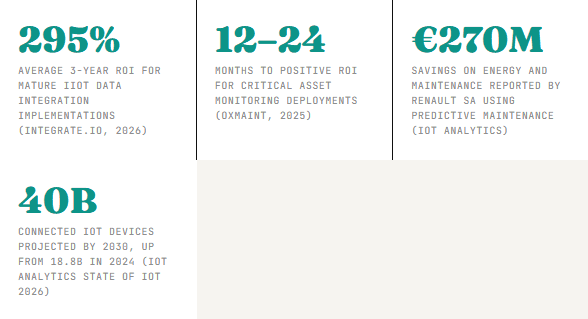
- Connected IoT devices are growing from 18.8 billion in 2024 to 40 billion by 2030 — the infrastructure decisions made now will determine who captures value from that growth
The central argument of this piece is one the industry has been reluctant to make directly: most Industrial IoT deployments fail to generate meaningful ROI not because the technology doesn’t work, but because the architecture was designed around connectivity rather than financial outcomes.
That distinction matters more in 2026 than it ever has. Connected IoT devices are projected to grow from 18.8 billion in 2024 to 40 billion by 2030 according to IoT Analytics’ State of IoT Summer 2026 report. More devices mean more data. More data means more infrastructure decisions. And every infrastructure decision that prioritizes connection over outcome is money spent generating dashboards nobody acts on.
The industrial IoT architecture ROI problem has a precise diagnosis: when architecture is decided before the financial case is defined, the system is built to collect data rather than to generate value. As a recent analysis published on IoT Tech News put it plainly — “technology on its own does not create value; integration into operational systems does.”
This article maps the six architectural frameworks that are demonstrably generating returns in 2026 — not in controlled pilots, but in production environments. It also explains why human nature — specifically the desire for visible progress, the fear of being left behind on digital transformation, and the organizational weakness of IT/OT silos — drives so many companies toward the wrong architecture for the wrong reasons.
Why Industrial IoT Architecture ROI Starts With the Balance Sheet, Not the Sensor
The sequencing error that kills most IIoT ROI is predictable: a company decides it needs to be “more connected,” selects a platform, deploys sensors across a facility, and then asks what to do with the data. The financial case is constructed after the fact, around whatever the data happens to show.
The architecture that generates returns runs the sequence in reverse. Start with the specific operational cost driving the most financial pain — unplanned downtime, energy waste, quality defects, or logistics inefficiency. Document that cost against a baseline. Then design an architecture whose sole purpose is reducing that specific number. Everything else — platform choice, connectivity protocol, cloud versus edge — follows from that anchor.
“Architecture supports the business case, rather than shaping it.”— IoT Tech News, Designing Industrial IoT Around Measurable ROI, March 2026
This matters because audit-driven IIoT adoption crises are well documented — organizations that cannot demonstrate ROI from their connectivity investments face internal pressure to cut infrastructure budgets, which in turn undermines the very programs that would eventually generate returns if given time to mature.
The human psychology driving the wrong sequence is straightforward: fear. Every executive in 2026 has seen headlines about competitors deploying IIoT at scale. The pressure to move — to show the board something connected and modern — drives architecture decisions that should take months into compressed timelines measured in weeks. The result is a system that looks impressive in a demonstration and generates marginal value in production.
Why the 6 IIoT Architectures Below Actually Work — And What Makes Them Different
The frameworks below are not theoretical. Each is documented in production environments with measurable financial outcomes attached. What they share is a design principle that the connectivity-first approach lacks: every architectural decision is evaluated against its impact on operating cost and revenue, not against its technical sophistication.
Framework 01
Edge-First Architecture — Processing Where the Data Lives
Edge-first architecture moves data processing to the source rather than routing everything to a central cloud. Sensors and edge gateways handle local filtering, anomaly detection, and decision-triggering — only exceptions and summarized insights travel upstream. The result is sub-millisecond response times for critical alerts and a dramatic reduction in cloud bandwidth costs.
According to Katalyst Technologies, a Tier-1 auto-parts manufacturer deploying lightweight TensorRT models on NVIDIA Jetson edge devices feeding a Kafka stream to their enterprise MES achieved €1.7 million in annual savings. The architecture decision that made this possible was local inference — models running directly on the gateway rather than sending raw video to the cloud for processing.
The financial logic is direct: cloud storage and bandwidth for continuous high-resolution sensor feeds is expensive. Edge processing keeps 80–90% of raw data local, sending only the signals that matter.
Documented ROI driver
20–35% energy optimization savings and 35–50% reductions in unplanned downtime are the two most consistently documented outcomes from edge-first deployments in manufacturing environments, according to Oxmaint’s 2025 industry benchmarks.
Framework 02
Unified Namespace (UNS) — Eliminating the Silo Tax
The Unified Namespace is an architectural pattern where all operational data — from PLCs, SCADA systems, MES, ERP, and sensor networks — flows into a single, real-time data broker rather than living in separate, disconnected systems. Every application reads from and writes to the same namespace. There is no data translation layer, no integration middleware, no scheduled batch sync.
The ROI case for UNS is built on eliminating what the industry increasingly calls the “silo tax” — the hidden cost of maintaining separate data pipelines, resolving conflicting data versions across systems, and the delay between an operational event and the decision that should respond to it. IT and OT teams clashing over IIoT data ownership is one of the most documented failure modes in industrial connectivity — UNS removes the architectural root cause of that conflict.
According to the IIoT World 2025 survey of 446 IIoT professionals, data integration and the rise of UNS is one of the defining architectural shifts in the sector — specifically because it allows real-time industrial data unification that makes decision-making possible rather than just data collection.
Documented ROI driver
Organizations using event-driven architectures — of which UNS is the industrial implementation — report 295% average ROI over three years, with top performers achieving 354% returns, according to Integrate.io’s 2026 real-time data integration report.
Framework 03
Hybrid Edge-Cloud Architecture — Matching Compute to Latency Requirements
Not every data stream requires millisecond response times. Not every workload belongs at the edge. Hybrid architecture explicitly separates latency-sensitive decisions — safety alerts, machine control, quality inspection — from latency-tolerant workloads — reporting, predictive model training, supply chain coordination — and routes each to the appropriate compute layer.
The financial advantage of hybrid over pure cloud is the operating cost difference. Hybrid private 5G deployments in industrial environments demonstrate that processing latency-sensitive workloads locally while maintaining cloud connectivity for analytics reduces bandwidth costs significantly — in bandwidth-constrained environments, transmitting every data point to the cloud is neither practical nor economically justifiable.
Documented ROI driver
Hybrid architectures are specifically recommended by IoT Tech News for remote or bandwidth-constrained environments where cloud-only approaches carry ongoing storage and bandwidth expenses that erode the financial case. The operating expenditure reduction is evaluable from the outset as part of the financial model.
Framework 04
Condition-Based Monitoring Architecture — Starting With One Asset
Condition-based monitoring architecture concentrates sensor deployment and analytics on the specific assets where unexpected failure creates the highest operational and financial impact. Rather than instrumenting an entire facility, this approach starts with one production line, documents the baseline failure rate and repair cost, deploys vibration, thermal, and power-draw sensors on the target asset, and measures performance against that documented baseline.
The business logic is conservative by design: prove ROI on a single asset before scaling. When savings are consistent and repeatable, the approach extends to additional assets with documented confidence. Bosch’s documented predictive maintenance savings follow exactly this pattern — concentrated on high-value assets before facility-wide rollout.
Critical equipment monitoring typically delivers returns in 12–18 months. The constraint is not the technology — it is the discipline to start focused rather than broad.
Documented ROI driver
Machine vision — one specific form of condition-based monitoring — had the highest ROI and fastest payback period of all Industry 4.0 technologies tracked by IoT Analytics, driven by AI-assisted flaw detection and process optimization. Georgia-Pacific attributed hundreds of millions of dollars in annual value capture to targeted AI applications.
Framework 05
OT-IT Integrated Security Architecture — Protecting the ROI, Not Just the Network
Every IIoT deployment that generates ROI also creates a larger attack surface. Operational Technology systems — PLCs, SCADA, DCS — were designed for reliability, not security. Connecting them to information networks without an integrated security architecture is not just a cybersecurity risk; it is a financial risk. A single successful attack on an IIoT-connected production environment can erase months of efficiency gains in hours.
The Mitsubishi Electric acquisition of Nozomi Networks — covered in depth in our OT cybersecurity analysis — signals where the industrial sector is placing its security bets. The merger of OT expertise with network security intelligence represents the architecture direction that serious industrial deployments are moving toward: security embedded into the data pipeline, not bolted on afterward.
Documented ROI driver
IDC projects that 75% of large manufacturers will deploy AI-enabled OT cyber defense by 2030 — a clear indicator that unprotected IIoT connectivity is already being priced as a liability rather than an asset in industrial risk models.
Framework 06
Subscription-Based Sensor Analytics Architecture — Turning Infrastructure Into Income
The most financially sophisticated IIoT architecture in 2026 treats the sensor network not just as a cost-reduction tool but as a revenue-generating asset. IIoT sensors with subscription-based analytics are surging precisely because manufacturers have realized that the validated operational data their sensors generate has commercial value beyond their own four walls.
The architecture enables data licensing to OEM equipment manufacturers, insurance underwriters, and benchmark buyers — the same model explored in depth in our analysis of industrial IoT platforms driving emerging market growth. The sensor network pays for itself through internal efficiency gains and generates additional recurring revenue through licensed external access.
Documented ROI driver
This architecture converts a capital expenditure — sensor hardware and network infrastructure — into an ongoing revenue line. Total value creation from this model frequently exceeds direct cost savings by 200–300% when strategic licensing revenue is included alongside operational efficiency gains.
Field Note — Fiction A supply chain director I’ll call Priya had spent 18 months arguing for a facility-wide IIoT rollout. She got the budget. The sensors went in across all three production lines simultaneously. Six months later, the dashboards were beautiful. The data was flowing. The ROI report was blank. The issue wasn’t the technology. The issue was that nobody had defined what “success” looked like before the first gateway was installed. The system was designed to collect everything. Nobody had decided what to do with anything. The CFO asked her one question at the review: “What specific cost did this reduce, and by how much?” She had no answer. Not because the data wasn’t there — it was. But the architecture had been built around connection, not around that question. The next deployment, she started with the CFO’s question. Picked one asset. Documented the baseline. Deployed in 30 days. Had an answer in 90.— CreedTec Analyst, Illustrative Account Based on Documented IIoT Deployment Patterns
Why Human Nature Drives the Wrong Architecture Choice — And How to Correct It
The psychology behind failed IIoT ROI is consistent enough to be predictable. Three human dynamics drive the connectivity-first mistake:
The desire for visible progress. Sensors installed across a facility look like transformation. Dashboards showing live data feel like achievement. Both satisfy the organizational desire to demonstrate momentum — even when neither is connected to a financial outcome. The architecture that generates ROI is less visually impressive at deployment and more financially meaningful at the six-month review.
The fear of falling behind. Digital transformation anxiety is real. When a competitor announces an IIoT initiative, the pressure to respond accelerates internal timelines in ways that compress the financial planning that should precede architectural decisions. The result is a deployment that matches the competitor’s press release and fails to match their financial case.
The weakness of organizational silos. IT teams optimize for network performance. OT teams optimize for equipment reliability. Finance teams optimize for capital efficiency. When none of these functions owns the IIoT architecture decision collectively, the result is a system that satisfies each team’s individual metrics and fails to satisfy the one metric that matters: return on investment.
📌 The Architecture Test Every CFO Should Apply
Before approving any IIoT architecture, ask one question: “If this system generates the data it’s designed to generate, what specific financial decision will we make differently, and how much will that decision be worth?” If the answer requires more than two sentences, the architecture has not been designed around an outcome. It has been designed around connectivity.
Why 2026 Is the Year Architecture Decisions Compound — or Constrain
The IIoT decisions made in 2026 carry a disproportionate long-term weight. Connectivity-as-a-Service models are changing how industrial infrastructure is procured and maintained — moving from capital expenditure to subscription models that lock organizations into architectural patterns for years at a time.
Organizations that embed financial logic into their architecture decisions now — starting with the balance sheet, defining the operational problem precisely, testing at the asset level before scaling — build infrastructure that compounds. Each data point becomes more valuable as the dataset grows. Each validated outcome becomes licensable. Each efficiency gain funds the next deployment phase.
Organizations that defer the financial logic — deploying first, justifying later — build infrastructure that constrains. The sunk cost of an underperforming deployment makes it politically difficult to redesign. The complexity of an over-instrumented facility makes it expensive to maintain. The gap between connected and profitable widens rather than closes.
According to IoT Analytics’ Industrial AI Market Report 2025–2030, the global industrial AI market — within which IIoT architecture is the foundational layer — was valued at $43.6 billion in 2024 and is projected to reach $153.9 billion by 2030 at a 23% CAGR. The organizations capturing that growth are not the ones with the most sensors. They are the ones whose architecture was designed to generate a return from the first deployment decision.
Frequently Asked Questions About Industrial IoT Architecture ROI
What is Industrial IoT architecture ROI?
Industrial IoT architecture ROI refers to the measurable financial return generated by a specific IIoT deployment design — including edge computing, cloud integration, sensor infrastructure, and data pipeline decisions. It is calculated by comparing operational cost reductions, uptime improvements, and revenue gains against total implementation and ongoing infrastructure costs.
Which Industrial IoT architecture generates the best ROI?
Edge-first architectures combined with Unified Namespace data frameworks generate the strongest documented ROI for most manufacturers — primarily because they reduce latency, lower cloud bandwidth costs, and eliminate the data silos that prevent operational decisions from connecting to the systems that execute them. The best architecture for any specific facility depends on the primary cost driver being targeted.
How long does Industrial IoT ROI take to materialize?
Most manufacturers achieve positive ROI within 12 to 24 months for critical asset monitoring deployments. Facility-wide implementations typically optimize over 24 to 36 months. Initial investments of $200,000 to $800,000 commonly generate $1 to $3 million in annual operational improvements, according to Oxmaint’s 2025 industry benchmarks.
Why do most Industrial IoT deployments fail to deliver ROI?
The primary failure point is architectural sequencing: most IIoT deployments are designed around connectivity first and financial outcomes second. When predictive alerts don’t connect to maintenance management software, no work order is generated and no cost is reduced. Architecture must follow the business case, not precede it.
What is the Unified Namespace and why does it matter for ROI?
The Unified Namespace is an architectural pattern where all operational data flows into a single real-time data broker rather than living in separate disconnected systems. It eliminates the “silo tax” — the hidden cost of maintaining separate data pipelines and the delay between operational events and the decisions that should respond to them. Organizations using event-driven architectures built on UNS principles report 295% average ROI over three years.
The Architecture Is the Strategy — Choose It Like One
Beyond connectivity is not a destination — it is a discipline. The organizations generating real industrial IoT architecture ROI in 2026 did not arrive there by deploying more sensors or choosing a better platform. They arrived there by treating every architectural decision as a financial decision and every connectivity choice as a commitment to a specific outcome.
The six frameworks in this piece are not exhaustive. They are representative of a design philosophy: start with the cost you want to eliminate, build the minimum architecture that addresses it, prove the return, then scale. That sequence sounds obvious. It contradicts the way most IIoT projects actually run.
The gap between connected and profitable is not a technology gap. It is a sequencing gap. Fix the sequence, and the returns follow.
Get the IIoT Architecture Analysis Before Your Competitors Do
Weekly breakdowns on Industrial IoT ROI frameworks, connectivity strategy, and the operational decisions separating profitable deployments from expensive dashboards.
Subscribe for Weekly Insights →