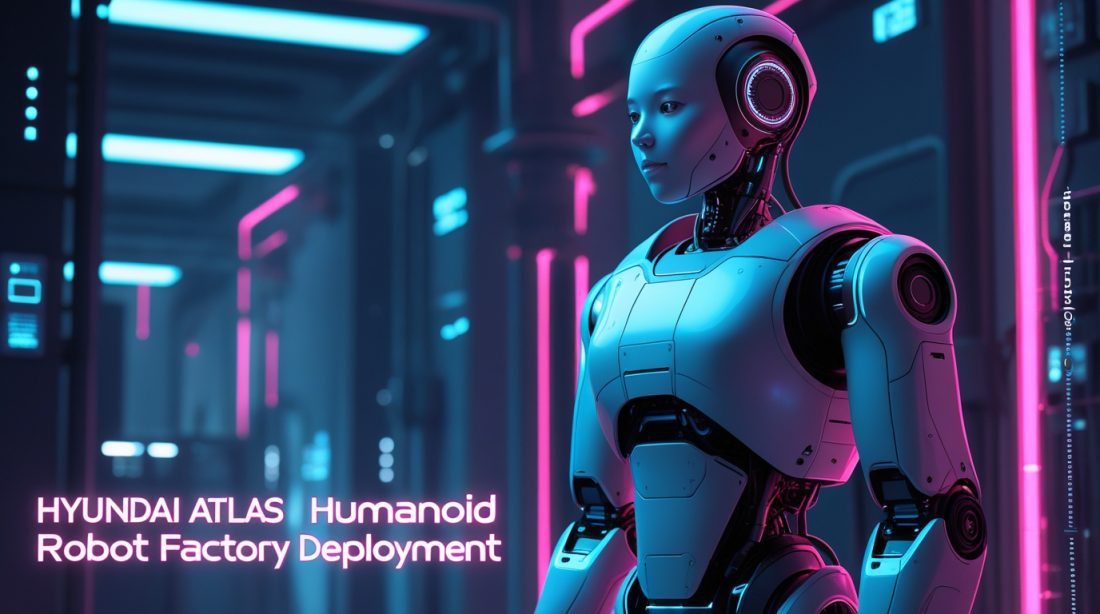
At the Consumer Electronics Show (CES) in January 2026, a blueprint for the next decade of manufacturing was revealed, centered on the Hyundai Atlas humanoid robot factory deployment. Hyundai Motor Group, leveraging its majority ownership of Boston Dynamics, announced the product-ready version of the all-electric Atlas humanoid robot and, more importantly, a concrete plan to begin its deployment in Hyundai’s own factories by 2028. This is more than a dazzling tech demo.
It answers a pressing industrial question: as companies face chronic labor shortages and intense global competition, what is the most viable pathway to bring advanced, adaptive robotics from the lab to the harsh reality of the production floor? The Hyundai Atlas humanoid robot factory deployment strategy—anchored by a specific date—offers a masterclass in pragmatic industrial AI strategy, prioritizing internal validation, strategic partnerships, and human-robot collaboration as the cornerstones of a new physical AI revolution.
Why Hyundai’s Factory Plan is the Smartest Move in Robotics
For years, the promise of general-purpose humanoid robots has been trapped in a cycle of spectacular research videos and pilot purgatory. The chasm between a prototype that can perform a choreographed task and a fleet of robots that can reliably work multiple shifts in a dynamic factory is vast. Hyundai’s decision to use its own automotive manufacturing network as the first proving ground is a deliberate, calculated move to bridge this chasm. It signals a shift from selling a vision to solving a tangible business problem.
As Boston Dynamics CEO Robert Playter stated, “This is the best robot we have ever built. Atlas is going to revolutionize the way industry works“. Hyundai is ensuring that the revolution starts within its own walls, where it can control the environment, integrate directly with its production systems, and prove the robot’s economic value before offering it to the world. This internal deployment creates a powerful feedback loop where real-world factory data directly fuels the improvement of both the robot’s hardware and the AI software that controls it.
The Technological Breakthrough: More Than Just a Dancing Robot
The new Atlas unveiled at CES is a machine engineered for the rigors of industry, not just the spotlight of a stage. Its specifications reveal a focus on durability, integration, and practical utility.
- Electric and Enduring: Unlike its hydraulic predecessor, the all-electric Atlas is designed for continuous operation. It can autonomously navigate to a charging station, swap its own battery, and return to work with minimal downtime—a critical feature for achieving the sustained uptime required in manufacturing.
- Built for Force and Range: With 56 degrees of freedom and joints capable of full rotation, Atlas possesses a remarkable range of motion. It can lift up to 50 kg (110 lbs) and extend its reach to 2.3 meters (7.5 ft), allowing it to perform tasks from heavy material handling to precise machine tending.
- Designed for Production: Boston Dynamics explicitly designed this generation of Atlas for manufacturability. Zack Jackowski, GM of Atlas, noted it has “significantly reduces the amount of unique parts” and that “every component has been designed for compatibility with automotive supply chains”. This focus on leveraging existing, scalable automotive manufacturing processes is what will allow Hyundai to eventually produce robots at its planned new factory, capable of an output of 30,000 units per year.
The Commercial Pathway: From Hyundai’s Factory to a $200 Billion Market
Hyundai’s roadmap provides a clear template for commercialization that others in the robotics space lack. The strategy is built on three foundational partnerships announced at CES 2026:
- Partnering Humans with Robots: Starting in manufacturing, robots will take on hazardous, dangerous, and repetitive tasks to ease physical strain on workers. Hyundai Vice Chair Jaehoon Chang addressed job displacement concerns directly, stating people will still be needed to train robots and perform higher-value roles.
- Partnering the Group Value Network with Boston Dynamics: This is the engine of scale. Hyundai will combine Boston Dynamics’ robotics expertise with its global manufacturing might, supply chain (via Hyundai Mobis actuators), and logistics (via Hyundai Glovis) to build an end-to-end AI Robotics value chain.
- Partnering with AI Leaders: The collaboration with Google DeepMind aims to integrate cutting-edge foundation models to give Atlas greater cognitive capabilities for reasoning and task learning.
This integrated approach is why analysts are bullish. Barclays Research estimates the global humanoid robotics market could grow from $2–3 billion today to a staggering $200 billion by 2035. Hyundai, by being its own first and best customer, is positioning itself to capture a leading share of this emerging physical AI market.
The Strategic Implications: A New Front in Global Industrial Competition
Hyundai’s move cannot be viewed in isolation. It is a strategic gambit in a larger global race where industrial AI and robotics are becoming core to national competitiveness. As noted in a CreedTec industrial AI strategy analysis, while the U.S. grapples with workforce challenges, China is executing a state-backed strategy to become the “land of robots,” with its humanoid robotics sector projected to surge. Hyundai’s fusion of Korean manufacturing precision, American robotics innovation (Boston Dynamics), and advanced AI (Google) creates a formidable transnational alliance.
The goal is not merely to automate tasks but to build what Hyundai calls a “human-centered smart factory.” The deployment at the Hyundai Motor Group Metaplant (HMGMA) in Georgia, USA, by 2028 is the first step. Success there will provide a replicable model for the global manufacturing sector, proving that humanoid robots can be a flexible, adaptive component of the industrial workforce.
Navigating the Remaining Challenges
Despite the compelling strategy, significant hurdles remain on the path to widespread adoption. These are the barriers Hyundai must solve within its own factories to make Atlas a true success:
- Safety and Certification: Operating fenceless alongside humans requires new, stringent safety standards and reliable human-detection systems that are still being formalized.
- Dexterity and Adaptation: While Atlas is strong, fine manipulation and adapting to highly unstructured tasks remain a challenge. As Ayanna Howard, a prominent roboticist, points out, translating simulation training to the messy physical world is a fundamental hurdle.
- Total Cost of Ownership: To achieve broad adoption beyond deep-pocketed corporations, the cost of humanoids must fall dramatically from current prototype levels. Hyundai’s focus on automotive supply chains and mass production is directly aimed at this problem.
Fiction: An operations manager at a mid-sized auto parts supplier watches the CES announcement. She’s intrigued by the potential to automate a difficult loading station that has high turnover, but she immediately wonders: “What’s the real cost per shift after maintenance? Can it be trained by my line supervisors, or do I need a PhD in robotics? How long before this moves from Hyundai’s showcase factory to a supplier like me?” These are the questions Hyundai’s 2028 deployment is designed to answer.
A Deployment to Watch
The announcement of the Atlas robot is impressive, but the commitment to a specific Hyundai Atlas humanoid robot factory deployment by 2028 is what makes 2026 a pivotal year. It represents a transition from research-oriented development to solution-driven deployment. Hyundai is betting that the fastest way to create a viable commercial humanoid robot is to become its own most demanding customer. The world’s manufacturing sector will be watching Georgia closely, not just for dancing robots, but for the hard data on productivity, reliability, and return on investment that will define the next era of industrial AI.
FAQ: Hyundai’s Atlas Robot and Factory Automation
Q: Will humanoid robots like Atlas take away human jobs in factories?
A: The stated strategy from Hyundai and other adopters is augmentation, not replacement. Robots are initially targeted at hazardous, repetitive, or physically strenuous tasks that are difficult to fill due to labor shortages. Hyundai’s Vice Chair has emphasized that human workers will be needed to train, supervise, and maintain these systems, potentially shifting the workforce to higher-value roles.
Q: When will humanoid robots like Atlas be available for other companies to buy?
A: Boston Dynamics has stated that all 2026 production is committed to Hyundai and Google DeepMind, with plans to add additional customers in early 2027. Widespread commercial availability will follow the initial internal deployment and validation phase.
Q: Are humanoid robots safe to work alongside people?
A: Safety is the paramount challenge. The new Atlas includes features like human detection and fenceless guarding. However, achieving full, certified safety for close collaboration in unstructured environments is an active area of development and standardization that must be solved before mainstream deployment.
Q: What is the cost of a humanoid robot like Atlas?
A: Official pricing has not been released. Current advanced prototypes from various companies can cost $150,000 to $500,000. A key part of Hyundai’s strategy is to leverage automotive manufacturing scale and supply chains to drive this cost down radically, with analysts suggesting a long-term target range of $20,000 to $50,000 per unit for broad viability.
TL;DR: Hyundai’s plan to deploy Boston Dynamics’ Atlas humanoid robots in its own factories by 2028 is a strategic masterstroke. It moves beyond flashy demos to solve real industrial problems, leverages Hyundai’s manufacturing scale to drive down costs, and creates a blueprint for the physical AI revolution. This internal deployment is the critical first step toward making humanoid robots a practical, economic reality in global manufacturing.
Follow the convergence of AI and physical systems as it reshapes industry. Subscribe to the CreedTec Insights newsletter for in-depth analysis on robotics, smart supply chains, and the industrial strategies defining our future. [Subscribe Here]
Further Analysis from CreedTec: