The central question for industrial leaders in 2026 is no longer whether AI is useful, but why its integration into complex physical operations remains so fraught with risk and disappointing returns. While headlines tout new models and robotics, a quieter, more significant story is unfolding at the intersection of advanced research and applied engineering. The recent achievement of Lawrence Dale Perkins, a 1999 Northview High School graduate and U.S. Air Force electronics engineer, in earning his Ph.D. in Intelligent Systems and Robotics offers a tangible case study in addressing this core challenge.
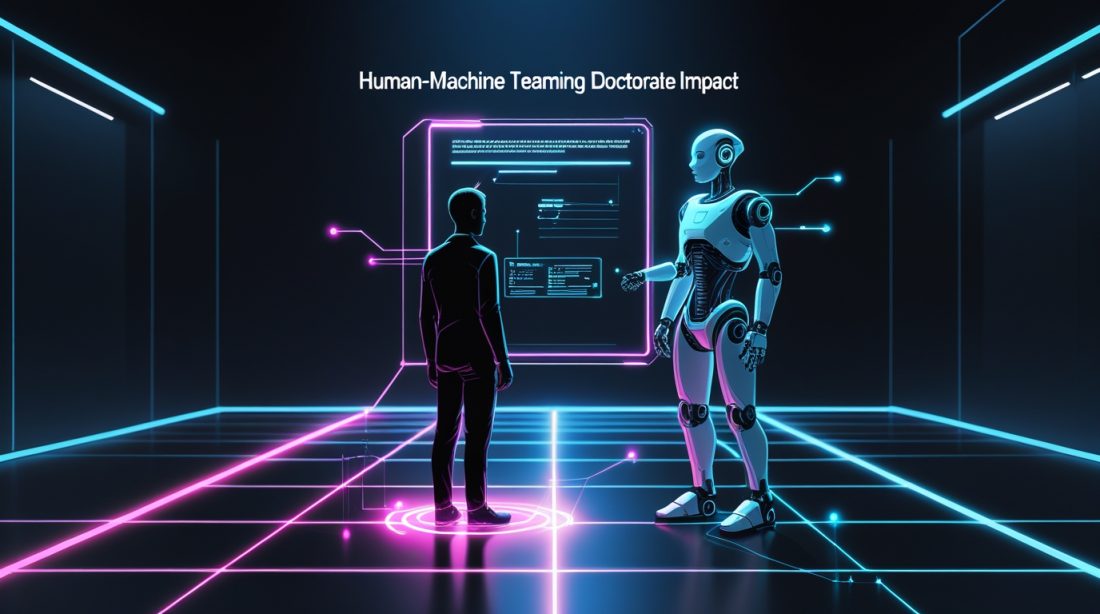
His dissertation on human-machine teaming provides a direct lens into the precise expertise needed to transition industrial AI from isolated pilot projects to reliable, scaled infrastructure, demonstrating the concrete human-machine teaming doctorate impact on solving real-world integration barriers.
This transition is the defining industrial battle of 2026. As noted by industry analysts, AI is beginning to “stop behaving like a side project and start behaving as infrastructure,” yet most organizations are still applying powerful new tools to broken or poorly understood processes. Perkins’ work, conducted through the University of West Florida and the Institute for Human and Machine Cognition, centers on a concept critical to this infrastructural shift: human-machine teaming. His research moves beyond viewing AI as a mere tool, instead framing it as a collaborative agent within a team—a perspective essential for the complex, safety-critical domains of manufacturing, energy, logistics, and defense where he operates.
Why a Human-Machine Teaming Doctorate Impact Industrial AI Strategy in 2026
The promise of agentic AI—systems that can autonomously execute workflows—is a dominant trend for 2026. Imagine an AI that doesn’t just alert a manager to a machine failure but autonomously generates a work order, checks part inventories, and schedules a technician. However, Gartner predicts that 40% of agentic AI projects will fail by 2027, often because they are misapplied or lack a clear anchor in a singular business problem. The failure isn’t in the technology’s capability, but in its integration with human roles and trust.
Perkins’ research tackles this integration gap head-on. In the high-stakes environment of U.S. Air Force operations, where he serves as an electronics engineer and SMART Scholarship recipient, the cost of misalignment between human operators and autonomous systems is measured in more than dollars. His predictive modeling work seeks to create frameworks where multi-agent systems (teams of AI) can scale their collaboration with human teams effectively. For industrial analysts, this translates to a vital lesson: the greatest ROI from AI in 2026 will not come from the most advanced algorithm, but from the most thoughtfully designed human-AI workflow.
This is where the industrial sector’s high failure rate for AI projects, estimated at up to 80% in complex physical industries, meets its solution. Success requires moving from a “crowdsourced” approach of testing many small use cases to a disciplined, top-down strategy focused on redesigning core workflows. Perkins’ doctorate exemplifies the deep, cross-disciplinary expertise—merging electrical engineering, computer science, and industrial systems—required to lead this redesign.
Why the Defense and Aerospace Sector Is a Leading Indicator for Industrial AI
The pathway of researchers like Perkins is a leading indicator for broader industrial adoption. The defense sector operates as a high-fidelity proving ground for technologies that later proliferate in civilian industry. The challenges are magnified: systems must be robust, secure, and function in unpredictable environments, making the principles of human-machine teaming non-negotiable.
This aligns with a major 2026 trend: the shift from generic generative AI to domain-specific, context-aware models. A generic language model doesn’t understand the safety protocols of a factory floor or the thermal tolerances of a jet engine. “In physical environments, context isn’t a nice-to-have; it’s the difference between insight and risk,” notes Giedrė Rajuncė, CEO of an industrial AI platform. The specialized training in systems engineering and robotics embodied by Perkins’ academic journey is the blueprint for building this essential domain intelligence.
Furthermore, the defense sector’s urgent need to stay ahead of global competitors like China, which is executing a state-backed strategy to dominate embodied automation and robotics, fuels this advanced research. The expertise cultivated here—in making AI reliable, trustworthy, and synergistic with human decision-making—will inevitably cascade into adjacent industries such as autonomous transportation, smart grid management, and advanced manufacturing.
‘States have taken the lead, as they have in so many issues… AI is the big one.’ — Tim Storey, CEO, National Conference of State Legislatures, on the evolving 2026 regulatory landscape for AI.
Why This Research Matters for the 2026 Industrial Workforce
The advancement symbolized by this doctorate also underscores a critical vulnerability and opportunity in the 2026 industrial workforce. The U.S. faces a profound skills gap, with widespread “math anxiety” eroding the foundational numeracy required to operate, maintain, and innovate within AI-driven ecosystems. At the same time, the nature of work is shifting. PwC’s 2026 predictions highlight the “rise of the AI generalist,” where agents handle specialized tasks, and human roles evolve toward oversight, orchestration, and strategy.
Perkins’ career trajectory—from Northview High to a doctorate while serving in the Air Force—models a pathway for building this future workforce. It highlights the necessity of combining hands-on experience with complex physical systems (gained through military or trade roles) with advanced theoretical training in AI and robotics. For industry, the imperative is twofold: first, to actively support continuous reskilling and advanced education for existing employees, and second, to partner with educational institutions to create pipelines for this hybrid expertise. Occupations in this field are projected to grow by 20% between 2024 and 2034, with roles like AI research scientist commanding median salaries approaching $200,000.
From Academic Model to Industrial Blueprint
The story of Lawrence Dale Perkins earning his doctorate is more than a local academic achievement. It is a concrete signal of where industrial AI must head in 2026 to deliver on its long-hyped potential. The key insights for industrial leaders are clear:
- Prioritize Teaming Over Tools: Invest in the design of human-AI collaborative processes as rigorously as you invest in the AI models themselves.
- Seek Domain-Deep Expertise: Value and integrate the specialized knowledge of professionals who understand both the physical operations of your industry and the capabilities of intelligent systems.
- Build the Workforce for Infrastructure: Recognize that scaling AI requires a new blend of skills and commit to developing talent that can bridge the gap between frontline operations and advanced analytics.
As AI transitions from a disruptive novelty to the operational backbone of industry, the human element—curated, enhanced, and strategically partnered with machine intelligence—remains the ultimate determinant of success. Research focused on this partnership, as demonstrated in this 2026 doctoral work, provides the essential blueprint for turning technological potential into durable competitive advantage.
FAQ: Human-Machine Teaming and Industrial AI
Q: What exactly is “human-machine teaming” in an industrial context?
A: It’s a framework where AI systems (like robots or software agents) are designed as collaborative teammates with human workers, rather than just tools. This involves AI understanding context, predicting human needs, and taking autonomous actions within a defined, trusted workflow—such as an AI agent coordinating a maintenance response after diagnosing a machine fault.
Q: Why is a doctorate-level research project relevant to factory floor problems?
A: The fundamental challenges of scaling AI in complex, physical environments—like trust, communication, and workflow design—are exactly what advanced academic research investigates. The models and principles developed in dissertations provide tested frameworks that industries can adapt to solve practical issues of integration and reliability, moving beyond one-off pilot projects.
Q: What’s the difference between generic AI (like ChatGPT) and the AI needed for industry?
A: Generic AI models lack specific knowledge of industrial equipment, safety protocols, and operational contexts. Using them can be a liability. Industrial AI requires domain-specific models trained on proprietary data (e.g., machine vibration logs, maintenance histories) to provide accurate, actionable, and safe recommendations for physical operations.
Q: How can a company start building a workforce capable of human-machine teaming?
A: Focus on developing “AI generalists” and upskilling current employees. Combine cross-training in data literacy and AI oversight with deep preservation of institutional domain knowledge. Encourage partnerships with universities and support advanced certifications for high-potential engineers, fostering the hybrid expertise that bridges operational reality with technical possibility.
Fast Facts
The human-machine teaming doctorate impact on industrial AI is demonstrated by a 2026 Ph.D. dissertation from a U.S. Air Force engineer. It provides a critical blueprint showing that success depends less on the AI itself and more on strategically redesigning workflows and building trust between workers and autonomous agents. This domain-specific, teamwork-focused approach is key to overcoming AI’s high failure rate in complex physical industries.
Stay Ahead of the Industrial Shift: The integration of AI into the physical world of manufacturing and defense is the defining story of this decade. For ongoing, in-depth analysis of these converging trends, subscribe to the CreedTec Insights newsletter. Receive exclusive commentary, expert interviews, and strategic frameworks delivered directly to your inbox.
For further analysis on the strategic context of this shift, explore our related insights on Industrial AI Strategy Analysis for 2026 Competition and the new compliance landscape in 2026 AI Regulation Compliance.