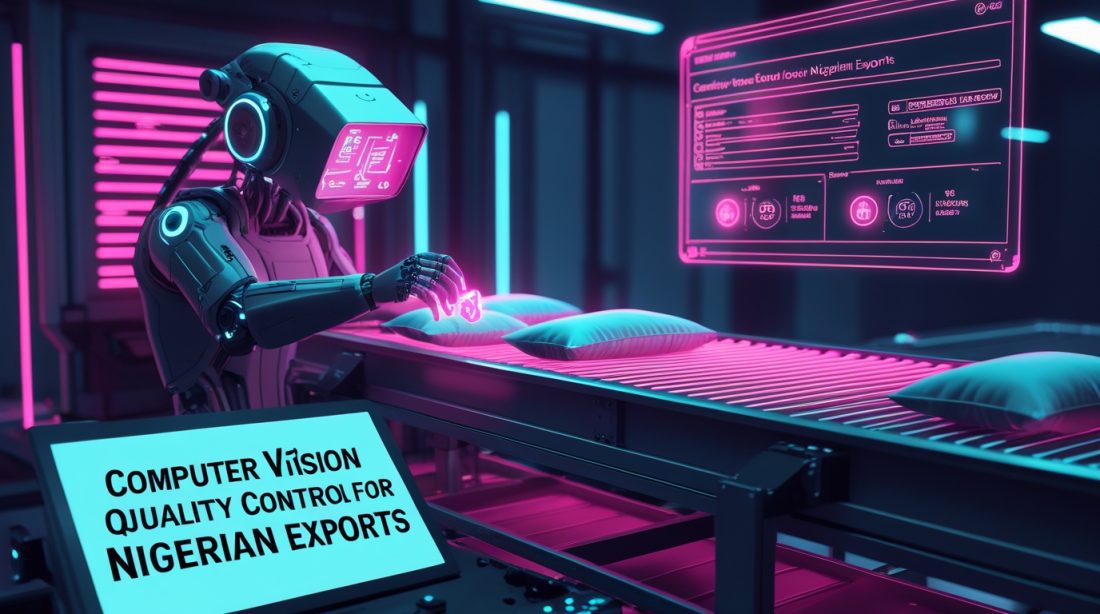
For decades, the narrative around Nigerian exports, particularly in agriculture and manufacturing, has been entangled with challenges of consistency, standardization, and trust. Rejected shipments, costly returns, and the persistent “quality perception gap” have clipped the wings of the nation’s export ambitions. Today, however, a new tool is fundamentally rewriting this story. The strategic implementation of computer vision quality control for Nigerian exports is no longer a futuristic concept but a present-day imperative for survival and growth in the fiercely competitive EU and Asian markets.
“Our commodities must now be traceable to the exact farm boundary, legally produced, and verifiably deforestation-free.” – Abubakar Kyari, Nigeria’s Minister of Agriculture and Food Security, on the stringent new EU benchmarks .
The stakes are monumental. The Federal Government has warned that failure to align with stringent international sustainability and quality regulations, like the EU Deforestation Regulation (EUDR), could jeopardize over $1 billion in direct export earnings annually. In this high-pressure environment, real-time AI-powered inspection is transitioning from a competitive advantage to a non-negotiable requirement for market access. This analysis explores why this technological shift is the cornerstone of Nigeria’s industrial recalibration and how it bridges the gap between local production and global expectation.
Why Meeting EU and Asian Standards is a $1 Billion Make-or-Break Challenge
The export landscape is governed by increasingly rigorous standards. The EUDR, for instance, demands that commodities like cocoa, coffee, and palm oil be traceable to their exact plot of origin and certified as deforestation-free. For Asian markets, the demands often center on precise grading, sizing, and flawless visual presentation. Traditional manual inspection is woefully inadequate for this task. It is slow, subjective, prone to fatigue, and incapable of processing the geospatial or intricate visual data now required.
Manual methods create a vulnerability that costs the economy dearly. Beyond the risk of outright shipment rejections, sub-par quality diminishes brand reputation, leading to lower prices and lost long-term contracts. The government’s partnership with the National Space Research and Development Agency (NASRDA) to use satellite imagery for monitoring is a step toward macro-compliance. However, the micro-level quality assurance—the inspection of individual beans, nuts, textiles, or machined parts—requires a different, more immediate solution. This is the gap that computer vision fills, transforming compliance from a reactive cost center into a proactive value proposition.
Computer Vision Quality Control for Nigerian Exports: Closing the Global Compliance Gap
At its core, computer vision uses cameras and deep learning algorithms to automate visual inspection with superhuman consistency. On a production line, it can scrutinize every single item, 24/7.
- In Agro-Processing: AI systems can sort nuts by size and color, detect mold or insect damage on grains invisible to the human eye, and verify packaging integrity and label accuracy before boxing. This directly reduces the “non-conformity” issues that lead to border rejections.
- In Manufacturing: For sectors like textiles, ceramics, or fabricated metals, computer vision detects surface defects—from hairline cracks in tiles to inconsistent stitching in garments—with pinpoint accuracy. It ensures that what leaves the factory meets the exact specifications of an international buyer.
The impact is measurable and significant. Industry analysis suggests that deploying computer vision for quality inspection can reduce scrap and rework by 10-30%. This directly boosts profitability while simultaneously building a documented history of quality compliance that is invaluable during buyer audits and regulatory checks.
The Tangible Benefits: From Cost Savings to Market Access
Implementing this technology creates a compelling cascade of advantages for Nigerian exporters:
- Unlocking Premium Markets: Consistent, verifiable quality is the ticket to higher-value markets. Buyers in the EU and Asia pay premiums for reliability. AI inspection provides the digital proof of compliance they require.
- Driving Operational Efficiency: The drastic reduction in waste and rework lowers production costs. Real-time detection also minimizes the cost of recalls or penalties for faulty goods shipped overseas.
- Building the “Brand Nigeria”: As more exporters adopt this technology, it creates a powerful collective reputation for Nigeria as a source of reliable, high-standard goods, moving beyond the commodity-focused, price-volatile export model.
A fictional case from a cocoa processing cooperative in Ondo State illustrates this shift. After integrating a computer vision sorter, the cooperative could guarantee that every bag of cocoa beans was 99.9% free of defective beans and foreign material. This allowed them to secure a long-term contract with a premium Swiss chocolatier at a 15% price increase, with the AI inspection reports serving as a key part of the contract’s quality assurance protocol.
Table: Impact of AI Quality Control on Key Export Sectors in Nigeria
| Export Sector | Key AI Application (Computer Vision) | Primary International Standard Addressed | Potential Business Impact |
|---|---|---|---|
| Cocoa & Cashew Processing | Sorting by size/color, defect detection (mold, insect damage) | EUDR (traceability), Quality Grading (ISO) | Access to premium contracts, reduced rejections |
| Textiles & Garments | Fabric flaw detection, stitching consistency check | Brand-specific quality audits, ISO 9001 | Higher export valuation, lower return rates |
| Manufactured Goods (e.g., ceramics, paints) | Surface defect inspection, packaging/label verification | International Standard (e.g., ASTM, CE marking) | Enhanced buyer trust, entry into regulated markets |
Navigating the Path to Implementation
The journey to integrating AI is phased but clear. It begins with identifying the highest-priority quality bottleneck on a processing or production line—perhaps the final inspection station before packaging. Starting with a pilot on a single line allows for measuring baseline error rates and demonstrating ROI.
Successful implementation hinges on viewing AI as a tool that augments human workers, not replaces them. Technicians are upskilled to manage and oversee the AI system, interpreting its alerts and performing higher-value maintenance and analysis tasks. This aligns with the national call for “decent work” in the digital transition, where technology creates more skilled roles. Furthermore, any system must be developed and deployed within Nigeria’s emerging frameworks for data protection and responsible AI, ensuring transparency and fairness.
Fast Facts
Nigerian exporters face a critical challenge: meeting the ultra-strict quality and traceability standards of EU and Asian markets. Real-time computer vision quality control for Nigerian exports is the essential tool to solve this, automating inspection to drastically reduce defects, provide digital proof of compliance, and unlock premium contracts. This isn’t just about technology; it’s a strategic necessity to protect over $1 billion in export revenue and build a new reputation for ‘Brand Nigeria’ based on reliability and quality.
FAQ: AI for Nigerian Export Quality Control
- How does AI help with the new EU Deforestation Regulation (EUDR)? While AI computer vision ensures product quality, complementary technologies like satellite monitoring (which Nigeria is deploying via NASRDA) and blockchain provide the farm-level traceability and deforestation verification that the EUDR mandates. They work as an integrated system.
- Is this technology only for large corporations? No. The proliferation of cloud-based AI services and “as-a-service” inspection models is making this technology increasingly accessible to SMEs and cooperatives, who can pay per use without massive upfront capital investment.
- What about data privacy and security? Responsible implementation is key. Systems must comply with the Nigeria Data Protection Regulation (NDPR). Best practice involves processing data on secure, local servers or using encrypted cloud solutions and ensuring no personally identifiable information is compromised during inspection.
- Does AI in quality control lead to job losses? The evidence suggests a shift in jobs rather than net loss. AI automates repetitive, mundane inspection tasks, allowing the workforce to upskill into more technical roles such as AI system supervisors, data analysts, and maintenance technicians for advanced machinery.
Stay ahead of the curve on Nigeria’s industrial transformation. Subscribe to our newsletter for in-depth analyses, case studies, and updates on how technology is reshaping manufacturing and export competitiveness in Africa’s largest economy.
[Subscribe to Our Newsletter]
Further Reading & Related Insights
- Delivery Robot Safety Concerns → Examines how autonomous delivery robots raise safety and accessibility issues in cities, echoing Nigeria’s challenge of aligning AI systems with public trust and compliance.
- Robotics in Nigerian Factories: Downtime Reduction → Explores how robotics improve efficiency in Nigerian manufacturing, directly connected to your article’s focus on industrial competitiveness.
- AI-Powered Security Robots for Public Safety → Highlights AI systems deployed in public environments, raising similar questions of reliability, oversight, and compliance.
- Why Domain Randomization in Industrial Robotics Is the Secret Weapon Behind Smarter, More Resilient Automation → Provides technical insight into how AI systems adapt to unpredictable environments, relevant to Nigeria’s export quality control challenges.
- Service Robotics in Sports: Secretly Replacing Stadium Staff → Shows how robotics reshape human-centered spaces, tying into the broader narrative of AI adoption and its social implications.