Fast Facts— Key Takeaways
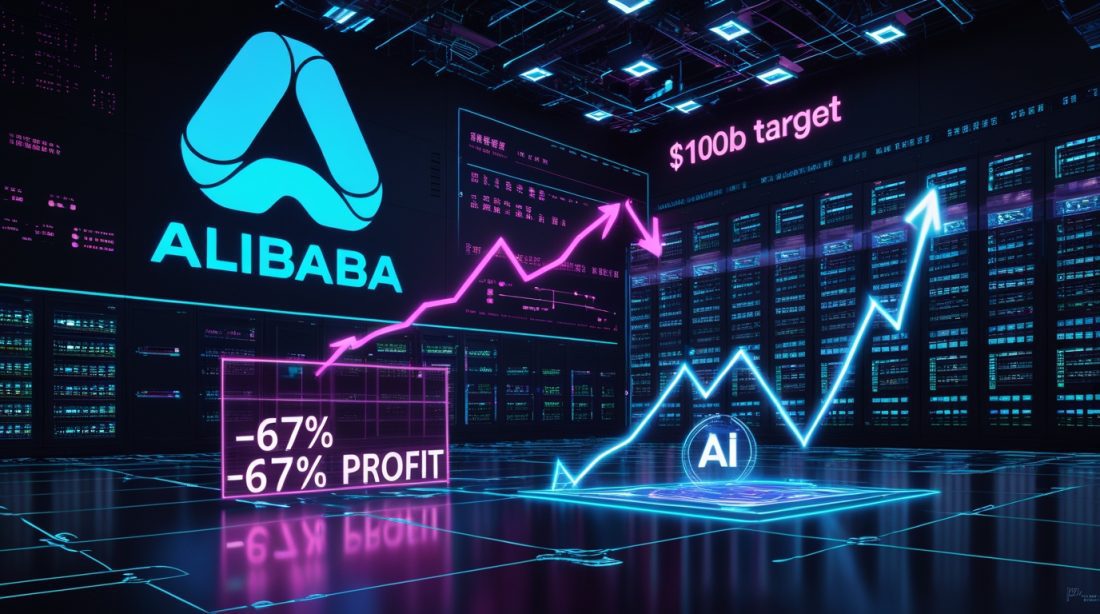
On March 19, 2026, Alibaba CEO Eddie Wu announced a target to exceed $100 billion in combined cloud and AI revenue within five years — on the same earnings call where the company reported a 67% collapse in quarterly profit. That combination is not a contradiction. It is the clearest statement yet of what enterprise AI economics actually look like during the infrastructure investment phase.
- Alibaba Cloud revenue grew 36% year-on-year to 43.3 billion yuan ($6.2 billion) in the October-December quarter.
- AI-related products on Alibaba’s platform have delivered triple-digit year-on-year growth for 10 consecutive quarters.
- Token consumption on Alibaba’s model platform increased sixfold in three months — the fastest adoption signal the company has reported.
- Alibaba has shipped 470,000 AI chips, with over 60% deployed by external customers — not internal use.
- The company is raising AI service prices by up to 34% while simultaneously launching Wukong, an enterprise agentic AI platform.
- Profit fell because of investment, not failure. The $53 billion three-year infrastructure commitment is the cost of building the revenue base Wu is projecting.
The most important thing to understand about Alibaba’s AI cloud revenue target for 2026 is that it was announced on the worst earnings day the company has had in years. Quarterly profit down 67%. Shares down 7%. Revenue growth of 2% — below analyst estimates. And in the middle of all that, CEO Eddie Wu announced a target to quintuple cloud and AI revenue to $100 billion within five years.
That sequence is not corporate spin. It is a precise statement about the economics of enterprise AI at scale: the companies willing to absorb short-term profit destruction to build AI infrastructure are the ones positioning for long-term revenue dominance. The ones protecting near-term margins will find themselves buying infrastructure from those who didn’t.
The central argument of this analysis is direct: Alibaba’s $100 billion target is not ambitious in spite of the profit collapse — it is credible because of the investment that caused the collapse. The numbers underneath the headlines tell a story about where enterprise AI revenue is actually being built, and what every operator and enterprise needs to understand about the investment-to-revenue timeline before making their own AI spending decisions.
The Gap Between the Headline and the Reality — What the Earnings Numbers Actually Show
The 67% profit drop dominated the coverage of Alibaba’s March 19 earnings. The more analytically significant number is the one that received far less attention: 10 consecutive quarters of triple-digit year-on-year growth in AI-related revenue.
According to Digital Commerce 360, Alibaba’s Cloud Intelligence Group reported revenue growth of approximately 35% from external customers, with AI-related products delivering triple-digit growth for the tenth consecutive quarter. Token consumption on Alibaba’s model platform increased sixfold over three months. More than 400 enterprise customers are running AI workloads on Alibaba infrastructure. The company has shipped over 470,000 AI chips, with more than 60% deployed externally.
None of those numbers suggest a company in trouble with its AI strategy. They suggest a company absorbing the capital cost of building infrastructure at a pace that is compressing near-term profitability while building the revenue base that justifies the $100 billion projection.
“Tokens are a key component of their production inputs, not just a part of their IT budget. This is the most fundamental long-term factor that we see driving future AI growth.”
— Eddie Wu, CEO, Alibaba Group, Q3 Fiscal 2026 Earnings Call, March 19, 2026
Wu’s token comment is the most strategically significant thing said on the call. When enterprise customers stop thinking of AI as an IT line item and start treating it as a production input — the way they treat electricity, bandwidth, or raw materials — the revenue model shifts from discretionary spend to operational necessity. That shift is what justifies the $100 billion projection. Once AI tokens are embedded in production workflows, the pricing power and retention economics look entirely different from traditional SaaS.
10x – Consecutive quarters of triple-digit year-on-year AI revenue growth at Alibaba Cloud — the streak that makes the $100 billion five-year target credible regardless of the quarterly profit headlines
The Investment That Caused the Profit Drop — and What It Is Actually Building
Alibaba’s profit fell to 16.3 billion yuan ($2.4 billion) in the quarter, down from 48.9 billion yuan in the same period last year. The primary causes were investment-driven: PYMNTS reported that Alibaba has already spent 120 billion yuan ($16.8 billion) in AI and cloud infrastructure capital expenditure over the past four quarters — on top of a 380 billion yuan ($53 billion) three-year investment commitment made last year.
That is not reckless spending. It is the same investment pattern that AWS, Microsoft Azure, and Google Cloud all executed during their infrastructure build-out phases — and that produced the cloud revenue dominance those platforms now hold. The difference is that Alibaba is executing this build-out in a market where it already holds more than 35% cloud market share in China, according to Motley Fool’s analysis — giving it a distribution advantage for the AI services being layered on top of that infrastructure.
The decision to raise AI service prices by up to 34%, announced the day before the earnings call, is the other side of this equation. Price increases during aggressive investment cycles are a signal that demand is strong enough to absorb higher pricing without significant churn. If enterprise customers were price-sensitive enough to leave at a 34% increase, Alibaba would not be raising prices during an already-pressured earnings period. The fact that it did suggests the company’s internal data on customer retention gave management the confidence to make that call.
Understanding how enterprise AI monetisation strategies evolve from pilot to production makes the Alibaba pricing move legible: companies that have moved from experimentation to production dependencies on an AI platform become far less price-elastic. The 34% increase is not a revenue grab — it is a test of how deeply Alibaba’s cloud has embedded itself in enterprise workflows.
Wukong and the Agentic AI Revenue Layer — What the New Platform Signals
The launch of Wukong — Alibaba’s enterprise agentic AI platform — on the same week as the earnings announcement adds a third revenue dimension to the story. According to Digital Commerce 360, Wukong integrates with corporate data systems and enables AI-driven task execution across end-to-end enterprise processes. Wu described it as Alibaba’s bet on AI agents handling mainstream work tasks across industries — which, in his framing, expands the total addressable market by several multiples.
The revenue logic is straightforward. Cloud infrastructure revenue is usage-based but relatively commoditised — storage, compute, bandwidth. Model-as-a-service revenue layers higher margin AI inference on top of that. Agentic AI platforms — where enterprises pay for outcomes and automated workflows rather than raw compute — represent the highest margin tier of the stack. Wukong is Alibaba’s attempt to establish a position in that tier before US competitors extend their existing enterprise relationships into the Chinese market.
⚠ Fiction — Illustrative Scenario
A regional manufacturing conglomerate in Southeast Asia with operations across Indonesia, Malaysia, and Vietnam runs its supply chain planning, procurement analytics, and quality monitoring on Alibaba Cloud. In Q1 2026 it receives notice of a 34% price increase on its AI inference workloads. The CFO reviews the options: migrate to a competing platform (6-month integration timeline, significant engineering cost), reduce AI usage (directly impacts forecast accuracy and procurement efficiency), or accept the price increase.
The supply chain team’s analysis shows the AI-driven efficiency gains — 18% reduction in procurement costs, 23% improvement in demand forecast accuracy — produce a 4.2x ROI on the current AI spend. A 34% price increase on that spend is still comfortably within positive ROI territory. The company accepts the increase. This scenario is speculative and illustrative but reflects the retention economics that Alibaba’s price increase decision implies about enterprise customer lock-in.
The China-US AI Revenue Race — What Alibaba’s Numbers Mean for the Competitive Landscape
Alibaba’s $100 billion target does not exist in isolation. It is a direct response to the competitive threat from US cloud and AI providers expanding globally. Microsoft Azure, AWS, and Google Cloud all have deeper enterprise relationships outside China — and all are pushing AI services that compete directly with Alibaba’s offerings in the markets where Alibaba has international ambitions.
The constraint that limits Alibaba most is not demand — the triple-digit AI revenue growth makes that clear. The constraints are US chip export controls limiting access to the most advanced AI processors, and geopolitical friction affecting international expansion. According to MLQ’s analysis, achieving the $100 billion target will depend on sustained AI adoption in China where enterprises shift from experimentation to deployment, with revenue acceleration projected from 2026-2028 as built infrastructure monetises and the consumer business stabilises.
The departure of Lin Junyang — head of Alibaba’s Qwen AI model division — this month adds execution risk to an already complex transition. Leadership continuity in AI model development is a genuine vulnerability, and Alibaba’s AI ambitions depend on Qwen maintaining its competitive position against domestic rivals like Baidu and ByteDance as well as internationally deployed models from OpenAI and Google.
For enterprises evaluating AI platform decisions, the Alibaba numbers provide a reference point for what the real ROI challenges of industrial AI investment look like at scale: strong revenue growth, compressing margins, and a multi-year timeline before the infrastructure investment produces the profitability that justifies it. That pattern is not unique to Alibaba — it describes the economics of every major enterprise AI platform investment currently in progress.
Understanding how AI is already generating $44 billion in enterprise revenue makes Alibaba’s five-year projection less surprising — and more instructive for how enterprises should be thinking about their own AI infrastructure commitments.
Global Implications
Alibaba’s $100 billion target carries direct implications for enterprise AI buyers outside China. The price increase on AI services, coming from a platform with 35% market share in China, signals a broader market dynamic: AI infrastructure platforms that achieve meaningful enterprise penetration gain pricing power as customers’ dependency deepens. Enterprises in Southeast Asia, Africa, and Latin America that build production dependencies on any single AI cloud platform — whether Alibaba, AWS, Azure, or Google — will face similar pricing dynamics as those platforms monetise their installed base.
The strategic lesson from Alibaba’s earnings is not company-specific: it is that the investment-to-revenue timeline for enterprise AI is long, the profitability compression during the build phase is real, and the enterprises that build infrastructure now will have pricing leverage over their customers later. Building AI dependencies on platforms where you have contractual protections and competitive alternatives is not paranoia — it is the correct procurement posture given what Alibaba’s numbers are revealing about how the economics develop.
Alibaba’s March 19 earnings call will be remembered for the 67% profit drop. The more useful thing to remember is what the company announced on the same call: a credible, data-backed target to quintuple AI and cloud revenue built on 10 quarters of triple-digit AI product growth, 470,000 chips shipped, sixfold token consumption growth, and 400+ enterprise customers running production AI workloads.
The profit drop and the $100 billion target are not in tension. They are two expressions of the same decision: absorb the cost of building infrastructure now, capture the revenue it produces later. Every enterprise, operator, and technology team making AI investment decisions in 2026 is navigating the same fundamental trade-off — just at a different scale.
Further Reading — Related Articles
- → Historic Surge: AI Semiconductor Revenue Drives Industry Past $1 Trillion in 2026
- → AI Startups and Industrial Monetisation Strategies — How the Best Ones Are Building Defensible Revenue
- → How Industrial AI Is Powering $44 Billion in Revenue — and What Comes Next
- → Oracle’s Warning on Industrial AI Investment ROI — The Challenges Nobody Is Talking About
- → Mind Robotics $500M Series A — Why Rivian’s Factory Robot Spinoff Is a Serious Threat to Every Automation Vendor
Frequently Asked Questions
What is Alibaba’s AI revenue target for 2026 and beyond?
Alibaba CEO Eddie Wu announced on March 19, 2026 a target to exceed $100 billion in combined cloud and AI commercial revenue — including model-as-a-service — within five years. This would require quintupling current revenue levels, implying at least 35% annual growth, roughly matching the pace the cloud division achieved in the December quarter.
Why did Alibaba’s profit drop 67% while announcing a $100 billion AI target?
The profit drop is primarily investment-driven. Alibaba has spent 120 billion yuan ($16.8 billion) on AI and cloud infrastructure in the past four quarters, on top of a three-year $53 billion commitment. Growing marketing costs and competition in food delivery also compressed margins. The profit decline and the revenue target reflect the same strategic decision: absorb infrastructure costs now to build the revenue base later.
How many consecutive quarters has Alibaba achieved triple-digit AI revenue growth?
Ten consecutive quarters as of the March 2026 earnings report. This streak is the primary evidence that Alibaba’s $100 billion target is credible — it reflects sustained enterprise adoption rather than a single quarter’s spike. Token consumption on Alibaba’s model platform also increased sixfold in three months as of Q3 fiscal 2026.
What is Alibaba Wukong and how does it fit the revenue strategy?
Wukong is Alibaba’s enterprise agentic AI platform, launched in March 2026. It integrates with corporate data systems and enables AI-driven end-to-end task execution across enterprise processes. It represents the highest-margin tier of Alibaba’s AI stack — above cloud infrastructure and model-as-a-service — targeting the revenue opportunity created when AI agents handle mainstream work tasks across industries.
Why did Alibaba raise AI service prices by 34% during a difficult earnings period?
Price increases during investment-heavy periods signal that enterprise customer demand and retention are strong enough to absorb higher pricing. If customers were price-sensitive enough to churn at a 34% increase, Alibaba would not have made the move during an already-pressured earnings cycle. The increase reflects management’s confidence in how deeply Alibaba Cloud has embedded itself in enterprise production workflows.
What should enterprise buyers learn from Alibaba’s AI investment and pricing decisions?
Three lessons: First, AI platforms that achieve production-level enterprise penetration gain pricing power as customer dependency deepens — build contractual protections before that dependency is established. Second, the investment-to-revenue timeline for AI infrastructure is long — enterprises should evaluate AI vendors on their infrastructure commitment depth, not just current pricing. Third, maintaining competitive alternatives is the best hedge against the pricing leverage that dominant AI platforms will exercise as their installed bases mature.
The enterprises absorbing AI infrastructure costs now will have the pricing power later.
Alibaba’s 67% profit drop and $100 billion AI target on the same day tells you everything about the economics of enterprise AI investment in 2026. The companies building infrastructure now — and the ones deploying on those platforms — are setting the cost and revenue dynamics that will define the next decade. CreedTec tracks the revenue strategies, pricing moves, and investment decisions that determine who wins.
Subscribe to CreedTec →