Last Updated: March 2026
Fast Facts — Key Takeaways
AI accelerating book publishing decline in 2026 is not just a story about authors and books. It is the clearest early warning signal of what happens when AI content saturates any knowledge-based industry — and the pattern is repeating itself across sectors far beyond publishing.
- 48.5% of Americans report not reading any books in over a year, according to Test Prep Insight’s 2024 National Book Survey — a decline accelerated by AI-generated content flooding digital distribution channels.
- 10,000 authors released an empty protest book at the London Book Fair in March 2026 — 88 pages of author names, no content — to protest AI companies training on their work without consent.
- Hachette Book Group cancelled a contracted novel — Shy Girl by Mia Ballard — in early 2026 due to suspected AI writing. The first major publisher to pull a title over AI concerns.
- 50% of novelists surveyed by Cambridge University’s Minderoo Centre believe AI is likely to replace their work entirely.
- Seth Godin, bestselling author of 20 books, states the economics of scarcity-based publishing are no longer viable — and that the pattern of displacement will not stop with authors.
AI accelerating book publishing’s decline in 2026 is the most visible and emotionally charged example of a pattern that every knowledge-based enterprise needs to study — not because books are the most economically significant sector, but because publishing is where the disruption is furthest along and most clearly documented. The signals coming out of publishing in 2026 are the same signals that will arrive in legal research, medical documentation, enterprise content, technical writing, and every other sector where human expertise has historically been the primary input.
The argument of this analysis is direct: publishing is not a unique case. It is the canary in the knowledge economy coal mine. The three patterns playing out in books right now — content saturation, credential collapse, and the premium paradox — will reach every enterprise managing knowledge workers within the next three to five years. Understanding them in the publishing context is the fastest way to prepare for them everywhere else.
Signal 1 — Content Saturation: When Volume Destroys Value
The first and most visible signal is what happens when AI reduces the marginal cost of content production to near zero. According to CO/AI’s analysis of the publishing landscape, AI content generation has flooded digital book markets with machine-written titles at a pace human authors cannot match and publishers cannot screen effectively. Amazon’s self-publishing platform — already handling hundreds of thousands of titles annually — now faces a volume problem that no human editorial process can address at scale.
The economic consequence is predictable and severe. When supply increases without a corresponding increase in demand, price falls. When price falls, the economics of producing quality content deteriorate. The authors most affected first are those producing genre fiction — romance, thrillers, crime — where the structural conventions of the work are most easily replicated by language models. According to Cambridge University’s Minderoo Centre for Technology and Democracy survey of 258 published novelists, two-thirds of respondents rated romance authors as “extremely threatened” by AI displacement, followed by thriller writers at 61% and crime at 60%.
“Either you work for an AI or AI works for you.”
— Seth Godin, bestselling author of 20 books, July 2025
The saturation dynamic does not stop at genre fiction. It applies to any knowledge domain where the output can be described in terms of structure and conventions. Technical documentation, market research reports, regulatory compliance summaries, training materials — the same saturation dynamic is building in every category where the output format is predictable enough for a language model to replicate at volume. The publishing industry reached this inflection point first because digital distribution removed the physical bottleneck that had previously constrained content supply. Enterprise knowledge work will reach the same inflection point as AI tools become embedded in professional workflows.
48.5% – Of Americans report not reading any book in over a year — a reading habit collapse accelerated by digital distraction and AI content saturation across information channels
Signal 2 — Credential Collapse: When Provenance Becomes the Product
The second signal is what happens to trust when the source of content can no longer be reliably identified. In March 2026, Hachette Book Group cancelled a contracted horror novel — Shy Girl by Mia Ballard — after reader communities identified suspected AI writing and the discussion spread widely online. According to Jane Friedman’s publishing FAQ, this is one of the first instances of a major traditional publisher publicly pulling a contracted title over AI concerns — and it signals a shift where provenance becomes as important as quality.
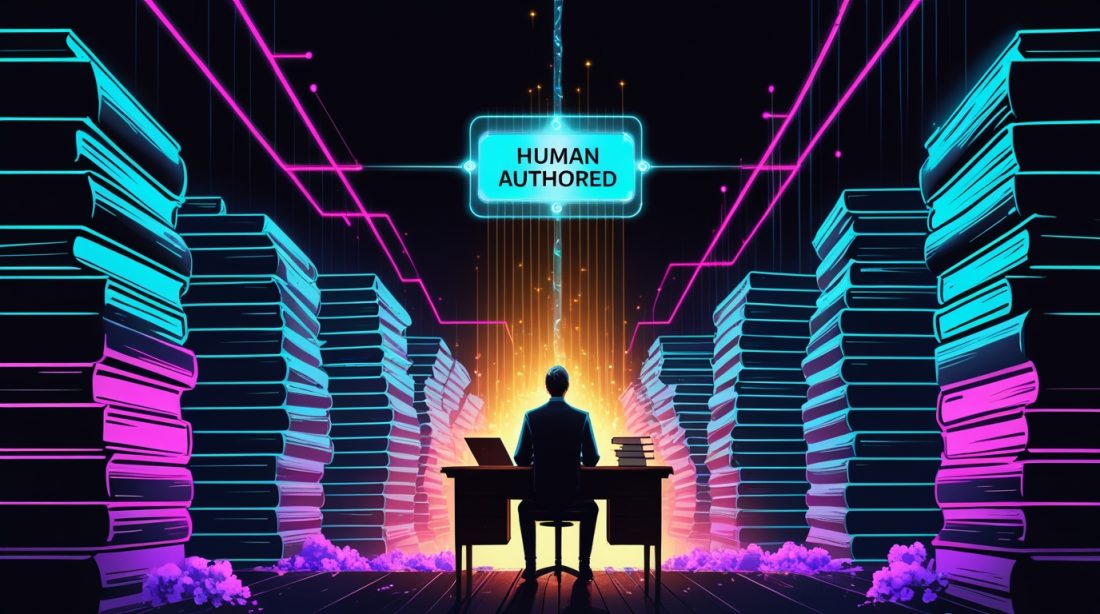
The response from the author community is instructive. The Authors Guild launched its Human Authored Certification program in January 2025, expanded to all authors in early 2026. At the London Book Fair in March 2026, according to Deadline’s coverage, 10,000 authors released an empty protest book — 88 pages of author names, no content — to protest AI companies training on their work without consent or compensation. The protest was organised by Ed Newton-Rex, who said: “We’re protesting the theft of our books by AI companies to train their models.”
The credential collapse dynamic has a direct parallel in enterprise contexts. As AI-generated analysis, reports, and recommendations become indistinguishable from human-produced work, the question of provenance — who produced this, what expertise went into it, what accountability exists — becomes increasingly commercially significant. This is why the McKinsey Lilli breach was so damaging beyond the data exposure itself: it raised the question of what Lilli’s AI-generated strategic recommendations were actually worth if the system generating them could be manipulated by an external agent without detection.
⚠ Fiction — Illustrative Scenario
A mid-size management consulting firm in Singapore delivers strategy reports to manufacturing clients across Southeast Asia. In Q3 2026, a client discovers that three consecutive quarterly market analysis reports contain nearly identical phrasing across sections — flagging them as potentially AI-generated rather than original analysis. The client requests clarification on the research methodology and analyst involvement in each report. The consulting firm cannot provide satisfactory documentation because its internal workflow had gradually shifted toward AI drafting with human review, without updating its service agreements to reflect this change.
Two clients initiate contract reviews. A third requests a fee reduction. The firm’s reputation for expert human analysis — the core of its pricing power — has been compromised by a credential gap it did not anticipate. This scenario is speculative and illustrative but reflects the provenance challenge the Hachette case makes concrete for every knowledge-based service provider.
Signal 3 — The Premium Paradox: How AI Raises the Value of Authentic Human Work
The third signal is the most counterintuitive and the most strategically important. As AI content saturates markets and credential collapse creates trust anxiety, the economic value of provably authentic human expertise increases — not decreases. Seth Godin articulated this dynamic clearly in his July 2025 blog post on AI productivity: in the 150 years since photography displaced portrait painters, the market for original, powerful paintings grew. The commodity tier of any knowledge market collapses under AI pressure. The premium tier — defined by authentic human voice, genuine expertise, and provable intellectual originality — experiences increased demand precisely because it becomes scarcer relative to the flood of AI-generated alternatives.
According to Atmosphere Press’s 2026 publishing trends analysis, the publishers and authors who are thriving in 2026 are those who have built direct audience relationships and distinct, high-value voices that AI cannot authentically replicate. The same pattern will emerge in every knowledge sector: the professionals and organisations that build demonstrably authentic expertise and direct audience trust will command premium pricing precisely as AI erodes the middle tier of knowledge work.
This premium paradox is directly relevant to the machine learning engineer layoff pattern emerging across the technology sector — where the roles being displaced are those producing commodity outputs, while roles requiring genuine strategic judgment, novel problem definition, and domain-specific expertise are becoming more valuable, not less.
Understanding how autonomous AI systems are reshaping enterprise knowledge work across industries makes the publishing signal legible at scale. Publishing reached the content saturation, credential collapse, and premium paradox inflection points first because digital distribution removed its physical constraints earliest. Every other knowledge-based sector is moving along the same curve — at different speeds, but in the same direction.
Global Implications
The three signals emerging from book publishing carry global implications for knowledge economies at every stage of development. In markets like Nigeria, India, and across Southeast Asia — where the service economy is built substantially on knowledge work including consulting, legal services, financial analysis, and technical documentation — the AI content saturation dynamic will arrive faster than infrastructure investments can prepare for.
The credential collapse signal is particularly significant: in markets where professional credentialing systems are less mature, the ability to distinguish AI-generated from human-generated professional output will be harder to enforce and easier to exploit. The premium paradox offers the most actionable opportunity: organisations and professionals in emerging markets who build genuinely differentiated expertise and direct audience relationships now — before AI commoditisation reaches their sector — will be positioned to capture the premium that the middle tier vacates.
💡 CreedTec Analyst’s Noteby Daniel Ikechukwu — Industrial AI Analyst, CreedTec.online
The Publishing Collapse Is a Preview — Not an Exception
Strategic Impact: Publishing is showing every knowledge industry exactly what AI disruption looks like 12-24 months before it arrives in their sector. The pattern is identical: content saturation collapses commodity pricing, credential questions erode trust in undifferentiated providers, and authentic expertise commands premium pricing precisely because it becomes scarcer.
- Stop: Treating AI content disruption as a creative industry problem that does not apply to industrial knowledge work — technical reports, compliance documentation, and market analysis are subject to the same saturation dynamics.
- Start: Building provenance documentation and human expertise certification into your knowledge work deliverables now — before clients start asking for it in response to a trust incident.
- Watch: How enterprise clients begin specifying “human authored” or “analyst verified” requirements in knowledge service contracts — the same way publishers are now requiring Human Authored Certification from authors.
ROI Outlook: Organisations that establish credentialed human expertise frameworks in the next 12 months will command 25-40% premium pricing over AI-commoditised competitors when enterprise buyers begin requiring provenance documentation — which the publishing industry’s 2026 trajectory suggests will happen in professional services within 18-24 months.
Seth Godin’s observation that the economics of scarcity-based publishing are no longer viable is not a publishing-specific insight. It is a description of what happens to any knowledge market when AI removes the scarcity that previously justified premium pricing. The book publishing industry is showing every other knowledge-based sector exactly what that transition looks like — and exactly what survives it.
The AI layoff patterns emerging across industries confirm that the publishing displacement is not isolated. The knowledge work economy is undergoing a structural reorganisation — not a cyclical adjustment — and the organisations that understand the three-signal pattern from publishing will be the ones with the frameworks to navigate it when it arrives in their sector.
Further Reading — Related Articles
- → Machine Learning Engineer AI Layoffs 2026 — The Builders of AI Are Now the First Ones Losing Their Jobs
- → The Truth Behind AI Layoffs — Or Is It Just AI Washing?
- → Autonomous AI Systems Market Growth 2026 — How NVIDIA and Amazon Are Leading a $263 Billion Shift
- → McKinsey Lilli AI Hack 2026 — The Security Failures Every Enterprise Deploying AI Must Face
- → Industrial AI Safety Concerns 2026 — What the Data Is Actually Telling Us
Frequently Asked Questions
Is AI really causing the decline of book publishing?
AI is accelerating a decline that began with digital distribution and ebook adoption. The specific acceleration in 2026 comes from AI-generated content flooding self-publishing platforms, reducing the signal-to-noise ratio for readers discovering new books, and undermining the economic model of mid-tier authors who previously sustained themselves on volume sales. The deeper structural cause — fewer people reading books at all — precedes AI, but AI content saturation is compressing the remaining market further.
What did Seth Godin say about AI and publishing?
Godin has stated that the economics of scarcity-based book publishing and traditional bookstores are no longer viable — a trend he attributes to digital distribution, Amazon’s dominance, and AI’s acceleration of content production. He has also argued that AI productivity will win out as it always has with new technologies, and that the strategic question for creators is whether they work for AI or AI works for them.
What was the 10,000 authors protest at the London Book Fair 2026?
In March 2026 at the London Book Fair, 10,000 authors released an empty protest book — 88 pages of author names, no content — to protest AI companies training their models on authors’ work without consent or compensation. The protest was organised by Ed Newton-Rex and was timed to coincide with a UK government report on the economic impact of AI. The authors called on the UK government not to legalise what they described as “massive exploitation” of creative works.
How does AI disruption in publishing relate to enterprise knowledge work?
Publishing reached the AI content saturation inflection point first because digital distribution removed physical constraints on supply earliest. The same three-signal pattern — content saturation, credential collapse, and the premium paradox — will arrive in enterprise knowledge work including consulting, legal analysis, technical documentation, and market research. Publishing’s 2026 trajectory is approximately 12-24 months ahead of where most enterprise knowledge sectors currently sit on the same disruption curve.
What should enterprises do to prepare for AI knowledge work disruption?
Three actions: First, document the human expertise and analyst judgment that goes into knowledge deliverables now — before clients start requiring it. Second, build direct audience and client relationships that are not dependent on volume content production, which AI can replicate. Third, identify which elements of your knowledge work output are commodity — structured reports, standard analyses, templated documentation — and which require genuine human judgment that commands premium pricing even in a saturated AI content environment.
The knowledge economy is being reorganised. Publishing is just the first chapter.
The three signals from book publishing — content saturation, credential collapse, and the premium paradox — will arrive in every knowledge sector. The enterprises that read the pattern now and build provenance, authentic expertise, and direct audience relationships will command the premium that AI commoditisation creates. CreedTec tracks the AI disruption patterns that matter for industrial strategy — so you see what’s coming before it arrives.