Fast Facts
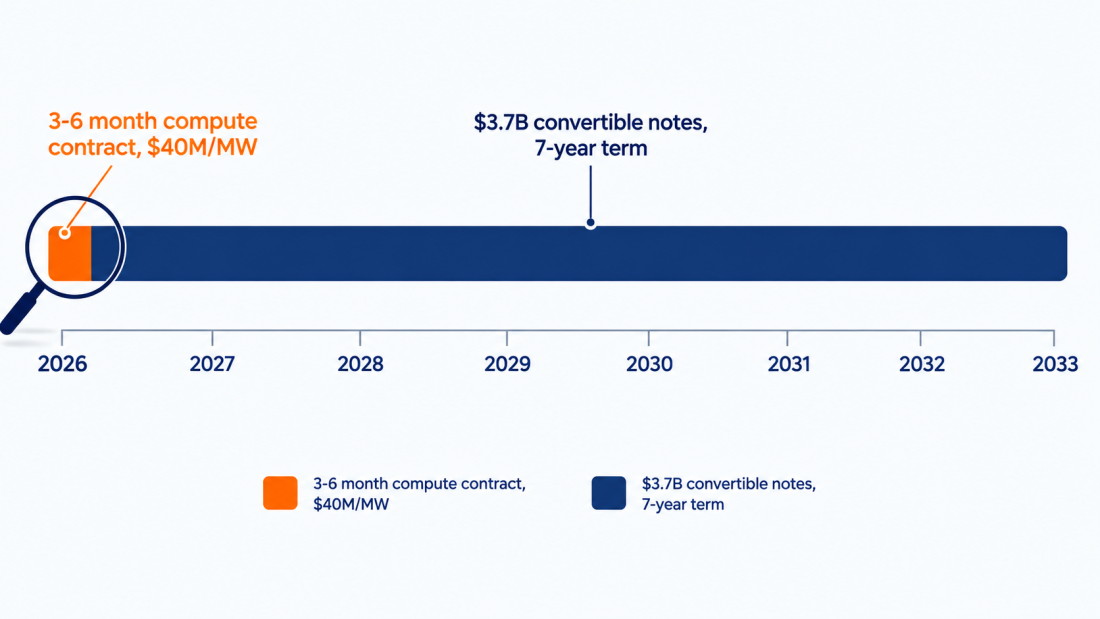
- New CoreWeave revenue disclosures show the company pricing short-term compute contracts, lasting three to six months, at roughly $40 million per megawatt on an annualized basis — a scarcity price, not a stable multi-year rate.
- To fund that capacity, CoreWeave priced $3.7 billion of convertible notes due 2033 on September 18 — meaning seven-year capital is now backing contracts that could expire long before the debt does.
- The same week, Virginia stripped large data centers of expedited permitting, and Amazon locked in generator supply from Generac with an equity warrant worth up to $8 billion instead of a straight purchase order.
- None of this makes CoreWeave’s revenue fake — it makes it a temporary scarcity price getting locked into a permanent capital structure, a mismatch procurement and investment teams should be pricing separately.
New CoreWeave revenue data released this week gives the clearest look yet at how AI compute pricing actually works when scarcity meets a financing calendar. On September 17, CoreWeave disclosed that customer contracts signed for just three to six months were priced at roughly $40 million per megawatt on an annualized-revenue basis — a number that says more about the financing structure underneath the AI infrastructure boom than any quarterly earnings call has managed to.
The Number: $40 Million Per Megawatt, for Three to Six Months
This week’s CoreWeave revenue disclosure also restated existing figures — more than $25 billion of additional contracted commitments and 4.2 GW of contracted power — first shared in August. What’s new is the price on the shortest-duration deals: $40 million per MW, annualized, for contracts that run a fraction of a year. That figure is a snapshot of what scarce compute costs right now, not a promise about what a megawatt will earn in year five of its useful life.
Why Seven-Year Debt Funding Three-Month Contracts Is a Real Risk
On September 18, CoreWeave priced $3.7 billion in 2.875% convertible notes due 2033 — upsized from an initial $3 billion target — with a conversion price of $97.85, about 22.5% above the prior day’s close. Roughly $499 million of the proceeds will fund capped-call transactions meant to limit shareholder dilution. The mechanics matter more than the headline: CoreWeave revenue earned today, at today’s scarcity price, is now collateral supporting debt that doesn’t mature until 2033. CoreWeave has to keep matching short-duration customer pricing to long-lived facilities, successive GPU generations to fixed 2033 obligations, and today’s tight compute market to whatever residual value its clusters hold once the current contracts expire and get renewed, or don’t.
📊 The Numbers That Matter
- $40M/MW — CoreWeave’s disclosed annualized-revenue rate on new 3–6 month compute contracts
- $3.7B — convertible notes priced Sept 18, due 2033, upsized from $3B
- $97.85 — conversion price, 22.5% above the September 17 closing price
- $25B+ / 4.2GW — CoreWeave’s total additional contracted commitments and power (restated from August)
- $8B — ceiling on Amazon’s equity warrant tied to its Generac generator supply deal
“It’s evidence of current scarcity, not a seven-year revenue curve.”— Dave Friedman, AI infrastructure analyst, Buy the Rumor; Sell the News
What Virginia and Amazon Did the Same Week
On September 18, Virginia Governor Abigail Spanberger signed Executive Order 22, immediately excluding new data-center projects of at least 25 MW from expedited state permitting and proposing a shift toward local approval and community-benefit agreements. Separately, Generac disclosed a long-term generator supply deal with Amazon worth an expected $2.4 billion in 2027–2028 deliveries — but Amazon also received a warrant for up to 1.69 million Generac shares, vesting as payments are made, with a ceiling tied to $8 billion in purchases. That warrant functions as an equity rebate: if Generac’s stock rises on the strength of Amazon’s own demand, Amazon recaptures part of its infrastructure spending in a form that never appears on the generator invoice.
What This Means for Industrial AI Revenue Analysis
Total contracted value keeps getting quoted as if it were equivalent to revenue already earned, and this week’s disclosures show why that comparison keeps breaking down — see our analysis where we explain why the industrial AI market size nobody can agree on is the real story, because contracted commitments and delivered, revenue-generating capacity are measuring two different things. CoreWeave itself has been down this road before — see our analysis of CoreWeave’s revenue backlog as an infrastructure asset class and CoreWeave CEO Michael Intrator’s own warning about Nvidia capacity constraints.
The lock-in pattern isn’t unique to compute either — see our analysis of how Micron’s take-or-pay memory contracts lock in $100 billion with no cancellation clause, the same long-capital-against-short-demand structure showing up one layer down the supply chain. And the underlying question of whether power or chips is the real bottleneck keeps resurfacing — see our analysis of why the TeraWulf-Anthropic deal proves power beats chips in this cycle.
How CoreWeave Revenue Fits the Neocloud Financing Pattern
CoreWeave isn’t the only AI infrastructure provider mixing short-term contracted revenue with long-dated capital this month. Nscale filed for a U.S. IPO reporting $140.6 million in first-half revenue against a $1.02 billion net loss and more than $103 billion in total contracted value — with the Financial Times noting only about 55 MW is actually operating today.
Nebius raised on-demand GPU pricing 17–21% for the second time in three months, even as a cross-provider benchmark index barely moved, evidence that pricing power is provider- and contract-specific rather than market-wide. Set against that backdrop, CoreWeave revenue at $40 million per MW looks less like an outlier and more like the clearest data point yet in a sector-wide pattern: contracted revenue and delivered, cash-generating capacity are being reported as if they were interchangeable, and they aren’t.
Quick Questions
Is CoreWeave’s $40 million-per-MW number a permanent price?
No — the CoreWeave revenue figure reflects current scarcity pricing on short-term contracts lasting three to six months, not a stable rate the company expects to earn over the multi-year life of a data center.
Why does 7-year debt funding 3-month contracts matter?
Because CoreWeave has to keep re-signing customers at whatever the market rate is when each short contract expires, while its convertible notes carry fixed obligations through 2033 regardless of how compute pricing moves.
What was new in Amazon’s Generac deal?
Beyond the $2.4 billion in generator orders, Amazon received an equity warrant worth up to $8 billion in vesting value — a rebate structure that doesn’t show up in the sticker price of the equipment.
💡 CreedTec Analyst’s Note by Daniel Ikechukwu
Strategic Impact: CoreWeave revenue built on short-duration, scarcity-priced contracts is real money today, but locking seven-year capital against it transfers the renewal risk onto the balance sheet rather than removing it — a structure that looks fine as long as scarcity holds and looks very different the moment it doesn’t.
Stop
- Treating a single quarter’s CoreWeave revenue rate, or any neocloud’s short-contract pricing, as a stable multi-year run rate.
Start
- Separating “total contracted value” from CoreWeave revenue currently being earned every time either number appears in an AI infrastructure story.
Watch
- Whether CoreWeave’s short-term contracts renew at similar pricing when they expire, or whether the $40 million-per-MW figure turns out to be a peak.
ROI Outlook: The convertible notes’ low coupon and successful upsizing show real investor appetite, which is a genuine vote of confidence — but confidence in current scarcity pricing is not the same as confidence in 2033 pricing, and that gap is exactly what this week’s CoreWeave revenue disclosure exposed.
— Daniel Ikechukwu
Sources
- CoreWeave Investor Relations — Continues to Contract New Compute Capacity at Higher Prices
- CoreWeave Investor Relations — Prices Upsized $3.7 Billion Convertible Senior Notes Offering
- Office of the Governor of Virginia — Executive Order 22
- SEC EDGAR — Generac 8-K, Amazon Supply Agreement and Warrant
- Buy the Rumor; Sell the News — North American AI Compute Infra Report, Week Ended Sept 21, 2026