Fast Facts
Humanoid robots running nonstop in package testing aren’t just proving capability — they’re dismantling the shift-based labor model that global logistics has operated on for a century. The financial threat isn’t automation. It’s that the cost structure just went from variable to fixed.
📊 By the Numbers
- $38B — Global warehouse automation market projected by 2030 (Grand View Research, 2025)
- 20+ hours — Continuous operational runtime logged in recent humanoid robot package trials (Bloomberg, 2026)
- 45% — Labor as a share of total logistics operating costs in most mid-size facilities (PeakLogix, 2025)
- $25–$35/hr — Fully loaded cost of a US warehouse shift worker including benefits and turnover (BLS, 2025)
The story being told about humanoid robots nonstop in package testing is a story about endurance. How long can they run? How many packages? What’s the error rate? Those are the wrong questions — and they’re designed, intentionally or not, to keep the real conversation off the table.
The real conversation is financial. When a humanoid robot runs 20-plus hours straight on a package line, it isn’t just outperforming a human worker on a single shift. It’s making the entire shift model — the scheduling infrastructure, the overtime liability, the turnover budget — structurally redundant. That’s not an efficiency story. That’s a cost architecture story.
The Shift Model Has Always Been Logistics’ Hidden Tax
PeakLogix, a leading automation integrator, reports that personnel expenses account for 45% of total warehouse operating costs—and that’s before factoring in benefits, overtime, training, and turnover. That figure understates the real number when you include scheduling overhead, absenteeism buffers, turnover replacement costs, and peak-season premium pay. The shift model — built around human biological limits — has always been a tax on logistics efficiency. The industry normalized it because there was no alternative.
There is now. Humanoid robots entering paid commercial deployment don’t need shift rotations. They need maintenance windows — which, unlike human breaks, can be scheduled around operational demand. That’s not a marginal improvement. It’s a structural inversion of how labor costs are modeled.
Nonstop Operations Flip Variable Costs to Fixed
The financial logic of nonstop robot operations is straightforward, and that’s what makes it threatening to the existing order. Human labor in logistics is a variable cost — it scales with volume, season, and shift availability. A humanoid robot fleet is a fixed capital cost with a predictable depreciation schedule.
For a CFO, fixed costs are preferable when volume is predictable. For a logistics operator running seasonal peaks, they create new risks. But for any facility where throughput is consistent — and package testing environments typically are — the math favors the robot before the first shift comparison is even run. The ROI drivers for humanoid robots are strongest precisely where the work is repetitive, high-volume, and shift-dependent.
“Labor accounts for 35% of total warehouse operating costs — and that figure understates the real burden when turnover and absenteeism are included.”
What the Package Testing Environment Reveals About Deployment Readiness
Package testing is a deliberate choice as a proving ground. The task profile — lift, sort, scan, place — mirrors the most common warehouse operation globally. It involves object variability, conveyor timing, and spatial accuracy under time pressure. The Robot-as-a-Service model emerging through deals like Agility Robotics and Toyota depends on exactly this kind of environment demonstrating reliable, sustained performance before broader deployment contracts are signed.
Running nonstop in a controlled test is the proof-of-concept that enterprise procurement needs. It’s not a demo. It’s an audition for a contract that replaces a headcount line on the P&L.
⚠ Fiction — Illustrative Scenario
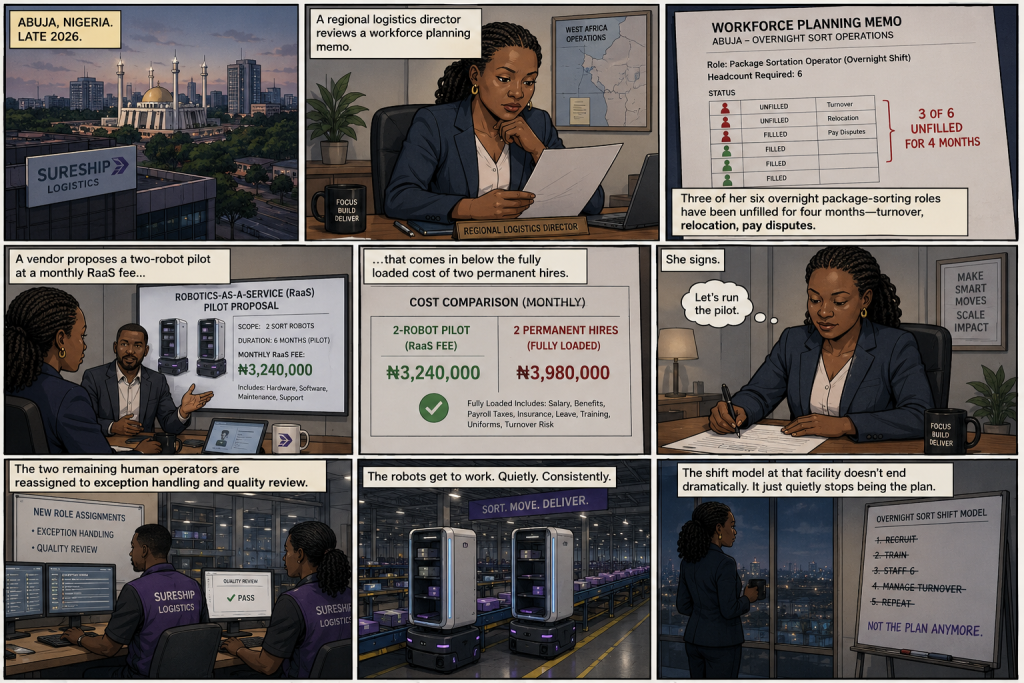
A regional logistics director in Abuja reviews a workforce planning memo in late 2026. Three of her six overnight package-sorting roles have been unfilled for four months — turnover, relocation, pay disputes. A vendor proposes a two-robot pilot at a monthly RaaS fee that comes in below the fully loaded cost of two permanent hires. She signs. The two remaining human operators are reassigned to exception handling and quality review. The shift model at that facility doesn’t end dramatically. It just quietly stops being the plan.
Emerging Markets Are Watching the Same Numbers
In Nigeria, Ghana, and across Southeast Asia, the conversation about humanoid robots in factory and logistics settings is still framed as a distant Western development. It isn’t. The RaaS pricing model — monthly subscription, no capital expenditure — is specifically designed to lower the entry barrier for exactly these markets. When the upfront cost is removed, the decision becomes operational, not financial. And operationally, a robot that doesn’t require shift premiums, doesn’t call in sick during rainy season, and doesn’t need a pension is competitive in Lagos at a lower fee threshold than most operators currently assume.
The headless robot deployment wave of 2026 is already seeding this across factory floors without the press coverage the humanoid pilots attract. Package testing is the visible edge of a much broader deployment curve.
💡 CreedTec Analyst’s Note
Daniel Ikechukwu — Strategic Impact
Humanoid robots running nonstop in package tests are settling a financial argument, not just an engineering one. The shift model is the most expensive structural assumption in global logistics — and it has never been seriously challenged because nothing could sustain nonstop operations reliably enough to replace it. That’s changing faster than most workforce planners are acknowledging in their 2027 headcount models.
- Stop: Treating humanoid robot pilots as engineering news. They are procurement signals — read them as such.
- Start: Modelling the 36-month total cost of ownership for a RaaS deployment against your current overnight shift cost. The numbers are closer than expected.
- Watch: RaaS contract structures entering emerging market logistics in West Africa and Southeast Asia. The entry price is dropping faster than local workforce planning models are updating.
ROI Outlook: Facilities with consistent, high-volume overnight operations have the strongest near-term case. The ROI window is 18–24 months for nonstop deployment environments where labor costs exceed $28/hr fully loaded. Below that threshold, the case is still building — but the trajectory is one direction.
Frequently Asked Questions
Can humanoid robots actually run nonstop without failures?
Current trials show 20-plus hour continuous runs in controlled environments. Maintenance windows exist but are schedulable — unlike human absenteeism, they’re predictable and can be aligned to low-demand periods.
What’s the procurement model — buy or subscribe?
Most enterprise-scale deployments are moving toward Robot-as-a-Service (RaaS) — monthly fees covering hardware, software updates, and maintenance. This removes capital expenditure barriers and makes the cost directly comparable to a per-shift labor line.
Does this apply to logistics operations in emerging markets?
The RaaS model is specifically designed to lower market entry costs. Facilities in Nigeria, Ghana, and Southeast Asia with consistent overnight volume should model the comparison now — the pricing gap is narrowing faster than most regional operators realize.
Robotics economics, deployment signals, and market intelligence before the mainstream catches up. No hype — just the analysis that matters.