Fast Facts
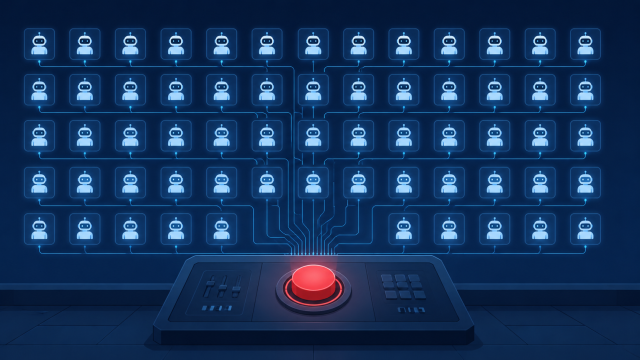
Factory AI makes decisions in milliseconds — stopping lines, clearing safety flags, rerouting quality control — without a human signature. The tech is working. The accountability framework isn’t. That gap is where the financial exposure lives.
📊 By the Numbers
- $165B — Global AI in manufacturing market projected by 2030 (MarketsandMarkets, 2025)
- <10ms — Edge AI inference latency in modern factory deployments (McKinsey, 2025)
- 44% — Industrial facilities reporting AI false positives causing unplanned downtime (Forrester, 2025)
- $260K — Average cost of one hour of unplanned automotive manufacturing downtime (Automotive Manufacturing Solutions, 2024)
Industrial AI decision-making in factories is now faster, quieter, and more consequential than most operators realize. In the time it takes a floor supervisor to read a dashboard alert, the AI has already made its call — stopped a conveyor, rerouted a batch, or cleared a sensor flag — and moved on. The question nobody in the boardroom is answering clearly: when that call is wrong, who owns it?
Most coverage of factory AI focuses on speed and efficiency. Those numbers are real. What gets buried is the governance structure — or the lack of one — sitting behind every autonomous decision the system makes.
The Decision Architecture Most Plants Don’t Fully Understand
Factory AI doesn’t “think” the way the marketing decks imply. At its core, it runs inference — pattern matching between live sensor data and a trained model’s learned thresholds. When a vibration reading from a motor exceeds a confidence boundary, the model fires a decision: flag, halt, or escalate. That decision tree executes in milliseconds at the edge layer, before any human sees the data.
The problem isn’t the speed. It’s that the model’s confidence threshold was set during training — often on data that doesn’t fully represent the plant’s operating conditions today. Dust levels change. Shift patterns vary. A model trained in a controlled environment makes decisions in a live one, and the gap between those two realities is where the 44% false positive rate Forrester documented comes from.
Speed Is the Selling Point. Accountability Is the Blind Spot.
According to McKinsey’s 2025 State of AI report, manufacturers deploying edge AI cite decision latency under 10 milliseconds as a primary performance benchmark. That metric wins procurement approvals. It doesn’t answer what happens when a sub-10ms decision halts a $260,000-per-hour production line on a false positive.
The financial logic here is uncomfortable: the faster the system, the harder it is to audit the decision after the fact. Most factory AI deployments today lack a real-time decision log that a plant manager — or an insurance adjuster — can interrogate. The trustworthy AI frameworks being built in 2026 are trying to close this gap, but adoption is lagging adoption of the systems themselves.
“AI in manufacturing is projected to reach $165 billion by 2030 — but the governance infrastructure is years behind the deployment curve.” — MarketsandMarkets, 2025
The Human Behavior Problem Inside the Machine
There’s a subtler issue running beneath the technical one. When operators trust the AI consistently, they stop second-guessing its calls. That’s rational — overrides take time, and the system is right most of the time. But that behavioral shift creates a compounding risk: the moment the AI makes a consequential wrong call, the human reflex to intervene has already atrophied.
This is the same pattern documented in aviation’s automation complacency research. The International Air Transport Association flagged it for aircraft systems a decade ago. Factory AI is replicating it on the production floor — and unlike a cockpit, most facilities have no mandatory human-in-the-loop protocol for AI decisions above a certain operational impact threshold.
⚠ Fiction — Illustrative Scenario
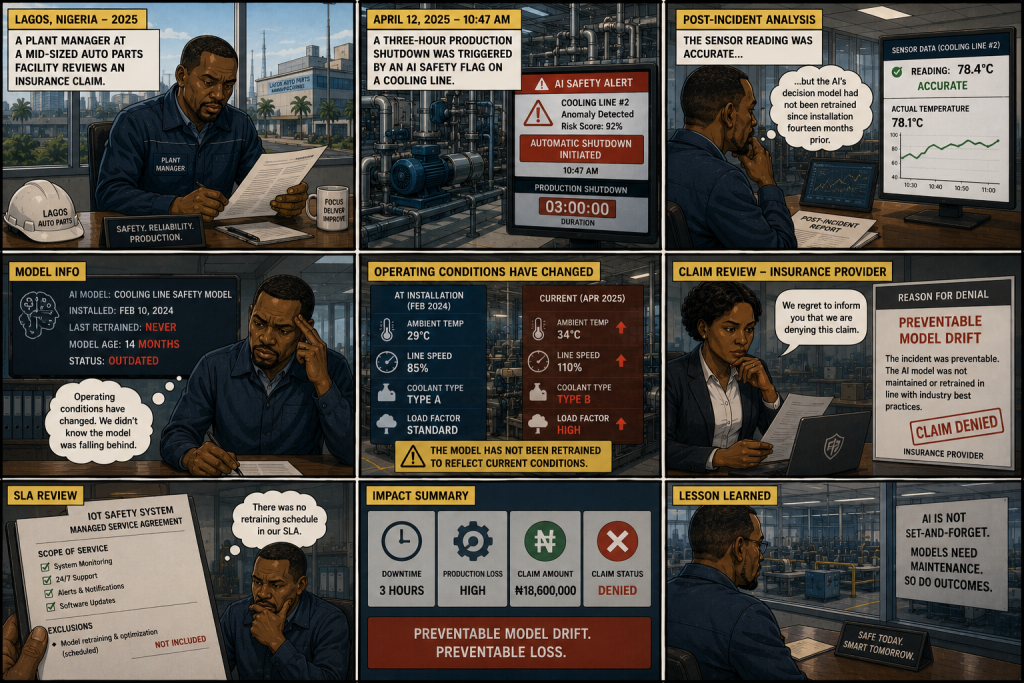
A plant manager at a mid-sized auto parts facility in Lagos reviews an insurance claim in 2025. A three-hour production shutdown was triggered by an AI safety flag on a cooling line. Post-incident analysis showed the sensor reading was accurate — but the AI’s decision model had not been retrained since installation fourteen months prior. The operating conditions had changed. The insurance provider denies the claim, citing “preventable model drift.” No one at the facility had a retraining schedule in their SLA.
What Emerging Market Factories Face That Others Don’t
For facilities across Nigeria, Ghana, and Southeast Asia, the accountability gap has an additional dimension: most AI systems deployed in these markets are configured and maintained remotely by vendors headquartered elsewhere. When a decision audit is needed, the data sits in a cloud environment the local operator does not fully control. Autonomous AI systems are scaling faster than the contractual clarity around who owns decision logs, model versioning records, and retraining timelines.
That’s not a technology problem. It’s a procurement problem — one that surfaces only after the liability event has already occurred. The fear of AI retraining costs is keeping facilities on stale models far longer than the vendors recommend.
💡 CreedTec Analyst’s Note
Daniel Ikechukwu — Strategic Impact
The real story of industrial AI decision-making isn’t the inference engine — it’s the accountability vacuum around it. Vendors sell speed; buyers inherit liability. Until decision audit trails, model versioning, and retraining SLAs are written into procurement contracts, the financial exposure from AI-driven downtime sits entirely with the operator. That asymmetry is the defining governance risk of 2026 for industrial facilities.
- Stop: Accepting AI system deployments without a documented decision audit trail and retraining schedule in the SLA.
- Start: Treating AI confidence thresholds as operational parameters — review them quarterly, not only at installation.
- Watch: Regulatory movement in the EU and emerging AI liability frameworks in Southeast Asia. When mandatory explainability requirements arrive, facilities without audit infrastructure will face retroactive compliance costs.
ROI Outlook: Facilities that build governance infrastructure now — decision logs, retraining schedules, human override protocols — will face significantly lower insurance and compliance costs when liability frameworks tighten. The cost of building it before an incident is a fraction of the cost of defending one after.
Industrial AI analysis that applies financial logic — not just technical specs. Built for operators, procurement teams, and plant managers who need the full picture.Join the Newsletter →