Fast Facts
- Onsemi Q1 2026 revenue: $1.51 billion — beat guidance
- AI data center revenue more than doubled YoY, up 30% sequentially
- GAAP loss persists because industrial and automotive remain in cyclical trough
- Data center is racing. Industrial is recovering.
- The gap between them is a procurement window for industrial buyers
- Better pricing and lead times available now — before demand converges
- When industrial recovers fully, the window closes
Every outlet covered this as a data center story. The actual signal in onsemi’s Q1 2026 results runs deeper. Onsemi’s AI data center revenue industrial recovery in 2026 reveals a semiconductor market running at two different speeds simultaneously — and the gap between them is an opportunity window that will close faster than most industrial procurement teams expect.
| Stat | Value |
|---|---|
| $1.51B | Q1 2026 revenue — above guidance midpoint |
| 2×+ | AI data center revenue growth — year-over-year |
| 30% | AI data center sequential growth — nearly double expected rate |
| 2× | Operating income growth vs revenue growth — 10% YoY vs 5% YoY |
The Split That Earnings Summaries Don’t Show
Onsemi posted a GAAP diluted loss of $0.08 per share in Q1 2026 while posting non-GAAP EPS of $0.64 — beating the $0.61 consensus. The gap between those two numbers is the story. Non-cash charges related to the company’s restructuring pull the GAAP figure down while the operating business performs well. That disconnect exists because onsemi is simultaneously managing an AI data center business accelerating at unexpected speed and an industrial and automotive semiconductor business still working through a demand trough that began in 2024.
“Our AI data center business accelerated, growing more than 30% sequentially — nearly double our expected growth rate entering the quarter, driven by broader adoption across the power tree with multiple XPU vendors and all leading hyperscalers.”— Hassane El-Khoury, President and CEO, onsemi — via GlobeNewswire (May 4, 2026)
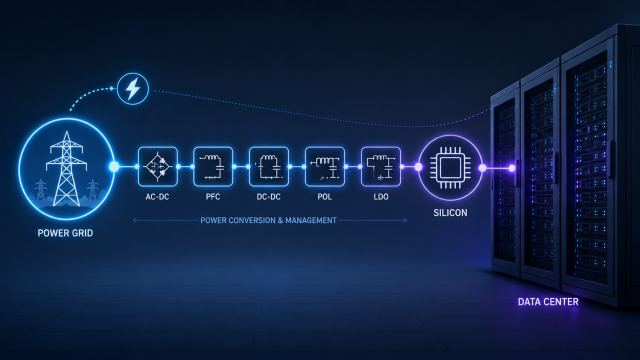
Onsemi now expects AI data center revenue to double year-over-year for full-year 2026 — a projection that was high-teens growth entering the quarter and had to be revised upward after Q1 results came in. According to the official Q1 results release, this growth is coming from broader adoption “across the power tree” — not just a single hyperscaler relationship or a single chip application, but onsemi’s power semiconductors appearing at multiple stages of the AI infrastructure power chain. That breadth matters. It’s harder to displace than a single design win.
The Onsemi AI Data Center Revenue Signal for Industrial Operators
Here’s what industrial buyers should take from this quarter that the financial press is not saying. Onsemi is explicitly positioned as the only broad-based U.S. power semiconductor supplier covering the full AI data center power tree — from grid to processor. That position was built while industrial demand was weak. When industrial AI deployment accelerates — and the semiconductor revenue trajectory past $1 trillion in 2026 confirms it’s already underway — onsemi’s manufacturing capacity and customer relationships will be split between two growing demand pools simultaneously.
⚠ Fiction — Illustrative Scenario
A procurement manager at a Nigerian cement manufacturer is six months into evaluating power semiconductor suppliers for an AI-driven motor control upgrade. She gets quotes in Q1 2026 with reasonable lead times. She defers the decision to Q3, waiting for better pricing. By then, onsemi’s industrial order book has recovered alongside AI data center demand, lead times have extended, and the Q1 pricing is no longer available. The window she thought was open closed quietly while she was waiting for it to get better.
That scenario is not speculative. Semiconductor supply constraints have historically hit industrial customers first and hardest when demand recovers, because hyperscalers and automotive OEMs have more purchasing leverage and longer-term supply agreements. The industrial AI semiconductor demand timeline matters precisely because of this dynamic. Industrial operators who act while the market is still two-speed — AI data center ahead, industrial recovering — access better pricing and lead times than those who wait for the convergence to become obvious.
The Q2 2026 guidance of $1.535–$1.635 billion confirms sequential growth continuing. The Celestica concentration risk analysis from last week is the counterpoint — onsemi’s diversification across automotive, industrial, and AI data center reduces the single-segment exposure that hit Celestica’s valuation despite strong numbers. That diversification is both a current weakness (industrial trough dragging GAAP) and a future strength (three growing demand pools converging). The strategic AI infrastructure investment framework for 2026 should weight segment diversification in semiconductor suppliers exactly this way.
💡 Analyst’s Note
By Daniel Ikechukwu
Strategic Impact
Onsemi’s Q1 2026 results document the two-speed semiconductor market in real financial terms: AI data center doubling year-over-year while industrial and automotive recover from trough. That gap represents a procurement opportunity for industrial operators who recognise it — and a supply risk for those who don’t act until the gap closes. The company’s positioning as the only broad-based U.S. power semiconductor supplier covering the full AI power tree means its capacity will be increasingly contested as industrial AI deployment accelerates through 2026 and 2027.
Stop / Start / Watch
- STOP reading onsemi’s GAAP loss as a signal of weakness. The operating business — 10% YoY operating income growth outpacing revenue growth by 2x — is performing. The GAAP loss reflects restructuring charges, not operational deterioration.
- START treating semiconductor lead time windows as procurement intelligence. Onsemi’s industrial recovery is underway but still soft — that’s the window for industrial buyers to lock supply agreements before AI data center demand compresses capacity further.
- WATCH onsemi’s Q2 guidance midpoint of approximately $1.585 billion and specifically the industrial segment commentary. When industrial stops being described as “recovering” and starts being described as “accelerating,” the two-speed market is converging — and pricing and lead times will reflect it.
ROI Outlook
Onsemi’s full-year AI data center revenue doubling projection means the company’s capacity allocation decisions will increasingly favour the segment growing fastest. For industrial buyers, the ROI of acting now versus waiting 12 months is the difference between current industrial-trough pricing and post-convergence pricing where AI data center and industrial demand compete for the same wafer starts. That pricing gap is not quantifiable today — but the direction is clear from Q1 results.
The Semiconductor Window Is Open — For Now
We track the AI hardware earnings signals, industrial semiconductor shifts, and procurement windows that operators need to act on before the two-speed market converges.
Join the Newsletter →