Fast Facts
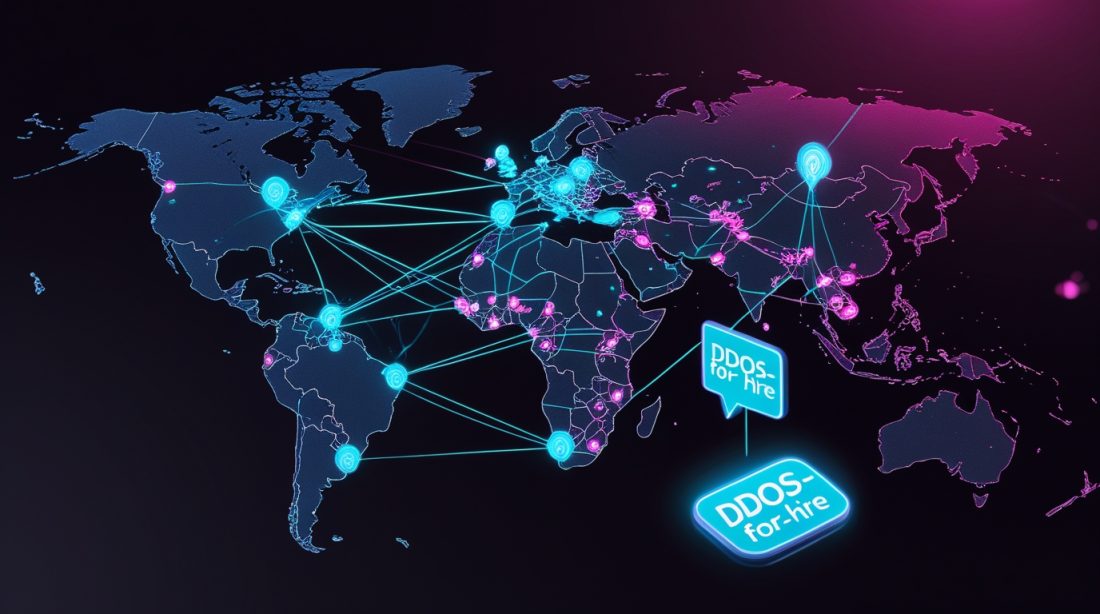
The Masjesu botnet — also known as XorBot — has been quietly hijacking industrial IoT routers and gateways since 2023 and is now available as a commercial DDoS-for-hire service on Telegram. With attack capacity reaching 290–300 Gbps and infected devices across six continents, operators who haven’t patched their edge hardware are providing free attack infrastructure to whoever is willing to pay.
The Masjesu botnet DDoS-for-hire did not make headlines by being loud. It made headlines this week by being patient. Documented by Trellix security researchers on April 8, 2026, Masjesu — also tracked as XorBot — has been operating since at least 2023, methodically compromising IoT routers, gateways, DVRs, and cameras across multiple hardware architectures while its operators quietly built a commercial attack service advertised on Telegram.
The business model is straightforward: compromise as many unpatched IoT devices as possible, rent out the resulting attack capacity to paying customers, and avoid any target that might trigger meaningful law enforcement attention. According to The Hacker News, Masjesu deliberately avoids blocklisted IP ranges including Department of Defense networks — a calculated decision that extends operational lifespan at the expense of ambition.
What makes this specifically relevant for industrial operators is not the DDoS service itself. It is the infection vector: the same routers, gateways, and network edge devices that connect factory floors, warehouse systems, and operational technology networks to the internet. The devices being weaponized are the devices you are relying on for uptime.
| Metric | Value |
|---|---|
| Advertised DDoS attack capacity | 300 Gbps |
| Command injection exploits added in latest iteration | 12+ |
| Of observed traffic originating from Vietnam | ~50% |
| Year Masjesu first emerged — active for 3+ years undetected | 2023 |
The Business Model Behind the Botnet
Most coverage of Masjesu frames it as a cybersecurity threat. The more useful frame for operators is economic: Masjesu is a commercial enterprise with a product, a distribution channel, and a customer acquisition strategy. Understanding it that way changes how you think about your exposure.
The product is volumetric DDoS capacity. The distribution channel is Telegram, where operators have run bilingual channels — including one with over 2,000 subscribers before it was removed — posting rental details, feature updates, and live performance screenshots to attract buyers. The customer acquisition strategy is demonstrated capability: according to GBHackers, recent posts advertise attack capacities of 290–300 Gbps, placing Masjesu among the more dangerous commercial DDoS platforms available.
“Built for persistence and low visibility, Masjesu favors careful, low-key execution over widespread infection, deliberately avoiding blocklisted IP ranges to ensure long-term survival.”— Mohideen Abdul Khader F, Trellix Security Researcher
The raw material for this business is compromised IoT hardware. Masjesu exploits known vulnerabilities across devices from D-Link, Huawei, NETGEAR, TP-Link, GPON, Intelbras, and MVPower — targeting routers, cameras, DVRs, and NVRs. These are not obscure enterprise devices. They are the commodity hardware sitting on the edge of industrial networks in factories, logistics facilities, and operational technology environments globally.
The financial logic from the attacker’s perspective is compelling: IoT devices are abundant, frequently unpatched, and rarely monitored for outbound attack traffic. The cost of compromising them is low. The revenue from renting the resulting capacity is recurring. This is why Masjesu has operated for three years without significant disruption — the economics reward patience and stealth over aggression.
What Industrial Operators Are Actually Providing
The uncomfortable reality for any operator running unpatched IoT edge hardware is that their devices may already be nodes in Masjesu’s infrastructure. They are not being targeted — they are being used. The distinction matters operationally: your network is not under attack, it is under occupation, silently contributing to attacks on someone else’s infrastructure while consuming bandwidth and processing resources you are paying for.
⚠ Fiction — Illustrative Scenario
A facilities manager at a mid-sized cold storage operator in Lagos notices intermittent latency spikes on the network connecting temperature sensors to the monitoring dashboard. A firmware audit three weeks later reveals that four gateway routers — all running firmware versions from 2022 — have been compromised and are participating in outbound DDoS traffic at a rate of 40 Mbps. None of the standard uptime monitors flagged it. The devices were fully operational from a local perspective. The bandwidth was being silently rented to a paying customer on Telegram.
Masjesu achieves this through a combination of XOR-based encryption to conceal command-and-control communications, executable renaming to mimic legitimate system components, cron job persistence, and randomized headers and spoofed IPs to make attack traffic harder to distinguish from legitimate flows. Once embedded, it is designed to be invisible to standard monitoring tools that check for uptime and local function rather than outbound behavioral anomalies.
For operators whose IIoT botnet protection strategy relies entirely on perimeter firewalls and uptime dashboards, this gap is structural. Masjesu does not trigger uptime alerts. It degrades performance at the margins and rents your compute capacity to strangers.
The Emerging Market Exposure Nobody Is Counting
Masjesu’s infected device geography is instructive. According to SecurityWeek, attacks primarily originate from Vietnam, Ukraine, Iran, Brazil, Kenya, and India — with Vietnam alone contributing close to 50% of observed traffic. Kenya and Brazil represent emerging market presence that reflects a broader pattern: regions with high IoT deployment growth and lower firmware patching rates provide ideal infection environments.
Nigeria fits this profile precisely. The combination of rapid IoT operational intelligence deployment growth and inconsistent firmware update practices across SME and mid-market operators creates exactly the device population Masjesu targets. An operator deploying smart meters, cold chain sensors, or warehouse routing hardware on legacy gateway firmware is not just running a security risk — they are providing free infrastructure to a commercial attack service.
The broader AI-driven cybersecurity threats to IoT devices are compounding this exposure. As botnets like Masjesu incorporate more sophisticated evasion techniques — randomized payloads, multi-architecture support, encrypted C2 channels — the detection gap between attacker capability and operator monitoring widens in markets where security tooling investment lags deployment pace.
The OT Network Risk Is the Real Concern
For most enterprise security teams, DDoS exposure is a connectivity problem — bandwidth gets saturated, services go offline, you mitigate and recover. For industrial operators, the risk profile is different. A DDoS attack against an OT-connected network does not just take a website offline. It can disrupt sensor communication, delay control system responses, and in worst cases create the kind of operational disruption that triggers safety shutdowns or equipment damage.
Masjesu’s operators have explicitly marketed their service’s suitability for targeting CDNs and enterprise infrastructure. The overlap between “enterprise infrastructure” and “industrial control system network” is growing as more operational technology connects to internet-facing gateways — exactly the devices Masjesu compromises for its botnet. The OT cybersecurity gap in AI-driven industrial operations is not theoretical when a commercially available botnet is actively recruiting the edge devices bridging IT and OT networks.
The cost of downtime in manufacturing, logistics, and cold chain operations ranges from tens of thousands to hundreds of thousands of dollars per hour depending on the sector. A sustained DDoS attack enabled by compromised gateway devices — devices that sit inside the operator’s own network — creates a liability that no standard cyber insurance policy is written to cleanly cover.
💡 Analyst’s Note
By Daniel Ikechukwu
Strategic Impact
Masjesu reframes the IoT security question for industrial operators. The threat is not that your devices will be targeted — it is that they will be conscripted. Unpatched gateway hardware is not just a vulnerability; it is a resource being actively harvested by a commercial DDoS marketplace. Every device running firmware from 2022 or earlier on a public-facing interface is a potential revenue stream for Masjesu’s operators and a liability for you.
Stop / Start / Watch
- STOP treating IoT firmware patching as a deferred maintenance task. Masjesu has been actively exploiting unpatched devices since 2023. Every month of delay is another month of potential occupation.
- START monitoring outbound traffic anomalies from gateway and router hardware — not just inbound threats. Compromised devices look healthy from the inside. The signal is in unusual outbound HTTP connections, repeated contact with unknown C2 domains, and unexplained bandwidth consumption on edge devices.
- WATCH the Aisuru botnet takedown aftermath. The U.S. Justice Department, Canada, and Germany dismantled four major IoT botnets in March 2026 — including Aisuru, Kimwolf, JackSkid, and Mossad. Masjesu’s operators will likely absorb displaced botnet traffic, expanding their infection base as competitors disappear.
ROI Outlook
A firmware audit and patch cycle for 50 edge devices costs roughly 20–40 hours of IT labor. A single hour of OT network downtime caused by a DDoS attack on compromised infrastructure costs multiples of that in lost production alone. The math is not complicated — the only reason patching gets deferred is organizational inertia, not economic logic. Treat the escalating IoT botnet threat landscape as a recurring maintenance cost line, not a one-time security project.
Your Edge Hardware Is Either Defended or Rented
We track IoT security threats, botnet developments, and the operational risks that manufacturers and industrial operators need to act on first.
Join the Newsletter →