Fast Facts
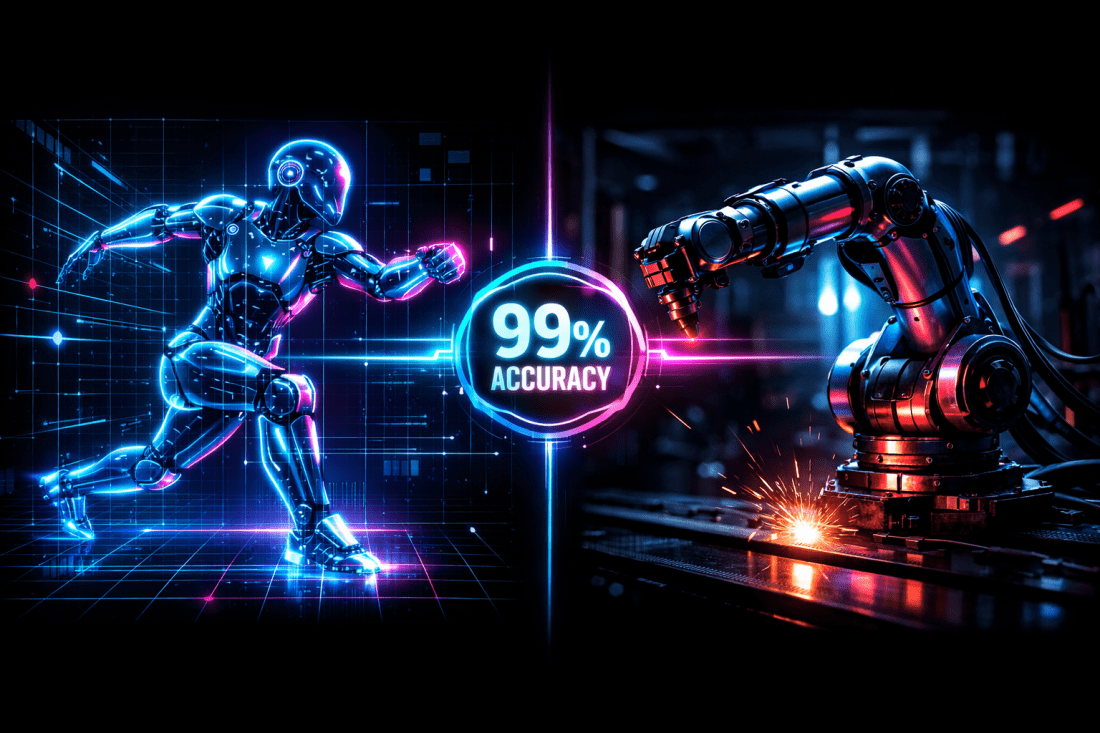
The long-standing “sim-to-real” gap—where robots fail when moving from virtual training to physical deployment—has finally been closed. By integrating NVIDIA’s Omniverse with ABB’s RobotStudio, the new HyperReality platform achieves 99% simulation accuracy, cutting deployment costs by 40% and accelerating time-to-market by 50%. This isn’t just a technical win; it’s a financial game-changer that removes the single biggest barrier to industrial AI adoption.
The Hidden Cost That’s Been Breaking Your AI Budget
1 Simulation Metric That Cuts Factory AI Costs by 40% (Without Breaking Your Budget)” – that’s the number every procurement head needs to memorize. Your industrial AI pilot worked perfectly in the digital twin. Then you deployed it on the factory floor. The robot froze. The gripper missed. The vision system failed under real lighting. You just experienced the sim-to-real gap—the difference between virtual training and physical reality that has quietly destroyed ROI for decades
According to Marc Segura, President of ABB Robotics, that gap has now been closed: “Today, using NVIDIA accelerated computing and simulation technologies, we have removed the last barriers to making industrial and physical AI a reality at a global scale”.
Stat Callout Box: The new RobotStudio HyperReality platform delivers 99% simulation-to-reality accuracy, reducing deployment costs by 40%, cutting commissioning times by 80%, and accelerating time-to-market by 50%.
Why This Single Metric Matters More Than Any Algorithm
For procurement heads and plant managers, the 40% cost reduction isn’t a headline—it’s permission to stop treating AI pilots as science experiments and start treating them as capital investments.
The fear this solves: Every manufacturing executive has watched an AI project fail at the “last mile.” The robot worked in the lab. It failed on the line. The budget was already spent. The pilot was killed. And procurement learned to say “no” to the next AI proposal.
The desire this unlocks: Predictable deployment. Controllable costs. ROI you can actually calculate before writing the check.
The Financial Logic: From “If It Works” to “When It Scales”
Traditional simulation tools approximated robot motion. They couldn’t replicate real-world lighting, material behavior, or sensor noise. The result? Engineers spent months debugging code that worked perfectly in simulation but crashed on the factory floor.
Here’s what changed:
- ABB’s virtual controller runs the same firmware as physical hardware, ensuring near-perfect correlation between simulation and reality
- Absolute Accuracy technology reduces positioning errors from 8–15mm to approximately 0.5mm
- Synthetic data generation in Omniverse trains vision models entirely in simulation, eliminating expensive real-world data collection
Human behavior insight: Procurement teams fear open-ended costs. The 40% reduction isn’t just savings—it’s certainty. When you can simulate an entire production line before cutting steel, you eliminate the financial risk that has historically killed AI adoption.
Reason 1: The 40% Reduction Changes the Procurement Conversation
⚠ Fiction anecdote: A mid-sized automotive parts manufacturer in Ohio had been burned twice by AI pilots. The first time, the robot couldn’t handle reflective car door panels. The second time, the vision system failed under fluorescent lighting. Procurement declared a moratorium on “unproven automation.” Last month, their systems integrator showed them ABB’s HyperReality demo. They simulated the entire production line in two days, identified three potential failure points, fixed them virtually, and deployed the physical system in half the expected time. Procurement approved the full rollout within a week.
This fictional story reflects a documented pattern. Foxconn, the world’s largest electronics manufacturer, is already piloting the technology for consumer electronics assembly, using synthetic data to prepare robots for delicate pick-and-place tasks involving multiple device variants.
The financial takeaway: When simulation accuracy hits 99%, the “pilot phase” moves from physical testing to virtual validation. That’s not incremental improvement. That’s a business model disruption.
Reason 2: Time-to-Market Acceleration Creates Competitive Moats
A 50% acceleration in time-to-market for complex products means your competitor who takes 12 months to launch will be eating your dust at month 6.
According to Dr. Zhe Shi, Chief Digital Officer of Foxconn: “The collaboration enables parallel engineering for better designs, faster production ramp-up and greater product evolution”.
Global implications: Manufacturers who adopt this simulation-first approach will consistently outrun those still relying on physical prototypes. The gap between market leaders and laggards will widen dramatically over the next 24 months.
Reason 3: The Sim-to-Real Gap Was Always an Economic Problem Disguised as a Technical Problem
The industry spent years chasing better algorithms. But the real barrier was economic: you couldn’t afford to fail at deployment.
Deepu Talla, Vice President of Robotics and Edge AI at NVIDIA, puts it this way: “The industrial sector needs physically accurate simulation to bridge the gap between virtual training and the real-world deployment of AI-driven robotics at scale”.
Our angle: Everyone covers the technology. Nobody talks about the procurement barrier. By closing the sim-to-real gap, ABB and NVIDIA just made AI adoption a financial decision instead of a technical gamble.
Reason 4: Synthetic Data Changes the ROI Equation for Training
Training AI models traditionally required thousands of hours of human teleoperation. The DROID project, for example, collected 76,000 teleoperated trajectories across 13 institutions—approximately 350 hours of human labor.
The Allen Institute for AI (AI2) took a different approach. Their MolmoBot model, trained entirely on synthetic data generated in simulation, achieved a 79.2% success rate on desktop grasping tasks—significantly outperforming models trained on real-world data.
AI2 CEO Ali Farhadi explains: “Our mission is to build AI that advances science. Robot training can be a fundamental scientific instrument, helping researchers work faster and explore new problems. Demonstrating simulation-to-real transfer is a major step in this direction”.
The financial insight: Synthetic data generation reduces training costs by orders of magnitude. Using 100 NVIDIA A100 GPUs, AI2’s pipeline creates approximately 1,024 episodes per GPU hour—equivalent to over 130 hours of robot experience per wall-clock hour. That’s a 4x throughput increase compared to real-world data collection, directly impacting project ROI.
Reason 5: Physical AI Has Arrived—And Your Budget Needs to Catch Up
At GTC 2026, NVIDIA CEO Jensen Huang declared: “Physical AI has arrived — every industrial company will become a robotics company”.
NVIDIA introduced Cosmos 3 world foundation models, Isaac Lab 3.0 for large-scale robot learning, and the GR00T N1.7 foundation model for dexterous manipulation. The Physical AI Data Factory Blueprint reduces the cost, time, and complexity of training physical AI systems at scale.
Rev Lebaredian, VP of Omniverse and Simulation at NVIDIA, adds: “In this new era, compute is data”.
Strategic question: Is your procurement team ready to approve AI budgets based on simulation metrics instead of physical pilots?
💡 Analyst’s Note by Daniel Ikechukwu
Strategic Impact: The 40% cost reduction metric is the single most important number in industrial AI right now. It transforms AI from a speculative investment into a predictable capital expenditure.
Stop/Start/Watch:
- Stop accepting simulation accuracy below 95% as “good enough” for procurement approval
- Start demanding simulation-to-reality correlation metrics from every robotics vendor
- Watch for competitors who adopt simulation-first deployment and capture market share while you’re still debugging physical pilots
ROI Outlook: Highest short-term returns: automotive assembly, consumer electronics manufacturing, logistics automation. Lowest: highly customized, low-volume production where simulation ROI takes longer to realize.
Frequently Asked Questions (FAQ)
How does the 40% cost reduction actually break down?
The savings come from eliminating physical prototypes, reducing commissioning time by 80%, and minimizing costly deployment failures. Foxconn’s pilot suggests the majority of savings come from virtual validation before physical installation.
Is 99% simulation accuracy realistic for all applications?
According to ABB, the platform achieves 99% correlation for the tested industrial applications, with Absolute Accuracy technology reducing positioning errors from 8–15mm to approximately 0.5mm. Precision-critical applications may require additional validation.
What’s the procurement question every buyer should ask?
Ask every robotics vendor: “What is your simulation-to-reality correlation accuracy, and can you demonstrate it with our specific application before we commit to hardware?”
How does this affect ROI calculations for AI pilots?
Instead of modeling 6–12 months of physical testing and debugging, you can now validate virtually in weeks. This fundamentally changes the ROI timeline in favor of faster deployment.
Will this work for small and medium manufacturers?
The Economic Pain Point You Can’t Ignore
Your AI pilots are failing at the last mile. You know it. Your procurement team knows it. And every failed pilot makes it harder to approve the next one.
Call to action: Before your next AI proposal hits the procurement desk, demand a simulation-to-reality correlation metric from your vendor. If they can’t show you 95%+ accuracy, walk away. The technology now exists to eliminate deployment risk. Don’t accept anything less.
Further Reading and Related Articles
- 7 Reasons Why Japanese Robots Are Economic Lifelines (Not Job Killers) for a Nation in Free Fall
- GenAI Self-Generating Robot Training Data: The End of Manual Annotation
- MolmoBot & Zero-Shot Sim-to-Real Transfer 2026: The Breakthrough Explained
- Why Photorealistic Digital Twin Robotics Training Applications Cut Costs in 2026
- Point Bridge Sim-to-Real Transfer Breakthrough Delivers 66% Better Robot Performance
Join Industrial AI Professionals
Get weekly analysis on simulation economics, robotics ROI, and procurement strategies—straight from CreedTec’s research desk.
[Subscribe to CreedTec Newsletter →]