Originally published 2024 · Updated April 2026
Fats Facts
Since its 2024 unveiling, the Hyundai and Kia X-ble Shoulder has moved from concept to commercial deployment — first to Korean Air in July 2025, then KS-certified in March 2026, now targeting Europe and North America. The device reduces shoulder load by 60% and muscle activity by 30% with no battery required. For manufacturers dealing with aging workforces and rising injury compensation costs, this is a deployable solution, not a prototype.
When Hyundai and Kia’s X-ble Shoulder wearable robot was first unveiled in November 2024, the conversation centered on the technology. In 2026, the conversation needs to shift to the economics — because this device has cleared the certification, deployment, and real-world validation hurdles that most wearable robotics announcements never reach.
In March 2026, the X-ble Shoulder became the first wearable robot in Korea to receive Korea Industrial Standards (KS) certification from the Korea Institute for Robot Industry Advancement (KIRIA), according to Hyundai Motor Group’s newsroom. That milestone matters not because it is a badge — it matters because it sets the first national quality standard for wearable robots, which is what procurement teams need to justify budget allocation.
Global expansion to Europe and North America is now actively targeted for 2026, building on domestic Korean market experience that includes Korean Air as the first commercial customer and distribution to 27 Hyundai Motor Group affiliates. The question for every industrial operator watching this is no longer whether the X-ble Shoulder works. It is whether their workforce pain justifies the procurement conversation.
| Metric | Value | Description |
|---|---|---|
| Shoulder Load Reduction | 60% | Reduction during overhead work |
| Muscle Activity Reduction | 30% | Measured decrease in muscle usage |
| Device Weight | 1.9 kg | Lightweight design with no battery required |
| Market Projection | $10.25B | Estimated wearable robot market size by 2029 |
The Injury Cost Nobody Puts in the ROI Calculation
Musculoskeletal disorders (MSDs) from repetitive overhead work are among the most expensive and underreported cost lines in manufacturing, aviation maintenance, shipbuilding, and construction. They accumulate slowly — a worker doesn’t collapse from one shift of overhead welding. They degrade over months and years, until absenteeism climbs, workers’ compensation claims spike, and experienced operators leave the floor permanently.
This is the economic problem the X-ble Shoulder is built to address. Its pilot trial — conducted from 2022 to 2024 across approximately 300 workers and health managers in Hyundai and Kia plants — generated the 60% shoulder load reduction and 30% muscle activity reduction figures that now appear in its commercial specification. Those numbers came from production floors, not a lab, across real tasks, not controlled demonstrations.
“The X-ble Shoulder reduces shoulder loads from overhead work — just by being worn, it can increase workers’ efficiency and reduce musculoskeletal injuries.”— Hyundai Motor Company, Official Press Release, November 2024
According to Assembly Magazine, the device weighs 1.9 kilograms, adjusts between 406 and 446 millimeters in body length, and allows full arm movement from 0 to 180 degrees without restricting work or rest. The non-powered torque generation mechanism is one of its most operationally significant features — no battery, no charging schedule, no downtime waiting for power. A worker puts it on and works. That removes one of the core adoption barriers for wearable robotics in shift-based manufacturing environments.
Korean Air Was Not a Showcase Deployment
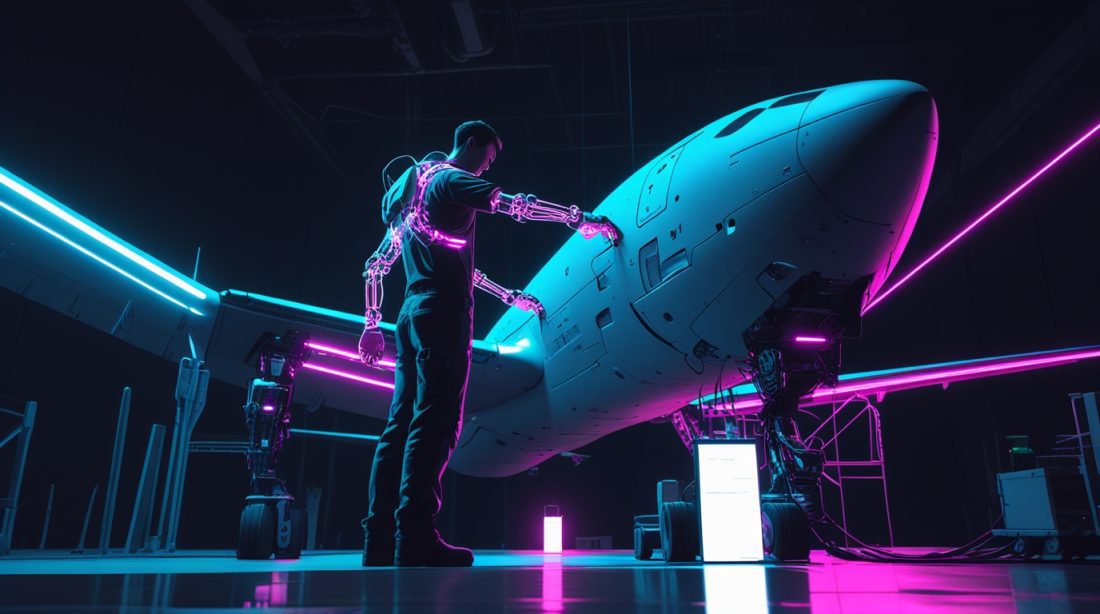
When Korean Air received the first commercial X-ble Shoulder unit in July 2025 at its Incheon aircraft maintenance hangar, it was not a press event with a robot in the corner. The device was deployed across assembly and maintenance operations covering commercial airliners, military aircraft, UAM vehicles, drones, stealth aircraft, and satellite launch vehicles — an environment where overhead work is not occasional but structural to the job.
Aviation maintenance is one of the hardest validation environments for a wearable robot. Workers operate across irregular surfaces, in confined spaces, with variable task durations, and under safety standards that tolerate no movement restriction. The fact that Korean Air selected the X-ble Shoulder as its first exoskeleton deployment — rather than running a limited pilot — signals a level of operational confidence that no press release creates.
⚠ Fiction — Illustrative Scenario
A maintenance supervisor at a shipyard in Busan had run the same calculation for three years: his overhead welding team filed an average of four shoulder injury claims per quarter, each costing between $12,000 and $40,000 in medical costs, lost productivity, and temporary replacement labor. When the X-ble Shoulder became available for external purchase, he ran the numbers again. At a unit cost he could justify in a single quarter’s injury budget, the question shifted from “can we afford this” to “why didn’t we deploy this sooner.”
This financial dynamic — where the cost of not deploying a wearable robot exceeds the cost of deploying it — is the argument that procurement teams in construction, shipbuilding, and heavy manufacturing need to make internally. The X-ble Shoulder’s expansion plan targets exactly these sectors. Hyundai’s broader factory robotics strategy increasingly positions wearable augmentation alongside autonomous systems — not as alternatives, but as complementary layers of a workforce productivity stack.
Certification as a Market Signal, Not a Formality
The March 2026 KS certification from KIRIA is worth examining beyond its headline. It is the first time a wearable robot’s quality has been nationally recognized in Korea, establishing a benchmark that future competing products will need to meet. For procurement teams in any market, national certification reduces the internal approval burden — you are not arguing for an untested product, you are procuring a certified one.
The X-ble Shoulder also holds ISO 13482 certification for personal assistant robots from DNV, earned in February 2025, and EU Directive on machinery certification, earned in May 2025. These are not overlapping validations — they address different risk frameworks across different regulatory environments. Together they make the X-ble Shoulder one of the most certification-dense wearable robots available at commercial scale, which matters directly for operators in regulated industries like aviation, healthcare-adjacent manufacturing, and defense supply chains.
The wearable robot and exoskeleton market was valued at approximately $2.5 billion in 2024 and is projected to reach $10.25 billion by 2029, according to New Atlas. That growth curve is being driven by exactly the workforce conditions the X-ble Shoulder addresses: aging industrial workforces in Korea, Japan, Germany, and increasingly in emerging markets where manufacturing growth is outpacing available skilled labor.
The Emerging Market Angle for 2026 and Beyond
Every coverage of the X-ble Shoulder focuses on Korea, Europe, and North America. The emerging market angle is underreported and worth flagging for operators across West Africa and Southeast Asia.
Manufacturing growth in Nigeria, Ghana, Vietnam, and Indonesia is creating factory floors that are staffed with younger workforces today — but the MSD problem is not exclusive to aging workers. It is a function of task repetition and ergonomic load, which are identical whether a worker is 25 or 55. And as Industry 5.0 adoption challenges in Nigeria demonstrate, the gap between available technology and local deployment is closing faster than analysts expected.
The broader humanoid robot deployment in small-town factories trend points in the same direction: wearable and collaborative robotics are entering manufacturing environments that full automation cannot reach economically. The X-ble Shoulder’s non-powered design, adjustable fit, and low maintenance footprint make it more deployable in resource-constrained environments than battery-dependent alternatives.
For investors tracking physical AI investment opportunities in 2026, the wearable robotics segment specifically represents a differentiated play — it solves a recurring cost problem in industries with deep labor pools, without requiring the full infrastructure build that autonomous systems demand.
💡 Analyst’s Note
By Daniel Ikechukwu
Strategic Impact
The X-ble Shoulder has cleared every barrier that typically kills wearable robotics at the pilot stage: real-world validation, national certification, commercial deployment, and international expansion. The 2026 global rollout marks the shift from “interesting technology” to “procurement decision.” Manufacturers delaying evaluation are not saving budget — they are accumulating injury cost that a deployment budget would offset.
Stop / Start / Watch
- STOP treating wearable robotics as a long-term roadmap item. The X-ble Shoulder is commercially available, KS and ISO certified, and in active deployment at Korean Air. The evaluation timeline for procurement is now, not 2027.
- START running the injury cost calculation before any wearable robot procurement conversation. Workers’ compensation, absenteeism, temporary replacement labor, and experienced operator attrition are the comparison numbers — not the device unit cost alone.
- WATCH the X-ble Waist development timeline. Hyundai Motor Group is developing this companion device for heavy lifting and back injury prevention — the next logical step after shoulder augmentation. Its commercialization timeline will follow the X-ble Shoulder’s market entry pattern.
ROI Outlook
A single avoided shoulder injury in a heavy manufacturing environment saves $12,000–$40,000 in direct costs. A team of 20 overhead workers wearing X-ble Shoulder units at 60% reduced shoulder load represents a measurable reduction in MSD incidence rates over 12–24 months. The break-even calculation favors deployment in any environment where overhead work is structural to daily operations — aviation maintenance, shipbuilding, automotive assembly, and construction are the clearest entry points.
Frequently Asked Questions
What is the Hyundai and Kia X-ble Shoulder and what does it do?
The X-ble Shoulder is an industrial wearable robot developed by Hyundai Motor and Kia’s Robotics LAB. It assists upper arm muscle strength during overhead work, reducing shoulder load by 60% and muscle activity by 30%. It operates without batteries using a non-powered torque mechanism, weighs 1.9 kilograms, and allows full 0–180 degree arm movement.
What has changed since the 2024 announcement?
Significant milestones: Korean Air received the first commercial unit in July 2025 for deployment across aviation assembly and maintenance. ISO 13482 and EU machinery certification were both obtained in 2025. In March 2026, the X-ble Shoulder became the first wearable robot to receive Korea Industrial Standards (KS) certification. Global expansion to Europe and North America is now actively targeted for 2026.
Which industries is the X-ble Shoulder suited for?
Aviation maintenance, automotive assembly, construction, shipbuilding, and agriculture — any environment requiring repetitive overhead work. Korean Air’s deployment covers commercial aircraft, military aircraft, UAM vehicles, drones, and satellite launch vehicles. Hyundai and Kia plan to expand availability to 27 group affiliates and external manufacturers across these sectors.
Why does battery-free operation matter for industrial deployment?
In shift-based manufacturing, battery-dependent wearables introduce charging schedules, downtime, and maintenance overhead that disrupt operational flow. The X-ble Shoulder’s non-powered torque mechanism eliminates these dependencies — workers put it on and work across full shifts without power management concerns. This is a significant adoption advantage over competing battery-powered exoskeletons.
Is the X-ble Shoulder relevant for manufacturers in Africa or Southeast Asia?
Yes, and the case is underreported. MSD injuries from repetitive overhead work are not limited to aging workforces — they are a function of task repetition and ergonomic load across any workforce. The device’s low maintenance footprint and battery-free design make it more deployable in resource-constrained environments than heavier alternatives. As manufacturing grows in Nigeria, Vietnam, and Indonesia, the injury cost calculus applies identically.
What should procurement teams evaluate before purchasing the X-ble Shoulder?
Three factors: (1) task audit — quantify what percentage of daily worker hours involve overhead work above shoulder height; (2) injury cost baseline — calculate current annual MSD-related costs including compensation, absenteeism, and replacement labor; (3) fit assessment — the Robotics LAB offers integrated consulting covering process analysis and suitability evaluation before purchase. Run the consultation before committing budget.
The Wearable Robotics Window Is Open Now
We track the robotics deployments, certifications, and industrial workforce shifts that procurement teams and operators need to act on first.
Join the Newsletter →