Fast Facts — Key Takeaways
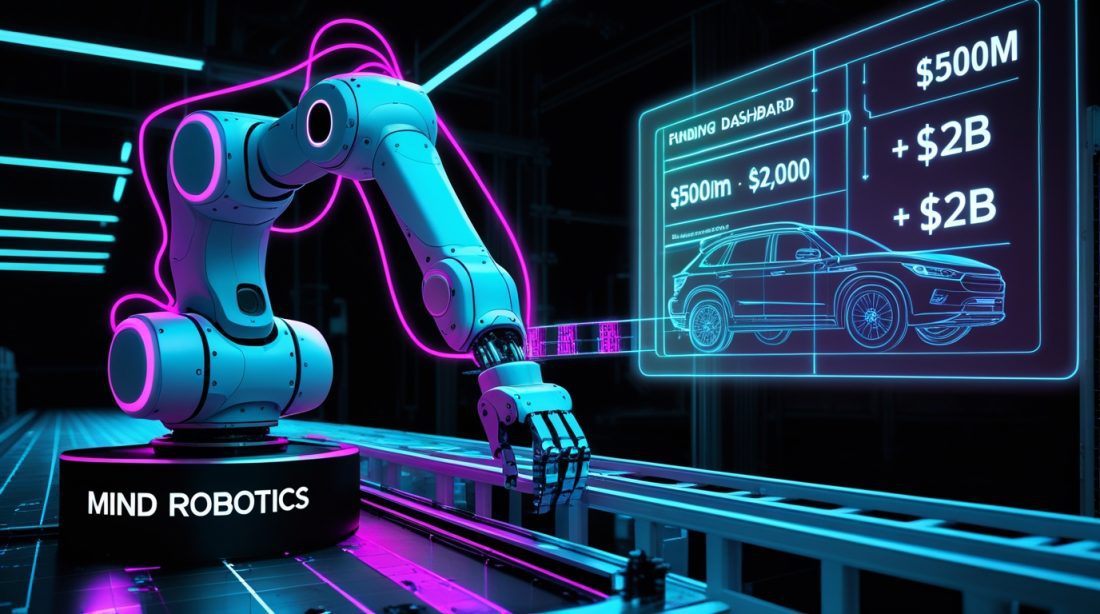
On March 11, 2026, Mind Robotics — an industrial robotics startup spun out of Rivian by CEO RJ Scaringe — closed a $500 million Series A round co-led by Accel and Andreessen Horowitz, bringing total funding to $615 million and valuation to $2 billion in just a few months of existence.
- The bet is explicit: purpose-built factory robots over humanoids — using Rivian’s real production data to train more dexterous, adaptable machines.
- The revenue model is full-stack: foundation models + purpose-built hardware + deployment infrastructure — the same architecture that produced software-premium margins at Skild AI.
- Rivian is both partner and shareholder — providing training data and a live deployment environment that most robotics startups spend years trying to acquire.
- The Series A is one of the largest in robotics history — at a moment when manufacturers face acute labour shortages and aging production lines.
Here is the question that the Mind Robotics $500M Series A funding round forces onto every manufacturer’s desk: if the founder of an electric vehicle company — someone who runs factories, understands production data, and has watched every humanoid robot pitch in the industry — chose to build purpose-built factory robots instead, what does that tell you about where the real manufacturing automation revenue is being made?
RJ Scaringe knows what a factory floor actually needs. He built Rivian’s Normal, Illinois manufacturing plant from scratch and has been running high-volume EV production for years. When he spun out Mind Robotics in November 2025 and immediately raised $115 million in seed funding, it was a signal. When Accel and Andreessen Horowitz co-led a $500 million Series A in March 2026 — bringing the valuation to $2 billion in just a few months — it became a thesis statement.
The thesis is this: the largest, most durable automation revenue opportunity in manufacturing does not sit in humanoid robots designed to mimic human workers. It sits in purpose-built machines that are trained on real production data, designed for specific industrial tasks, and deployed through a full-stack platform that includes the AI models, the hardware, and the infrastructure to make them work at scale.
That is what Mind Robotics is building. And the capital structure behind it tells you exactly how seriously the venture community is taking that argument.
RJ Scaringe’s Contrarian Bet on Factory Robots Over Humanoids — and What It Signals to the Market
The humanoid robot category has attracted enormous attention and capital. Tesla’s Optimus, Figure AI backed by NVIDIA, Boston Dynamics’ Atlas — the narrative around bipedal robots working alongside humans in factories has dominated robotics coverage for two years. Scaringe looked at all of it and made a different call.
According to TechCrunch, Scaringe stated that Mind Robotics intends to focus on more traditional factory robot designs rather than humanoid form factors. His reasoning is operational: the tasks that generate the most value on a factory floor are not the tasks that require a humanoid body. They are the tasks that require dexterity, adaptability, and real-time physical reasoning — capabilities that a purpose-built machine can develop faster and deploy more reliably than a general-purpose humanoid.
“As AI enters the physical world, we believe the largest, at-scale application for advanced robotics will be across the industrial sector. Advanced robotics are going to be critical for global competitiveness, as well as addressing the substantial industrial labor shortages that exist today.”
— RJ Scaringe, Founder and Chairman, Mind Robotics, March 2026
This is a contrarian position in a market where humanoid announcements generate ten times the press coverage of industrial robot deployments. But it is not a contrarian position in terms of where manufacturing revenue actually comes from. The factories buying automation today are not buying humanoids in volume — they are buying systems that solve specific, high-value production problems at scale.
Scaringe is not dismissing AI-powered robotics. He is arguing that the AI needs to be trained on the right data, deployed in the right form factor, and supported by the right infrastructure — and that a purpose-built factory robot, trained on real production data from Rivian’s own manufacturing environment, gets there faster and more profitably than a humanoid designed for general-purpose flexibility.
The Rivian Data Advantage: The Training Asset No Competitor Can Buy or Replicate
The most undervalued element of the Mind Robotics story is not the $500 million. It is the training data.
According to Reuters via Yahoo Finance, Rivian operates as both a partner and major shareholder in Mind Robotics — providing the startup with manufacturing data for training its models and a live production environment where those models can be tested and deployed in real conditions. That arrangement gives Mind Robotics something most robotics startups spend years trying to acquire: a high-volume, real-world factory floor as a continuous training and validation environment.
Training foundation models for physical robotics requires vast amounts of real-world data — not just simulated environments. The data challenge is why Skild AI’s $1.4 billion raise was structured around a horizontal model trained across multiple robot types and environments. Mind Robotics solves the same problem differently: instead of aggregating data across many environments, it goes deep in one — a real EV factory running real production shifts — and uses that depth to build models that generalise to other industrial environments from a position of manufacturing-specific strength.
$615M-Total funding raised by Mind Robotics in just a few months — $115M seed (Eclipse Capital, late 2025) + $500M Series A (Accel + a16z, March 2026) — one of the largest early-stage robotics funding totals on record
There is also a hardware angle that most coverage has missed. According to TechCrunch’s reporting, Rivian is developing custom silicon designed to power its autonomous vehicle software — and Scaringe noted in an interview that it does not take much imagination to see Rivian selling those chips to Mind Robotics. A purpose-built robotics processor, designed by the same team that built the factory where the robots are being trained, creates a vertical integration story that compounds the data advantage with a hardware cost and performance edge over startups buying off-the-shelf compute.
The Full-Stack Revenue Model Behind a $2 Billion Valuation in Months
The valuation question is worth examining directly. $2 billion at Series A, on a company that is months old and has no commercial revenue yet, requires a revenue thesis that justifies it. That thesis is in the architecture.
According to SiliconAngle, Mind Robotics is building a full-stack platform: foundation models, purpose-built robots, and deployment infrastructure. That combination is not accidental. It is the same architecture that commands software-level margins rather than hardware-level margins in every comparable sector.
A company that sells only robots sells hardware — a capital-intensive, margin-compressed business where competition is fierce and pricing power is limited. A company that sells robots plus the AI models that make them work plus the deployment infrastructure that keeps them running sells a platform. Platform revenue is recurring, scalable, and defensible in ways that hardware revenue is not.
This is the same logic that explains why the most successful industrial AI monetisation strategies are built around software and services layered on top of hardware — and why the automation profit shift consistently favours platform owners over component suppliers.
For Accel and Andreessen Horowitz, the $2 billion valuation is not a bet on how many robots Mind Robotics can ship in year one. It is a bet on what the platform is worth when it has trained models across dozens of production environments, a deployment infrastructure serving hundreds of facilities, and a hardware stack that benefits from Rivian’s custom silicon roadmap.
⚠ Fiction — Illustrative Scenario
A plant manager at a mid-size automotive components supplier in Michigan has been tracking the humanoid robot announcements for two years. Every demo looks impressive. Every timeline keeps shifting. In Q1 2026, she sees the Mind Robotics announcement — not a humanoid, not a demo reel, but a factory robot trained on real Rivian production data, backed by $615 million, with a full-stack platform covering models, hardware, and deployment. She calls her automation vendor. The conversation is different this time. This scenario is speculative but reflects the procurement shift that the Mind Robotics architecture and funding are designed to trigger.
The Timing of the $500M Raise Tells You More Than the Amount
The $500 million matters. But the timing matters more. According to Reuters, the round comes at a moment when manufacturers are facing acute labour shortages and pressure to modernise aging production lines — conditions that have been building for years but accelerated sharply in 2025.
US manufacturing employment has a structural gap that is not closing through traditional recruiting. The facilities that need automation most urgently are not the flagship plants of the top five automotive OEMs — they are the mid-size suppliers, the regional manufacturers, and the industrial facilities where the economics of humanoid robots at current pricing do not yet work. A purpose-built robot platform, deployed through infrastructure that handles the complexity of integration and maintenance, is exactly what that market segment can actually buy.
The $44 billion in automation revenue already being generated across industrial sectors confirms that the demand is real and present — not projected. Mind Robotics is entering a market with confirmed spending, not creating one from scratch. The question is whether its platform architecture and Rivian data advantage are enough to capture a meaningful share of that spending before competitors with deeper deployment histories close the gap.
For manufacturers evaluating their automation roadmap, the Mind Robotics raise is a data point about where serious capital is betting on the next phase of factory automation revenue. Understanding how the automation profit shift is restructuring revenue models across the sector makes it clear why a full-stack platform with a live factory training environment commands a $2 billion valuation before a single commercial unit ships.
Global Implications
The Mind Robotics raise adds to a funding pattern that is concentrating advanced robotics capital in the United States and reshaping global manufacturing competitiveness. China holds 61% of global robotics component supply chains and is aggressively deploying automation at scale. Europe is investing through initiatives like BMW’s humanoid pilots. The US factory robotics ecosystem — with Mind Robotics, Skild AI, Figure AI, and others — is now drawing the capital to match.
For manufacturers in emerging markets, including Nigeria, India, and Southeast Asia, the practical implication is a widening window before this generation of purpose-built, AI-trained factory robots becomes accessible at a price point relevant to their facilities. The architecture being built now — full-stack platforms, trained on real factory data — will define the cost and capability benchmarks for the next five to ten years of global manufacturing automation.
RJ Scaringe is not the first person to look at the humanoid robot boom and ask whether the form factor matches the problem. He is the first person with a working EV factory, $615 million in backing, and a custom silicon roadmap to build an alternative at serious scale. That combination is what makes the Mind Robotics raise worth examining beyond the headline number.
The manufacturing revenue opportunity is real. The labour shortage is real. The question has always been which architecture gets there first — and whether the teams building it have the production data, the capital, and the deployment infrastructure to make it stick. Mind Robotics is making a credible claim on all three.
Further Reading — Related Articles
- → Skild AI Robotics Manufacturing Foundation Model — What a $14B Valuation Says About Where the Industry Is Heading
- → AI Startups and Industrial Monetisation Strategies — How the Best Ones Are Building Defensible Revenue
- → How Industrial AI Is Powering $44 Billion in Revenue — and What Comes Next
- → Decentralised AI Revenue — The Automation Profit Shift Restructuring Manufacturing Margins
- → Factory Floor Data Tokenisation — The C-Suite Guide to Monetising Production Data in 2026
Frequently Asked Questions
What is Mind Robotics and who founded it?
Mind Robotics is an industrial robotics startup spun out of EV maker Rivian in November 2025, founded by Rivian CEO and founder RJ Scaringe. It is building a full-stack platform of foundation models, purpose-built robots, and deployment infrastructure for industrial manufacturing environments. Scaringe serves as chairman, with Rivian as both partner and major shareholder.
How much has Mind Robotics raised and who are the investors?
Mind Robotics has raised $615 million in total — a $115 million seed round led by Eclipse Capital in late 2025, followed by a $500 million Series A co-led by Accel and Andreessen Horowitz in March 2026. The Series A values the company at $2 billion. Accel partner Sameer Gandhi will join the board as part of the deal.
Why is Mind Robotics building factory robots instead of humanoids?
RJ Scaringe’s position is that the highest-value manufacturing automation tasks do not require a humanoid form factor — they require dexterity, adaptability, and real-time physical reasoning in purpose-built machines. He argues that a factory-specific robot trained on real production data can address these tasks more reliably and profitably than a general-purpose humanoid designed for flexibility it rarely needs in a production context.
What is the Rivian data advantage for Mind Robotics?
Rivian provides Mind Robotics with real manufacturing data from its production facilities and a live factory environment where robots can be trained and tested in real conditions. This gives Mind Robotics a training data advantage that most robotics startups spend years trying to acquire — and removes the simulation-to-real-world transfer gap that slows competing platforms.
What does the Mind Robotics revenue model look like?
Mind Robotics is building a full-stack platform — foundation AI models, purpose-built robots, and deployment infrastructure. This architecture targets platform-level margins rather than hardware margins, with recurring revenue from model licensing, deployment services, and infrastructure management layered on top of the hardware sale. The model mirrors the software-premium approach that has produced the strongest valuations in industrial automation to date.
Should manufacturers consider Mind Robotics for their automation roadmap?
Mind Robotics is pre-commercial as of March 2026 — pilot programmes are expanding but commercial deployment at scale has not yet been demonstrated. Manufacturers should track the platform closely, particularly its deployment results in Rivian’s facilities over the next 12 months. The full-stack architecture and Rivian data advantage make it one of the most credible industrial automation platforms entering the market — but procurement decisions should wait for commercial pilot data.
The factories that move on automation data now set the margin benchmarks everyone else has to match.
Mind Robotics raised $615 million in months. Skild AI hit $14 billion. The capital is moving fast and the platforms being built now will define manufacturing competitiveness for the next decade. CreedTec tracks the funding, the architecture decisions, and the revenue implications — so you understand what is actually being built before it arrives at your facility.
Subscribe to CreedTec →