Fast Facts
When Figure 02 clocked into a paying client’s factory in December 2024, it didn’t just join Agility Robotics’ Digit on the payroll—it proved that humanoid robot paid job economics now depend on simulation-first training. This article breaks down the financial logic, human fears, and simulation metrics that turn a $130,000 machine into a sub-$3-per-hour worker.
Why a Second Paid Humanoid Changes the Investment Calculus
On December 16, 2024, Figure CEO Brett Adcock announced: “It’s official: F.02 humanoid robots have arrived at our commercial customer”. That customer was BMW’s Spartanburg plant, where Figure 02 later logged 1,250 hours, handled 90,000 parts, and contributed to 30,000 X3 vehicles. The second humanoid robot to secure a paid job wasn’t a lab demo—it was a production asset generating revenue.
Agility Robotics’ Digit had already broken the seal, becoming the first humanoid to earn a paycheck at a Spanx warehouse. CEO Peggy Johnson framed it bluntly: “We are the first company to deploy a humanoid robot that’s actually getting paid to do work”. Two paid deployments in one year signal a market that has moved from “if” to “how fast.”
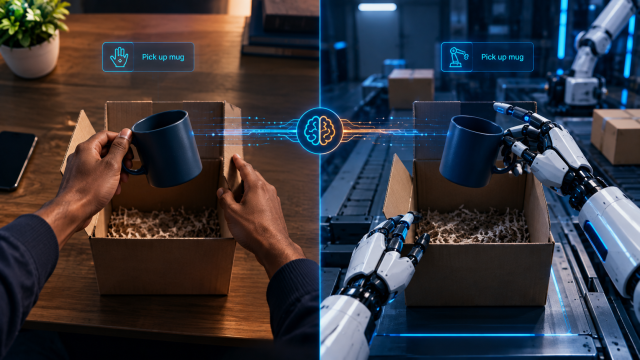
But the hidden story isn’t the hardware—it’s the training infrastructure that made these deployments possible. Every hour a humanoid works in a factory rests on thousands of hours of simulated training that happened before the robot ever touched a physical part.
Why Simulation Training Determines Whether You Profit or Lose
Training a humanoid in the real world is financially reckless. A production line stoppage costs 10,000to10,000to100,000 per hour. Physical trial-and-error burns budget and kills procurement confidence.
Simulation flips the equation. ABB’s RobotStudio HyperReality platform now delivers 99% simulation-to-reality accuracy, cutting deployment costs by 40% and accelerating time-to-market by 50%. Marc Segura, President of ABB Robotics, confirmed the milestone: “Today, using NVIDIA accelerated computing and simulation technologies, we have removed the last barriers to making industrial and physical AI a reality at a global scale”.
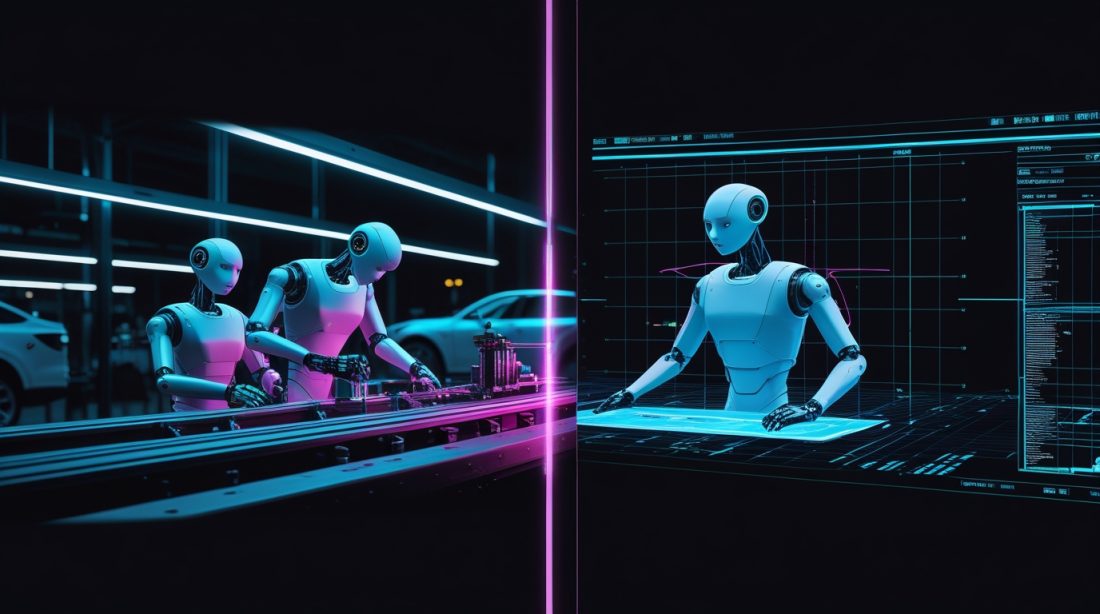
The financial logic is unforgiving: simulate first, deploy once. A robot that fails on the factory floor has already consumed its training budget. A robot that succeeds in simulation before physical deployment generates ROI from day one.
Why Fear Accelerates Adoption Faster Than Ambition
⚠ Fiction: Mark, a 15‑year warehouse supervisor in Ohio, watched a humanoid unload pallets for the first time. His hands trembled—not from fear of the machine, but from the realization that his accumulated experience might soon be worth less than a leased robot costing under $3/hour. He wasn’t afraid of robots. He was afraid of irrelevance.
Mark’s story is fictional, but the psychology is documented. “The current distrust many people feel toward AI stems from an age-old fear of losing control,” reports El País, capturing a sentiment that spans factory floors and boardrooms alike.
This fear is a financial accelerant. Companies don’t deploy humanoids because they love technology—they deploy because labor shortages are costing them revenue. Deloitte warned that unfilled manufacturing jobs could cost the U.S. economy $1 trillion by 2030. Fear of vacancy trumps fear of automation, and simulation-trained robots offer the fastest path to filling the gap.
Why the Math Favors Simulation-First Deployment
Agility Robotics charges a monthly fee for Digit, with customers seeing ROI in under two years at a fully loaded human labor rate of 30/hour∗∗[reference:8].Figure 02carriesapricetagaround∗∗30/hour∗∗[reference:8].Figure 02carriesapricetagaround∗∗130,000, but leasing models and declining hardware costs are pushing effective hourly rates toward 2–2–10.
Compare that to a U.S. manufacturing worker averaging **34.42/hour∗∗(over71,000 annually). The math tilts decisively when simulation training eliminates the cost of physical trial-and-error. A robot trained in a photorealistic digital twin doesn’t need weeks of on-site commissioning. It arrives pre-validated, reducing integration risk to near zero.
Procurement teams fear open-ended costs. Simulation provides the certainty they need to approve capital expenditure. The 40% cost reduction from simulation-first deployment isn’t just savings—it’s the difference between a pilot that dies in committee and a program that scales.
Why Global Implications Are Already Unfolding
Barclays Research projects the humanoid robotics market could reach 200 billionby2035∗∗,upfromjust∗∗200 billionby2035∗∗,upfromjust∗∗2–3 billion today. BMW has already expanded its humanoid pilot from Spartanburg to its Leipzig plant in Europe. China’s humanoid robotics hiring surged 409% year-over-year in early 2025.
The nations and companies that master simulation-first training will dominate this market. Those that delay will find themselves locked out by competitors whose robots are already trained, deployed, and generating returns. The simulation infrastructure isn’t a technical detail—it’s the moat that separates early movers from also-rans.
What This Means for Your Training Strategy
The second humanoid robot paid job confirms that simulation-trained robots are no longer experimental. They are production assets with calculable ROI. The question is no longer whether humanoids can work—it’s whether your organization has the simulation infrastructure to train them before your competitors do.
💡 CreedTec Analyst’s Note
By Daniel Ikechukwu
Strategic Impact: The paid deployment of Figure 02 and Digit validates the simulation-first training model. Companies that invest in digital twin and world model infrastructure today will be the ones deploying humanoids profitably in 2026–2027.
Stop / Start / Watch:
- Stop treating humanoid pilots as hardware experiments. They are training data problems.
- Start building simulation pipelines that can generate synthetic training data at scale.
- Watch the cost curve: as simulation accuracy surpasses 99%, the economic case for physical-only training collapses.
ROI Outlook: Organizations that adopt simulation-first training can expect 40–50% reduction in deployment costs and 2–3× faster time-to-production, based on current ABB and NVIDIA benchmarks.
FAQ
How much does a humanoid robot actually cost to operate?
Is simulation training reliable enough for production deployment?
Further Reading
- 1 Simulation Metric That Cuts Factory AI Costs by 40%
- 5 Reasons Humanoid Robot ROI Drives the 2026 Cost-Saving Shift
- World Models Robot Training Crossover 2026
- Humanoid Robots in Small Town Factories 2026
- Why Photorealistic Digital Twin Robotics Training Applications Cut Costs in 2026
📩 Get the Next Analysis Before Your Competitors Do
Join the CreedTec newsletter for weekly briefings on humanoid robotics ROI, simulation training economics, and procurement strategies that turn AI pilots into profit centers. No hype—just the numbers that matter.
[Subscribe Now]