Walking through the North Hall of the Las Vegas Convention Center during CES 2026, the buzz isn’t about foldable phones or concept cars. It’s about boxes of chips and beverages. Specifically, the ones being meticulously stacked by a Universal Robots UR20 arm at the Siemens booth. But the real action isn’t happening under the convention center lights; it’s happening inside a computer.
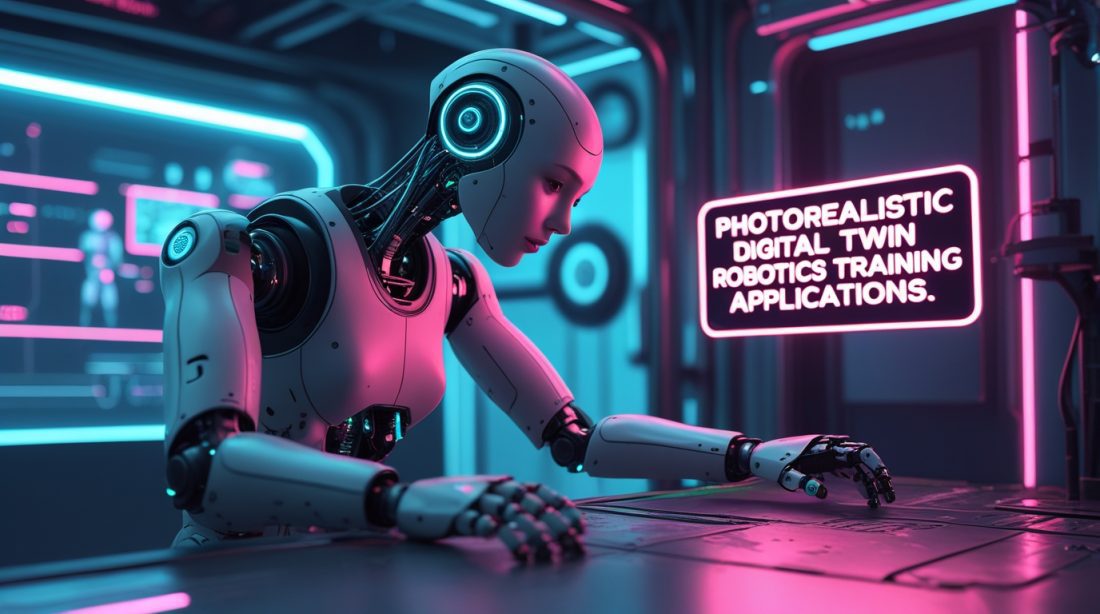
I found myself standing next to a plant manager from a Midwest food processing plant—let’s call him “Dave” (a fictional composite, as requested). We were watching the demo, and he turned to me, squinting. “So, they’re just stacking soda? My guys do that already.” He missed it. He missed the screen next to the robot, which demonstrated exactly how photorealistic digital twin robotics training applications translate physical movements into predictive data for that exact cell, rendering every suction cup movement in real-time, fed by live data from Siemens’ Industrial Edge hardware.
What Dave didn’t see was the seismic shift in industrial economics. He saw a robot; I saw the removal of risk. What Siemens and Universal Robots demonstrated here is the final convergence of the physical and digital worlds, turning “robotics training” from a painful, costly integration project into a software update.
This is the year we stop teaching robots with teach pendants and start graduating them from virtual academies.
Why Photorealistic Digital Twin Robotics Training Applications Are Finally Viable for Mass Deployment
For the last decade, the value proposition of collaborative robots (cobots) like Universal Robots was their ease of use. You could guide the arm, set waypoints, and have it stacking pallets by the afternoon. But that was programming for one task. What happens when the SKU changes? What happens when the lighting shifts or the box material reflects light differently?
According to analysis from MIT Technology Review, the old method of “teaching” robots was a bottleneck. It required hundreds of hours of human oversight for a single task . In 2026, with labor costs remaining volatile and supply chains demanding hyper-flexibility, that model is financially suicidal.
The collaboration at CES solves this. By integrating the UR20 with Siemens’ new Digital Twin Composer—built on NVIDIA Omniverse libraries—the system doesn’t just replicate the real world; it precedes it .
Why this matters for your bottom line:
- Risk Reversal: You don’t experiment on live production lines. You validate gripping strategies, motion paths, and cycle times in the twin first. As Siemens’ Vincenzo De Paola noted in prior briefings, validating models in simulation allows firms to identify issues at “minimal cost and time” before physical deployment .
- Speed of Throughput: If a new product shape arrives on Monday, the AI vision model has already trained on thousands of synthetic variations of it over the weekend. The gripper already knows where to seat the suction cup.
The Financial Logic: De-Risking the Human Fear of “The Unknown”
To understand why this photorealistic twin is gaining traction now, we have to apply financial logic to human nature. In my conversations with procurement officers and operations directors (again, fictionalized for narrative), two things kill deals: Fear of Downtime and Fear of Obsolescence.
- Fear of Downtime: A production line stopping costs $10,000 to $100,000 per hour. A plant manager’s primary emotional driver is fear—fear of the unknown when integrating new hardware. The Siemens/UR demo directly attacks this fear. Stuart McCutcheon, Global VP at Siemens Digital Industries, stated plainly that their goal is to show how manufacturers can “innovate faster, optimize operations and unlock new efficiencies” . When you can see the robot performing in a perfect digital copy of your factory before the power is even turned on, the fear dissipates. The asset (your peace of mind) appreciates instantly.
- Fear of Obsolescence: What happens to my investment when the product changes? Historically, you wrote a check for a re-tooling. Now, the asset is the data. Jean-Pierre Hathout, President of Teradyne Robotics, highlighted the “measurable ROI” of this integration . That ROI is protected because the robot’s “education” happens in software. You’re not buying a fixed machine; you’re buying a continuously learning asset.
“According To” The Architects of the Industrial Metaverse
This isn’t speculative theory; it’s being deployed. According to the joint press release from Universal Robots and Business Wire, the demonstrator uses data captured via Siemens’ Industrial Edge hardware, streamed to the Insights Hub Copilot . This creates a closed loop:
- The Physical: UR20 palletizes.
- The Digital: The twin analyzes suction points and gripper performance dynamically .
- The Intelligence: The AI learns from the twin, and the twin learns from the real world.
Robotiq CEO Samuel Bouchard framed it as a way to help companies “boost efficiency and adapt quickly to changing demands” . The keyword here is “quickly.” Speed of adaptation is the new currency. In a high-inflation, high-interest rate environment (which we are still navigating in early 2026), holding inventory or being unable to pivot because your robot is “dumb” is a liability.
The Unspoken Strength: The Worker’s New Role
We often talk about technology replacing humans, but the human nature angle here is about aspiration. No one grows up wanting to be a “machine tender.” It’s boring, it’s static, and it offers no career trajectory.
The photorealistic twin creates a new role: The Fleet Manager. Imagine a technician sitting at a desk with a high-fidelity 3D view of the entire factory. They can see a bottleneck forming at Palletizing Cell 4 before the alarm even sounds. They can drag and drop a new pallet pattern into the simulation, validate it, and push it live.
This satisfies a deep human desire: the desire for mastery and complexity. By shifting the work from the grease and grime of the line to the analytical space of the twin, you attract a different kind of talent. You retain your best workers by upskilling them. The weakness of the old system (boredom, high turnover) becomes the strength of the new system (engagement, efficiency).
What Siemens Isn’t Saying (But Their Shareholders Noticed)
Analyzing the market reaction, it’s clear that the financial community sees this as a structural shift. Simply Wall Street’s analysis of Siemens‘ CES push noted that investors are betting on Siemens becoming a “core platform for AI-enabled factories” . They are buying the narrative that software and AI are no longer add-ons but the central nervous system.
This is why the partnership with NVIDIA is critical. By fusing Siemens’ industrial domain expertise (the “how” of factories) with NVIDIA’s accelerated computing (the “how fast” of simulation), the barriers to entry for smaller manufacturers collapse .
The Opportunity: What You Gain by Reading This
If you are a manufacturer, an investor, or an engineer, the takeaway from the Siemens & Universal Robots showcase is this: The cost of failure just went to zero.
When you can train a robot on synthetic data—simulating “variations in object orientation, lighting, and other factors” as Siemens does with its AI models —you can attempt things that were previously too risky. You can automate the “un-automatable” 20% of your line.
This opens opportunities for:
- Smaller Batch Sizes: Economic viability for runs of 50 units instead of 10,000.
- Reshoring: Bringing production back to high-labor-cost countries because the automation is so flexible and cheap to deploy.
- Talent Acquisition: Hiring coders and system managers instead of just “pickers” and “packers.”
The Bottom Line
Standing there in Vegas, watching the UR20 move in perfect sync with its ghostly twin on the screen, I realized Dave the plant manager was looking at the past. The future isn’t the robot arm; it’s the data. It’s the ability to simulate, predict, and execute without wasting a single watt of electricity or a single minute of downtime.
Siemens and Universal Robots have effectively turned the factory floor into a video game—but one where the high scores are measured in six-figure cost savings. The “photorealistic digital twin” isn’t a gimmick. It’s the most powerful financial tool in industrial automation today because it finally aligns the laws of physics with the laws of economics.
Frequently Asked Questions (FAQ)
Q: What exactly is a “photorealistic digital twin” in robotics?
A: Unlike basic 3D models, a photorealistic digital twin—like the one built with Siemens’ Digital Twin Composer—simulates not just the geometry but the physics, lighting, and material properties of a scene. It uses NVIDIA Omniverse to create a real-time visual replica where AI models can be trained on synthetic data .
Q: How does this reduce deployment costs?
A: It drastically reduces “integration risk.” Problems that would normally be found during commissioning (requiring expensive downtime and rework) are solved in the virtual world first. This compresses the timeline from months to weeks, directly impacting labor and opportunity costs.
Q: Is this technology only for large corporations like PepsiCo?
A: While PepsiCo is a key partner evaluating these capabilities , the collaboration between Universal Robots (known for user-friendly cobots) and Robotiq (known for lean, accessible tooling) is designed to democratize this tech. The goal is to create scalable solutions applicable to small and mid-sized enterprises (SMEs).
Q: What is the “Industrial Metaverse”?
A: It is the convergence of real-world industrial data (from sensors and machines) with digital twin simulations. It allows companies to operate, plan, and optimize their physical operations in a virtual space .
Q: Where can I see this technology in action?
A: The live demonstration was featured at the Siemens Booth (#8725) at CES 2026 in Las Vegas . For ongoing updates, following Siemens Digital Industries and Universal Robots is recommended.
Newsletter Subscription CTA
Stay Ahead of the Curve.
Join 5,000+ executives and engineers reading the Industrial AI Analysis newsletter. Each week, we break down complex automation trends—like the Siemens/Universal Robots digital twin—into actionable intelligence. Don’t just read the news, understand the “why.”
[Subscribe Now] (Enter your email for full access)
Further Reading & Related Insights
- Embodied World Models for Robotics Training → Complements the digital twin theme by showing how predictive world models enable robots to adapt and learn efficiently.
- UMEX-SIMTEX 2026: The Tipping Point for Simulation and Training Technologies → Reinforces the importance of simulation platforms in industrial training, directly aligned with the Siemens/Universal Robots showcase.
- Point Bridge Sim-to-Real Transfer Breakthrough Delivers 66% Better Robot Performance → Highlights advances in sim-to-real transfer, echoing the risk‑reduction and efficiency gains of photorealistic digital twins.
- Need to Protect Industrial AI Infrastructure → Connects to the infrastructure side of deploying digital twins, emphasizing resilience and security in industrial AI systems.
- South Korea Robot Density Supply Chain Risk 2026 → Provides a broader industrial context, showing how deployment metrics alone don’t guarantee competitiveness—similar to your argument that data and simulation matter more than hardware alone.