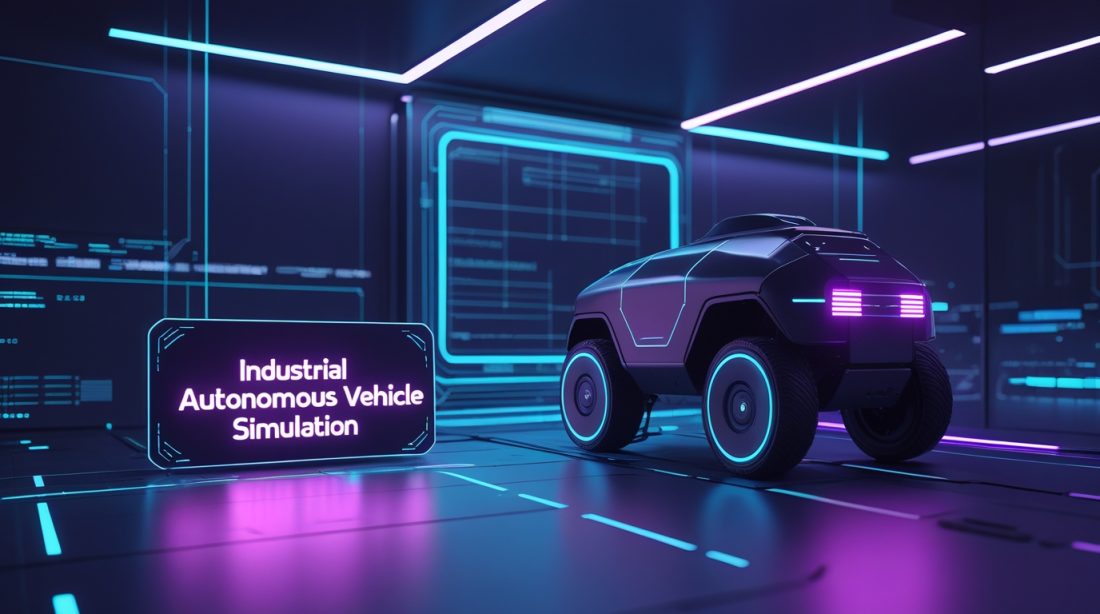
The autonomous industrial vehicle market’s path to success doesn’t run through crowded public roads, but through millions of simulated miles in virtual warehouses and factories. While headlines often focus on consumer self-driving cars, a critical, pragmatic revolution in industrial autonomous vehicle simulation is unfolding in industrial sectors. Here, AI-powered simulation is accelerating real-world deployments and solving acute business challenges like labor shortages. For manufacturers and logistics companies, simulation for industrial AVs has moved from a development tool to a strategic lever for commercial growth and supply chain resilience.
The recent announcement from Cyngn underscores this strategic pivot. The company has developed a high-fidelity simulation environment using NVIDIA Isaac Sim—a leading industrial robotics simulation platform—to accelerate the commercial deployment of its autonomous tuggers and forklifts. This move signals a broader trend: the maturation of digital twin for warehouse automation from an R&D aid into a core component of the product lifecycle, enabling faster, safer, and more scalable deployments.
The Simulated Proving Ground: From Concept to Commercial Deployment
Why is AI simulation for autonomous forklifts suddenly a top priority? The answer lies in the unique demands of industrial environments. Factories are dynamic, crowded, and expensive to disrupt. Physically testing every scenario is impractical.
Cyngn’s approach tackles this by creating a persistent digital twin of a factory floor. Their entire software stack runs inside this simulated world. This allows engineers to validate updates against thousands of simulated hours, a process critical for scaling autonomous fleets. It enables the testing of multi-agent simulation systems in complex scenarios and allows for virtual commissioning of AGVs before they ever ship to a customer site.
“Simulation is becoming a critical lever for how we bring new autonomous products to market,” says Felix Singh, VP of Engineering Services at Cyngn. “By using NVIDIA Isaac Sim… we can validate new forklift use cases faster, reduce development risk, and shorten the timeline from concept to commercial deployment.”
The Hard Business Case: ROI, Safety, and Scale
For industrial firms, investment is driven by urgent pressures. Simulation for industrial AVs directly addresses these by de-risking adoption and proving value.
| Challenge | How AI Simulation Provides a Solution | Tangible Outcome |
|---|---|---|
| Labor Shortages & Rising Costs | Enables rapid deployment of systems that extend human workers’ capabilities. | Solutions like Cyngn’s DriveMod Tugger target a compelling ROI for autonomous tuggers, with payback in under 2 years. |
| Safety Incidents & Downtime | Enables safety validation for industrial AVs by testing edge-cases (e.g., fallen pallets) in a risk-free environment. | Reduces costly accidents and unplanned downtime, a key benefit of digital twin. |
| High Physical Testing Costs | Replaces costly prototype damage with scalable cloud simulation. | Slashes development costs, directly impacting the cost of industrial AI simulation software. |
| Integration with Legacy Workflows | Models how vehicles interact with existing infrastructure before installation. | Ensures seamless integration, a core function of AI for predictive maintenance and operational planning. |
Beyond a Single Vendor: A Broader Market Inflection
Cyngn’s progress reflects a massive market shift. The company is contributing its proprietary industrial vehicle dynamics models back to the NVIDIA ecosystem, highlighting a move toward open-source robotics simulation collaboration. This fusion of industrial expertise with cutting-edge tools accelerates innovation for the entire sector, enabling more sophisticated hybrid AI models for industrial control and generative AI for industrial scenario creation.
As IDC notes, the industry is moving towards a future where “agentic product/process simulation” is standard. The journey from concept to a reliable fleet is now paved with simulated data, moving past physical AI vs traditional automation debates toward integrated, intelligent systems.
The Path Forward for Industrial Leaders
For operations executives, the implication is clear. Evaluating providers now requires assessing their simulation and validation capabilities. The most viable partners will demonstrate a robust digital twin strategy, proving safety and efficiency in a virtual copy of your facility—a critical step for deploying Level 4 autonomy in factories. This approach is fundamental for benchmarking autonomous vehicle performance and ensuring cybersecurity for simulated industrial environments.
FAQs: Industrial AI and Vehicle Simulation
Q1: What is NVIDIA Isaac Sim, and why is it important for industrial autonomy?
A1: It is an open-source, scalable robotics simulation platform. It allows companies to build high-fidelity virtual environments for training autonomous vehicles in virtual warehouses, which is crucial for safe, rapid, and cost-effective testing.
Q2: How does simulation specifically reduce the risk of deploying autonomous vehicles in my facility?
A2: It acts as a comprehensive digital proving ground for fleet management software simulation. It can model your specific layout and hazards, allowing software to be rigorously validated before deployment, minimizing operational risk.
Q3: What’s the difference between simulation for industrial AVs and for consumer self-driving cars?
A3: While technology overlaps, the focus differs. Consumer simulation emphasizes vast public roads. Industrial autonomous vehicle simulation focuses on confined, private spaces like warehouses, where precision around inventory and collaboration with humans is critical, often leveraging edge computing for autonomous vehicles.
Q4: Does AI simulation replace the need for all physical testing?
A4: No, it optimizes it. Simulation handles most iterative and edge-case validation. Final real-world testing remains essential. However, simulation for regulatory compliance and development drastically reduces the scale and cost of physical testing.
Fast Facts
Industrial autonomous vehicle simulation is a critical tool for 2026 deployments. Cyngn’s use of NVIDIA Isaac Sim industrial use cases to create digital warehouse twins enables faster, safer testing. This addresses core business pains like labor shortages, proving ROI for autonomous tuggers through reduced risk. The trend points to simulation-first development and ecosystem-driven growth in industrial autonomy.
Further Reading & Related Insights
- Point Bridge Sim-to-Real Transfer Breakthrough Delivers 66% Better Robot Performance → Complements the simulation theme by showing how sim-to-real advances are critical for reliable autonomous robotics.
- UMEX-SIMTEX 2026: The Tipping Point for Simulation and Training Technologies → Highlights the broader role of simulation platforms in industrial training and deployment, aligning with digital twin strategies.
- Need to Protect Industrial AI Infrastructure → Connects simulation with the importance of securing the underlying AI infrastructure that powers autonomous vehicles.
- Europe AI Robotics Opportunity → Expands the global perspective, showing how regions are positioning themselves in robotics and simulation innovation.
- Amelia AI Failure Case Study: 2026’s Critical System Governance Lesson → Provides a governance cautionary tale, reinforcing the need for robust validation and simulation before large-scale industrial AI deployment.
Stay ahead of the curve on how applied AI is transforming industrial operations. Subscribe to our newsletter for monthly analysis on autonomy, simulation, and the next wave of industrial productivity.