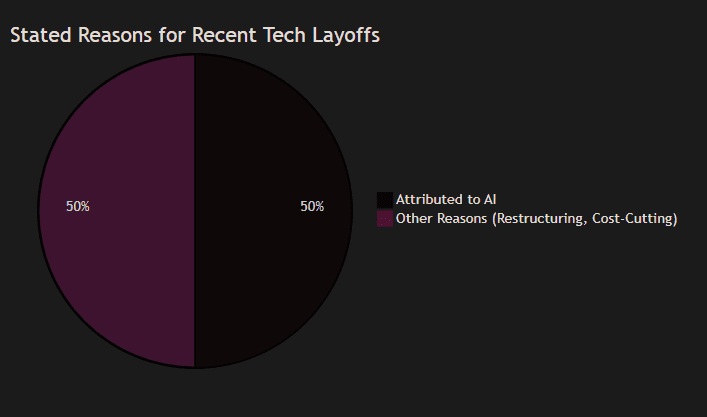
In 2025, over 50,000 layoffs were officially attributed to artificial intelligence, sparking a critical debate: are we seeing genuine AI layoffs or ‘AI-washing’? A closer analysis reveals a troubling disconnect between corporate rhetoric and technological reality. As an industrial analyst, I see a critical pattern emerging: the strategic use of “AI” as a narrative is often outpacing its actual implementation on the factory floor and in corporate suites.
This practice of ‘AI-washing’ is muddying the waters of genuine technological transformation and raising serious questions about corporate accountability. Are we witnessing a fundamental shift in labor due to automation, or is a powerful buzzword being leveraged to dress up traditional cost-cutting in the guise of innovation? This article dissects the evidence to separate the signal from the noise.
Why Are We Suddenly Hearing About AI Layoffs? The Rise of ‘AI-Washing’
The term ‘AI-washing’ has entered the business lexicon to describe a phenomenon where companies exaggerate or misrepresent their use of artificial intelligence. In the context of layoffs, it refers to attributing workforce reductions to AI-driven efficiencies when the underlying reasons may be more financially pedestrian. A January 2026 Forrester report was blunt in its assessment: “Many companies announcing A.I.-related layoffs do not have mature, vetted A.I. applications ready to fill those roles“. This gap between claim and capability is the hallmark of the trend.
The incentive for this narrative is clear. As Molly Kinder, a senior research fellow at the Brookings Institute, notes, pinning layoffs on AI is a “very investor-friendly message.” It frames the company as forward-thinking and efficient, actively harnessing cutting-edge technology. The alternative—admitting that “the business is ailing” or that management over-hired during the pandemic boom—is a far less palatable story for Wall Street. This creates a powerful PR tool, allowing companies to rebrand potentially negative news as a step in a sleek, automated future.
Why Are Companies Like Amazon and Pinterest Blaming AI? A Closer Look at the Cases
The sheer scale of layoffs attributed to AI demands scrutiny of specific cases. In early 2026, Amazon announced 16,000 corporate job cuts, part of a broader reduction that has totaled over 30,000 since late 2025. CEO Andy Jassy has been vocal about AI’s role, stating that as more generative AI is rolled out, “we will need fewer people doing some of the jobs that are being done today”.
However, skepticism arises from within. N. Lee Plumb, an Amazon employee laid off in early 2026 who was a top user of the company’s internal AI coding tool, expressed doubt. He suggested the narrative could simply be a “value story” for investors: “You could potentially have just been bloated in the first place, reduce head count, attribute it to AI, and now you’ve got a value story”.
Similarly, Pinterest was explicit, tying its decision to cut up to 15% of its workforce directly to an “AI-forward strategy” that involves reallocating resources to AI-focused roles. Other firms like Expedia and Dow have echoed this messaging. Yet, economists like Karan Girotra of Cornell University urge caution, pointing out that realizing workforce reductions from AI productivity gains requires significant managerial adjustment, which may not be happening as swiftly as layoff announcements imply.
Why Might ‘AI-Washing’ Be Happening Now? The Perfect Storm of Economic Pressure
The timing of these announcements is not coincidental. It follows a period of aggressive hiring during the pandemic-driven tech boom and a subsequent economic slowdown. Many organizations are now facing pressure to “reduce operating expenses and optimize the organizational structure,” as home services platform Angi stated while also citing “AI-driven efficiency improvements“. AI provides a convenient, future-oriented scapegoat for trimming the fat accumulated in previous years.
The regulatory and legal landscape is also reacting. The U.S. Securities and Exchange Commission (SEC) has already brought its first enforcement actions for ‘AI-washing,’ charging investment firms with misleading clients about their use of AI. The Federal Trade Commission (FTC) has launched “Operation AI Comply,” targeting deceptive AI claims. As Lina M. Khan, FTC Chair, stated, “Using AI tools to trick, mislead or defraud people is illegal… there is no AI exemption from the laws on the books“. This rising scrutiny means the risks of making hollow AI claims are growing, potentially including securities fraud allegations or consumer deception lawsuits.
What Does This Mean for the Future of Work and Investment?
This trend creates a fog of uncertainty for workers, investors, and analysts trying to gauge the real impact of AI. For employees, it becomes difficult to understand if their job was eliminated by genuine technological displacement or by broader financial strategies. For investors, as highlighted by a Mercer report, there is a growing focus on how companies upskill their workforce. A staggering 97% of investors said funding decisions would be negatively impacted by firms that fail to systematically upskill workers on AI.
The path forward requires sharper analysis. Real AI integration is measurable and specific—it involves documented use cases, changes in operational workflows, and investments in training data and infrastructure. As Ravin Jesuthasan, a future of work expert at Mercer, notes, investors are now looking beyond the buzzword: “How are you combining your workforces with AI? How are you bringing your workforces along?“. The companies that will separate themselves are those that can demonstrate this combination, not just announce it during a quarterly earnings call.
Key Examples of Recent Layoffs Attributed to AI
| Company | Layoff Scope | Stated Reason |
|---|---|---|
| Amazon | 16,000 corporate roles (2026) | Reducing workforce due to AI efficiency gains; reducing bureaucracy. |
| Up to 15% of workforce | “AI-forward strategy” and reallocating resources to AI-focused roles. | |
| Angi | 350 jobs | “AI-driven efficiency improvements” and operational optimization. |
| Dow | 4,500 jobs | Plan utilizing AI and automation to increase productivity. |
The narrative of AI-driven layoffs in 2026 serves as a potent case study in how technology buzzwords can be weaponized for corporate strategy. While AI is undoubtedly reshaping certain tasks and roles, the wave of layoffs attributed to it appears, in many instances, to be a smokescreen for more conventional financial restructuring. For professionals and analysts, the imperative is to look past the press release and demand evidence of tangible AI integration. The true measure of transformation won’t be found in the number of jobs cut, but in the clarity and substance of the strategy that remains.
Further Reading & Related Insights
- Need to Protect Industrial AI Infrastructure → Connects directly to the theme of safeguarding foundational AI systems, which is critical when companies claim layoffs are due to AI adoption.
- The 2026 Breakthrough in AI-Powered Underwater Robot for Kelp Restoration → Highlights genuine AI innovation, contrasting with “AI-washing” narratives by showing tangible ecological impact.
- Point Bridge Sim-to-Real Transfer Breakthrough Delivers 66% Better Robot Performance → Demonstrates measurable AI progress in robotics, reinforcing the need to distinguish real breakthroughs from corporate spin.
- Amelia AI Failure Case Study: 2026’s Critical System Governance Lesson → Provides a cautionary tale of governance failures, aligning with the risks of overstating AI’s role in corporate restructuring.
Frequently Asked Questions (FAQs)
- What exactly is ‘AI-washing’?
AI-washing is a deceptive practice where companies exaggerate or fabricate the extent, capabilities, or implementation of their artificial intelligence systems. In the context of layoffs, it means blaming job cuts on AI when the actual reasons are more related to over-hiring, cost-cutting, or other financial pressures. - Which major companies have recently blamed AI for layoffs?
In early 2026, several prominent companies cited AI as a factor in workforce reductions. These include Amazon (16,000 corporate jobs), Pinterest (up to 15% of its workforce), Dow (4,500 jobs), and Angi (350 jobs). - Are regulators doing anything about false AI claims?
Yes, regulatory scrutiny is increasing. The U.S. Securities and Exchange Commission (SEC) has brought its first enforcement actions for AI-washing against investment firms. The Federal Trade Commission (FTC) has also launched “Operation AI Comply,” a crackdown on businesses using AI to mislead consumers or investors. - If my job was cut due to ‘AI,’ was it actually because of AI?
Not necessarily. Experts like those at Forrester note that many companies announcing AI-related layoffs “do not have mature, vetted A.I. applications ready to fill those roles”. Your layoff could be part of broader restructuring or cost-saving measures, with AI used as a convenient public explanation. - How can I tell if a company is genuinely transforming with AI or just ‘AI-washing’?
Look for specific, demonstrable evidence beyond vague statements. Genuine transformation involves clear use cases, employee training programs, changes to business processes, and investments in data infrastructure. Be skeptical of claims that are purely aspirational or only mentioned in the context of layoffs and investor communications.