Fast Facts
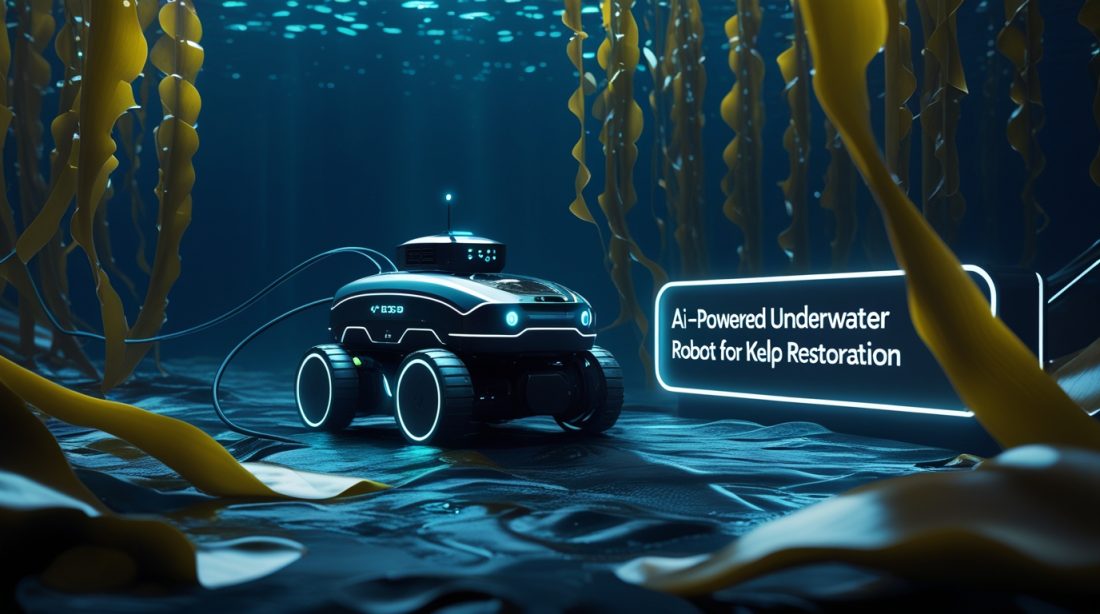
A team of Dublin High School students has engineered a breakthrough in marine conservation: an AI-powered underwater robot for kelp restoration. This submarine robot, utilizing AI image recognition and visual SLAM technology, autonomously locates and removes invasive purple sea urchins, a primary cause of the catastrophic 96% loss of Northern California’s kelp forests. By winning the UN Sustainable Development Goals Challenge, their prototype demonstrates how accessible, precise technology can scale critical environmental repair. This achievement signals a pivotal industrial shift, proving that solving complex, large-scale ecological crises requires intelligent, autonomous systems rather than reliance on manual effort alone.
The Problem: A Collapsing Ecosystem
Northern California’s once-vibrant bull kelp forests, essential habitats for marine life and powerful carbon sinks, have suffered a catastrophic 96% loss along the coast. The primary culprit is an unchecked population of purple sea urchins. With their natural predators, like sea otters and starfish, diminished, these urchins have consumed kelp down to bare rock, creating vast underwater “urchin barrens”.
Traditional removal methods rely on human divers, which is labor-intensive, expensive, and dangerous due to the urchins’ sharp, venomous spines and challenging dive conditions. This bottleneck makes restoration at the necessary scale nearly impossible. The students from Dublin High School, calling themselves the “Aqua Sentinels,” identified this critical gap: the terrain itself was the enemy, making manual intervention a dangerous and often impossible task. Their response was not just another tool, but a rethinking of the intervention model itself.
The Aqua Sentinels’ Solution: Precision Meets Autonomy
The team—Premang Jha, Adhi Jeyappragash, Suraj Kudrikar, Saif Jeelani, and Shikhar Jayswal—designed a prototype automated submarine that operates where humans cannot. Their system is a masterclass in applied, practical technology:
- Core Technology: The robot is built on a Blue Robotics frame, powered by a Raspberry Pi 5 computer, and propelled by four thrusters.
- The “Eyes” and “Brain”: An onboard camera feeds data to a custom-trained AI image recognition model that identifies purple sea urchins. Since GPS doesn’t work underwater, the robot navigates using visual SLAM (Simultaneous Localization and Mapping), building a real-time map of its surroundings to avoid rocks and other obstacles.
- Capability: The prototype can locate targets up to 950 meters deep and is designed for future integration of a removal tool.
From Idea to Impact: The journey began in May, winning their school’s Entrepreneurship Challenge and a $200 grant. They trained their AI model on hundreds of urchin images, collaborated with the Giant Kelp Restoration Project, and tested a working prototype in a swimming pool by late July. This rapid development cycle underscores a key industrial shift: leveraging off-the-shelf hardware and open-source software to accelerate innovation and reduce costs.
Why This Approach is a Blueprint for Industrial-Scale Restoration
The Aqua Sentinels’ project transcends a science fair win. It provides a scalable framework for applying autonomous systems to “mission-critical” environmental work.
The table above highlights a crucial insight: no single solution is sufficient. The future lies in hybrid strategies. For example, drones or boats could disperse kelp seeds over large areas, while squads of autonomous robots like the Aqua Sentinels’ later provide targeted maintenance by removing invasive species that threaten the young kelp. This mirrors advanced manufacturing or logistics, where different automated systems work in concert within a larger process.
The Path to Deployment and Broader Vision
The students’ vision is expansive. They are seeking funding and partnerships with agencies like the California Fish and Game Commission to test the robot in the Bay Area. Their goal is to mass-produce hundreds of these autonomous robots. As they state, their mission is to “create real change and leave a lasting impact on the health and diversity of our sea planet“.
This ambition is supported by a growing recognition of the need for technological intervention. Legislative efforts like the proposed Help Our Kelp Act of 2025 aim to fund restoration projects, and EU initiatives like BlueInvest are financing scalable ocean tech solutions.
Beyond Urchins: The team has designed a platform, not just a single-purpose machine. The same core technology—autonomous navigation and AI object detection—can be adapted to target other invasive species, such as lionfish or green crabs, providing a versatile tool for global marine conservation.
This article is an analysis from CreedTec, exploring how intelligent systems solve foundational industrial and ecological challenges.
FAQs: AI-Powered Underwater Robot Kelp Restoration
How does the robot find sea urchins without GPS?
The robot uses a technology called visual SLAM (Simultaneous Localization and Mapping). Its onboard camera continuously scans the seabed, while its computer simultaneously builds a map of the environment and locates itself within that map. This allows for fully autonomous navigation in GPS-denied underwater spaces.
What is the business model for deploying such robots?
While still in development, a viable model is Robotics-as-a-Service (RaaS). Conservation groups, governments, or ports would not purchase robots outright but would pay for a “restoration service.” Operators would manage fleets of robots to complete specific contracts, such as clearing urchins from a designated marine protected area. This aligns with the students’ vision of creating hundreds of robots for wide-scale deployment.
How does this compare to other kelp restoration methods?
It’s a complementary, precision tool. Methods like SeaForester’s seed stone deployment are excellent for large-scale reseeding. This robot addresses the subsequent maintenance challenge by precisely removing the invasive grazers that threaten new growth. Together, they form a more complete restoration pipeline.
Could this technology be used in other industrial applications?
Absolutely. The core competencies—autonomous navigation in unstructured environments and AI-powered visual inspection—are directly transferable. Potential applications include inspecting underwater infrastructure (pipelines, cables, offshore wind foundations), performing detailed seabed surveys for marine construction, or monitoring the health of aquaculture installations.
A Hypothetical Implementation Timeline
To understand the practical pathway from prototype to ecosystem impact, consider this projected timeline for a first commercial deployment:
A New Model for Planetary Stewardship
The achievement of the Dublin students is a powerful signal. Winning the UN Sustainable Development Goals Challenge validates that the world’s most pressing environmental problems require 21st-century solutions. Their work moves kelp restoration from an artisanal, diver-dependent activity toward an industrializable process defined by data, autonomy, and scale.
It demonstrates that the future of ecological restoration and industrial problem-solving are converging. The “why” is clear: to meet the magnitude of challenges like habitat loss and climate change, we must deploy systems that augment human effort with relentless, data-driven precision. The Aqua Sentinels haven’t just built a robot; they’ve built a compelling case for a smarter, more responsive approach to healing our planet.
Stay at the forefront of industrial innovation.
Subscribe to the CreedTec newsletter for monthly analysis on how intelligent systems are reshaping industries and solving global challenges.
Further Reading & Related Insights
- Point Bridge Sim-to-Real Transfer Breakthrough Delivers 66% Better Robot Performance → Complements the underwater robot story by showing how sim-to-real advances make autonomous robotics more reliable in complex environments.
- Why the UAE Robotics Headquarters Investment 2026 Signals a New Industrial Era → Connects to the theme of scaling robotics innovation for industrial and ecological applications.
- Europe AI Robotics Opportunity → Expands the global perspective, showing how different regions are positioning themselves in robotics innovation.
- UMEX-SIMTEX 2026: The Tipping Point for Simulation and Training Technologies → Highlights the role of simulation and training platforms, aligning with the students’ use of open-source and off-the-shelf robotics tools.