Fast Facts
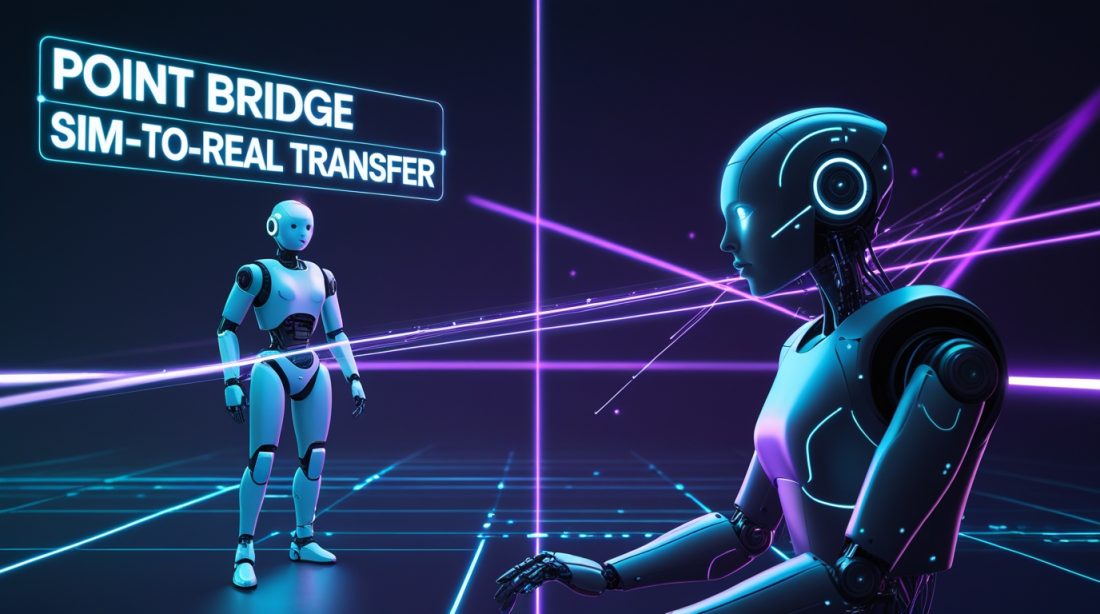
Point Bridge sim-to-real transfer is a new AI framework from NVIDIA and university researchers that solves a core robotics problem: transferring skills learned in simulation to the real world. By converting visual scenes into domain-agnostic 3D point clouds, it achieves up to 66% better performance than previous methods. This breakthrough reduces reliance on costly real-world data, enabling more scalable and adaptable robotic manipulation for industrial applications.
The Central Challenge: Why Simulation Alone Fails Robots
For years, the promise of training robots entirely in digital simulations has been tantalizing yet unfulfilled. Simulations are perfect, scalable, and cheap, allowing algorithms to practice for millions of trials without wear, tear, or real-world cost. However, a persistent and costly “reality gap” has blocked this path. A policy that masters stacking blocks in a pristine virtual environment often fails miserably when facing a real, slightly shiny table with imperfect lighting. This sim-to-real transfer problem has been the single greatest bottleneck preventing the scalable development of generalist robotic agents.
The root cause is a fundamental mismatch in representation. Traditional methods train robots using raw pixel data from simulation cameras. When deployed, the robot must interpret real-world camera feeds that differ in texture, lighting, and detail. This visual domain gap confuses the AI, causing failure. Collecting the massive datasets of real-world robot interactions needed to overcome this is prohibitively expensive and slow, creating what researchers call a “central bottleneck for building generalist robotic intelligence”.
Point Bridge directly attacks this bottleneck. Its core innovation is not a better simulation, but a smarter way for robots to see and understand both simulated and physical worlds through a common language.
How Point Bridge Works: The Power of a 3D Point Cloud Language
Point Bridge’s methodology is elegantly conceptual. Instead of feeding robots confusing pixels, it teaches them to perceive the world through unified, domain-agnostic 3D point clouds. Imagine translating both a detailed digital model and a live camera feed into the same set of 3D coordinates defining key object shapes and positions. This abstract representation strips away irrelevant visual noise like color and texture, focusing the robot’s “mind” on geometry and spatial relationships.
The framework operates in three key stages:
- 1. Scene Filtering & Unified Representation: In simulation, points are sourced directly from object meshes. In the real world, a Vision-Language Model (VLM) automatically identifies and extracts the crucial 3D points from camera data. This creates a consistent input language.
- 2. Transformer-Based Policy Learning: A neural network, adept at handling sequential data, is trained to make decisions (e.g., where to move the gripper) based on these point clouds. Trained primarily on vast amounts of synthetic data, it learns manipulation skills.
- 3. Efficient Real-World Deployment: A lightweight pipeline uses the VLM to filter live scenes into point clouds, allowing the simulation-trained policy to execute tasks in the physical world with minimal adjustment.
“By unifying representations across simulation and real-robot teleoperation, scalable sim-to-real transfer is achievable without the intensive manual effort typically required for alignment,” the researchers note. This method also handles challenging transparent or reflective objects by using advanced depth estimation, overcoming a classic hurdle for traditional sensors.
Why 3D points are the key to bridging the reality gap
The shift to a 3D point-based representation is transformative because it is inherently domain-agnostic. A point cloud defining the corners and handle of a mug is structurally identical whether generated from a CGI model or a real RGB-D camera. This allows a policy trained on millions of simulated mugs to instantly recognize and manipulate a real one it has never seen before, achieving what’s known as zero-shot transfer.
Quantifying the Leap: A 66% Performance Gain in Real-World Tasks
The true measure of Point Bridge lies in its tangible results. In rigorous testing across six diverse real-world manipulation tasks—including stacking bowls, folding a towel, and placing a bowl in an oven—the framework demonstrated substantial advancements.
Performance Comparison: Point Bridge vs. Prior Methods
- Zero-Shot Transfer (Sim-to-Real): Point Bridge outperformed the strongest prior vision-based methods by 39% on single tasks and 44% on multitask setups. This means a robot can successfully perform a task it only ever practiced in simulation.
- Enhanced Performance with Minimal Real Data: When the system was allowed to co-train on just 20 real-world demonstrations per task, its improvement over baselines jumped to 61% (single-task) and 66% (multitask).
- Success Rate on Complex Tasks: The system achieved an 85% success rate on tasks involving soft and articulated objects, such as folding towels and closing drawers.
These metrics are not incremental; they represent a phase shift. A 66% improvement in performance when using minimal real data dramatically alters the economics of robot training. It validates the core premise that synthetic data, when leveraged through the right representation, can shoulder the majority of the training burden.
The Industrial Imperative: From Lab Curiosity to Factory Floor Asset
The implications of Point Bridge extend far beyond academic labs. It provides a concrete solution to pressing industrial challenges identified in strategic analyses for 2026.
1. Solving the Data Scarcity Problem: The framework directly addresses the “critical bottleneck” of scarce, expensive real-world robotic data. By maximizing the utility of synthetic data, it enables faster, cheaper development of robust automation for tasks like assembly, packaging, and machine tending.
2. Building Adaptable Automation: Modern manufacturing requires flexibility. Point Bridge’s demonstrated strength in multitask learning and its ability to generalize across visually different objects mean robots can be adapted to new product lines or tasks without complete retraining. This agility is a key competitive advantage.
3. Strengthening Strategic Resilience: As global competition in automation intensifies, with nations like China making robotics a national priority, scalable training technologies become strategically vital. Tools like Point Bridge can help industries accelerate their automation roadmaps, building more resilient and responsive production systems.
While the researchers acknowledge current limitations—such as dependence on VLM performance and a lower control frequency than some image-based methods—the pathway forward is clear. As one industry observer on a related sim-to-real advancement noted, “This is a strong step toward making sim-to-real a design choice, not a research gamble… That’s what turns robotics from impressive demos into reliable infrastructure”.
FAQ: Demystifying Point Bridge and Sim-to-Real Transfer
What is the “sim-to-real gap” in robotics?
It’s the performance drop experienced when a robot policy trained in a simulation is deployed in the real world. Differences in physics, visuals, and sensor noise cause the robot to fail at tasks it mastered digitally.
How is Point Bridge different from other sim-to-real methods?
Most methods try to make simulation look more real (domain randomization) or align real and sim images. Point Bridge bypasses the visual problem entirely by converting both domains into a common 3D point cloud representation, making the policy indifferent to visual appearance.
What are the main limitations of the Point Bridge framework?
Its performance partly depends on the accuracy of the Vision-Language Model used to extract points from real scenes. It also currently operates at a lower control frequency than some methods and may lose some contextual scene information due to its abstract representation.
Can Point Bridge be used for tasks beyond simple object manipulation?
The core principle is broadly applicable. The research demonstrated success on a range of tasks, including dexterous manipulation (folding cloth) and operating articulated mechanisms (oven, drawer), suggesting potential for more complex industrial operations.
Why is this research important for the future of AI and robotics?
It provides a scalable pathway to train capable robots without needing impossibly large real-world datasets. This is essential for developing the “generalist” robotic agents needed for dynamic, unstructured environments, moving AI from digital intelligence
into effective physical action.
Stay Ahead of the Automation Curve
The transition from software intelligence to reliable physical automation is the defining industrial shift of our decade. For strategic insights on implementing robotics, overcoming integration hurdles, and building a future-ready workforce, subscribe to the CreedTec Insights newsletter.
Receive expert analysis on industrial AI, case studies, and strategic frameworks directly in your inbox. [Subscribe Now]
Further Reading & Related Insights
- UMEX-SIMTEX 2026: The Tipping Point for Simulation and Training Technologies → Directly complements the sim-to-real theme, showing how simulation technologies are evolving into practical industrial training.
- Agibots Open-Source Robotics Simulation Platform → Highlights open-source robotics simulation, aligning with Point Bridge’s focus on bridging simulation and real-world robotics.
- Lytes Visual Brain for Robotics → Explores advanced robotics perception systems, reinforcing the importance of unified representations like 3D point clouds.
- Industrial AI Strategy Analysis: How Robots, Tariffs, and Human Skills Define 2026’s Competition → Provides industrial context, connecting Point Bridge’s breakthrough to broader AI competitiveness and workforce integration.
- Europe AI Robotics Opportunity → Expands the global perspective, showing how regions outside the UAE and U.S. are positioning themselves in robotics innovation.